The final stretch · August 2026
The last 100 km: crowds and how to handle them
From Sarria the Camino really does change — more groups, more noise, the race for a bed — and it's also, for most people who reach Santiago, the only Camino that fits into a life. Both things are true at once. This guide is for whoever dreads the final stretch as much as for whoever starts there and owes nobody an explanation.
By Cesar Rodriguez · updated
On this page
Sarria is, by a wide margin, the most popular starting point on the whole Camino de Santiago — 161,901 pilgrims in 2025, two of every three who walked the Camino Francés, according to the Pilgrim's Office dashboard: it fits into a week's holiday, it doesn't demand serious fitness, and it hits exactly the minimum the Compostela requires. It's also, and nobody enjoys saying it, the stretch where the atmosphere of the Camino Francés changes the most. In August 2026 the pilgrims who have already walked it say so plainly on the forums — with opinions ranging from resignation to real anger — and they're defended just as firmly by people who started right there. Here is what both sides say, dated and with the nuance intact, so you can decide with information instead of guilt.
What really changes from Sarria
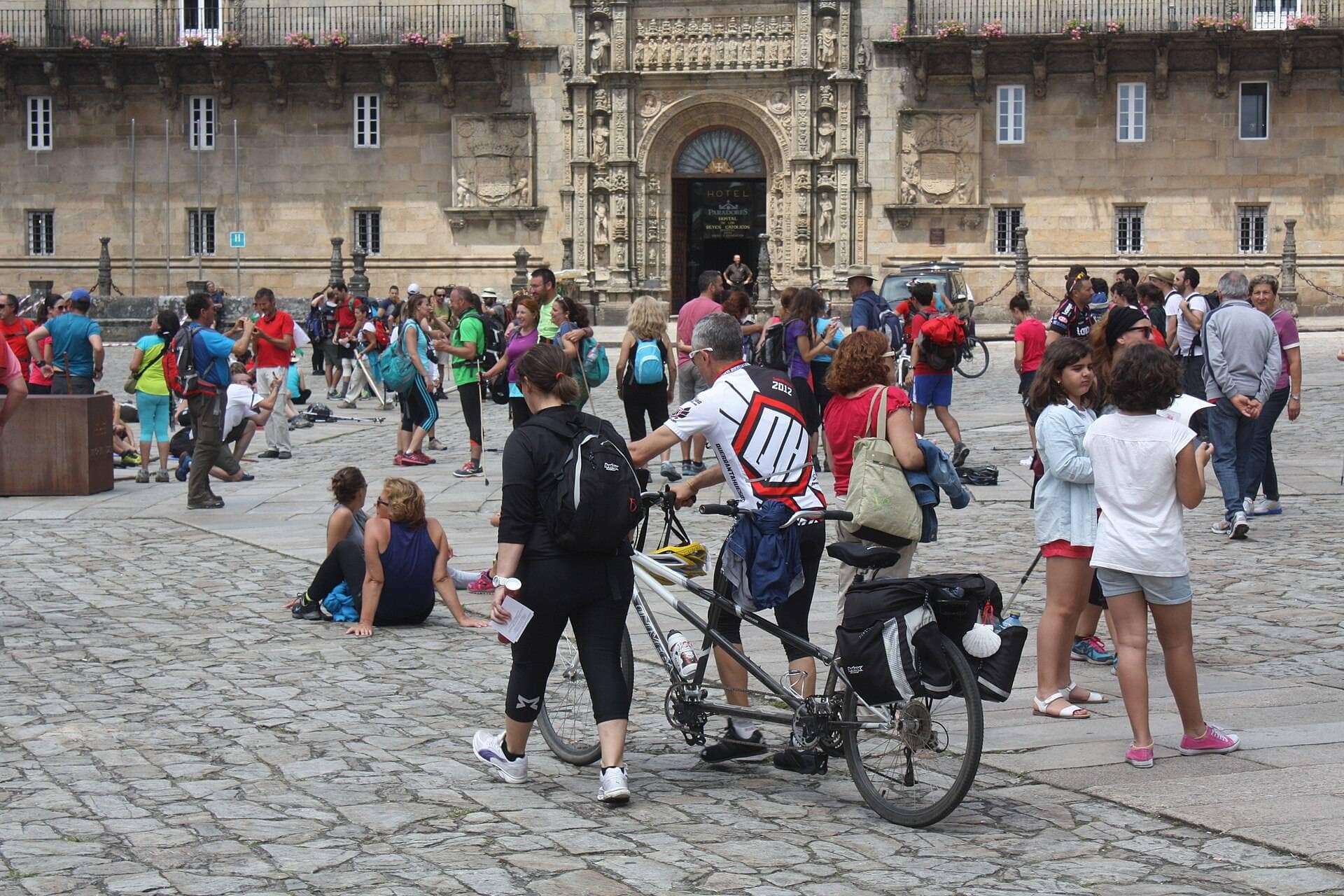
One pilgrim who walked it in late August 2026 tells it well, in a thread with 42 comments: at six in the morning half the room in the albergue decided to wake up and have loud conversations as if nobody else was asleep; the bunk neighbour talked on the phone without lowering their voice. A group of four walking abreast, taking up the whole width of the path, ignored a polite "sorry, excuse me" until there was no choice but to force a way through. Other pilgrims in the same thread add their own details: plastic bags rustling at four in the morning because someone didn't pack the night before, and red-tinted headlamps that — however dim they're supposed to be — are still blinding at thirty centimetres from someone's face who is trying to keep sleeping. The stretch even has a nickname: one pilgrim who had 500 km behind them that summer said a friend she met on the road had christened it the "final boss" — video-game slang for the last challenge — and that, half joking and half not, "we hated it too. The whole vibe of the Camino changed and it was really disappointing".
The top-voted comment in that same thread, though, puts the brakes on the complaint: "they existed long before Reddit and Instagram were a thing. I've also encountered rude pilgrims much earlier than Sarria. You can't change other people's behaviour, but you can focus on how it affects you." Several veteran pilgrims — one with fifteen years of walking the Francés, another whose first Camino was in 2009 — agree that large, inconsiderate groups always existed; what has changed is the volume, not the phenomenon. And against the harshest opinions in the thread — people who call the stretch outright "a disaster" or "the worst part of any Camino" — there are equally firm ones on the other side: a pilgrim whose first Camino was from Sarria with her child, and who has since walked five more Caminos plus the Kumano Kodo in Japan, answers a first-timer worried about starting there like this: "you have not messed up at all. This subreddit is just full of people who feel the need to denigrate anyone whose Camino doesn't meet their standards — which are pretty shallow, to be honest. You and your mum go and have a wonderful experience, because you will."
The trick veterans keep repeating: sleep outside the standard stage towns
It's the advice that comes up most often among people who've walked this stretch more than once: the crowd doesn't spread evenly through the day, it piles up in the towns where the guidebooks' "official" five-day stages end — Portomarín, Palas de Rei, Arzúa, O Pedrouzo — because that's where everyone following the standard split stops for the night. Walk five or ten kilometres further, or stop a little short, and the Camino empties out noticeably. The trade-off is that a hamlet has one bar and no shop, so shopping and dinner time need thinking about before you arrive, and there's no ATM either: the bed and dinner get paid with what you withdrew in the previous town. One real example already on this site: Santa Irene, a few kilometres before O Pedrouzo, works as an optional overnight stop precisely because it isn't the name every app surfaces first.
Stretching the walk to six or seven days doesn't dodge those four towns the way it sounds like it should: run the numbers and the six-stage and seven-stage plans both still sleep in Arzúa and O Pedrouzo — the same two nights as the standard split. What changes is how the other kilometres get divided, not those two crowded stopovers. The plan that actually skips them is the five-stage one: it stops in Boente and Santa Irene instead, in smaller places than the standard split uses. The standard split itself, town by town, is in the Sarria to Santiago stages.
For the rest of the nights, the honest way to find those "off-stage" villages is to check each stage's listing on Gronze, the Spanish-language reference for Camino accommodation: it lists, stage by stage, the small albergues in tiny hamlets that almost no travel guide mentions, with phone numbers and bed counts. The seven pilgrims recommend most on this stretch, counted one by one on the forum, are all in villages like these. One pilgrim who has walked the Camino every summer for over a decade puts it this way: "in summer I try to go in spring or autumn instead; if I can't do the whole route, I start from Ponferrada, and in the most crowded stretch I pick smaller albergues, because you're less likely to run into the big groups." Small private albergues with one or two rooms, tucked away from the ones every app lists first, are consistently the quietest at six in the morning.
When to go to dodge the crowds
The seasonal pattern is the easiest thing to plan around: spring and autumn spread pilgrims out far better than summer, when the largest and youngest crowd also concentrates — the one walking the stretch on school or university holidays, travelling in groups. August and September are the two busiest months on the whole Camino, and in 2025 the fullest was September: 81,546 Compostelas against 77,110 in August, each around 15% of the annual total (more on this in when to visit during Xacobeo). September is therefore high season in its own right — it does not ease off from August — and it's really in October that the stretch starts to feel noticeably quieter, with colder nights but also half-empty dormitories. It is worth separating a month's total volume from the actual wave: departures cluster in the first fortnight of May and of September, and that weighs more than the monthly figure.
If crowds aren't your thing: other routes
The 100 km minimum for the Compostela doesn't require entering through Sarria: any continuous stretch of that length on a recognised route counts, as long as the stage that completes it is the one arriving at the Cathedral. Three alternatives that clear the minimum with far fewer people:
- The Camino Inglés from Ferrol, the quietest of the routes with comfortable access to the Compostela — compared with the others in our routes guide, and worked out day by day in the five-stage plan from Ferrol.
- Camino de Invierno, which enters Galicia through the Ribeira Sacra instead of climbing O Cebreiro: in the August 2026 forums it keeps coming up as the serious answer for anyone who wants the Compostela without joining the crush at Sarria.
- The Camino Portugués from Tui, with the honest caveat that it also draws a real crowd in summer — it's the second most-walked route — though the atmosphere and the scenery are different. Its 116 km split into 5, 7 or 8 stages, depending on how much time you have.
- The Spiritual Variant of the Portugués, which detours through Combarro and Armenteira and adds a boat crossing on the Ría de Arousa: two or three extra days, and by far the quietest of the four.
If you're starting in Sarria: how to have a good Camino anyway
That said, four things that come straight out of the same August 2026 threads and genuinely help if you're starting in Sarria:
- Book a private room inside an albergue. It's the tip that comes up most often from people who tried it: you get every benefit of staying in an albergue — meeting people, sharing a meal if you feel like it — with the quiet privacy of your own room to sleep in. The best of both worlds, literally.
- Get up early — or deliberately don't. If you book ahead you don't need to compete for a bed, so you can afford to leave later and skip the six-a.m. commotion in the dorm. If you'd rather not book, get up early too — it's the only way not to rely on luck — and do it quietly: pack the night before, no rustling plastic bags, no lights pointed at the face of someone still asleep.
- Book the night in Santiago. It's the one stop on the entire Camino with no Xunta albergue in the historic centre, so there's no €10 fallback bed: it's all private, €12 to €25, on the exact evening everyone who set off when you did arrives at once. More in where pilgrims actually run out of beds.
- Mind basic etiquette. A "buen Camino" and some room when overtaking, quiet before seven, and respect for the waymarkers and the surroundings matter more than they seem for the stretch to work for everyone.
Frequently asked questions
Is it true the Camino gets crowded from Sarria?
Yes, and pilgrims say so themselves: in August 2026 several threads describe loud conversations at six in the morning, groups taking up the whole width of the path, and a sense that the atmosphere changes abruptly. It's also true that this kind of behaviour isn't new or unique to Sarria, and that most people who walk it have a good experience.
Is starting in Sarria cheating?
No. It's exactly what the Compostela minimum requires — 100 continuous km into Santiago — and Sarria is 114.2 km, with room to spare. Medieval pilgrims, for that matter, used whatever transport was available: the idea that only walking every metre counts is a modern convention.
How do I avoid the crowds on the final stretch?
The trick veterans repeat most is sleeping outside the towns where the standard stage ends — Portomarín, Palas de Rei, Arzúa, O Pedrouzo — because that's where everyone concentrates. A few kilometres before or after, or in a small private albergue instead of the best-known one, the Camino empties out noticeably.
When is there less traffic on the Sarria–Santiago stretch?
Outside the months with the most arrivals, which according to the Pilgrim's Office dashboard are September (81,546 Compostelas in 2025), May and August; July comes behind them. October already feels noticeably quieter, though with colder nights; so do April and the first half of May. In 2027, a Xacobeo Holy Year, expect more pressure than a normal year across every season.
Where do you meet people on the last 100 km if you walk alone?
Where the routes merge and where people stop. The Camino Primitivo joins at Melide (27,873 pilgrims in 2025) and the Camino del Norte at Arzúa (21,521), so from there the Francés carries three families of pilgrims mixed together. The public albergue at Ribadiso, by the river before Arzúa, and the communal dinners at the small albergues are where groups form; and in Santiago, the midday pilgrim's mass is the one nearly everyone who arrived that day goes to. Nobody starting in Sarria in high season walks alone for more than an hour.
Keep reading
Choosing a route
Camino de Santiago routes, compared
Eight roads, one destination: distances, days and the character of each route.
Sleeping
Where pilgrims actually run out of beds
The towns and months where albergues genuinely fill up, and what to do if it happens to you.
Another route
Camino de Invierno: the route that skips O Cebreiro
Ribeira Sacra, Las Médulas and the same Compostela, without the crush at Sarria.