The Camino that leaves Santiago
Camino to Finisterre and Muxía: stages, days and getting back
The only Jacobean route that begins at the Cathedral instead of ending there. Three or four days west to the Atlantic, with the distance of every stage, the certificate you collect on arrival and — the part almost nobody plans — the bus home.
By Cesar Rodriguez · updated
On this page
Every Camino leads to Santiago except this one. The route to Fisterra and Muxía starts in the Praza do Obradoiro and walks west, to the point Roman geography took for the edge of the earth: finis terrae. That's why it doesn't earn you the Compostela — it runs the wrong way — but two certificates of its own, the Fisterrana and the Muxiana. And it's why the question people actually ask isn't "what's it like?" but "will I make my flight?". This guide answers that first.
Do you have time? The short answer
Budget four walking days and one extra night for the common version, Santiago to Fisterra with the bus back. Add Muxía and it's five or six. And if what you have is hours rather than days, the bus does Santiago–Fisterra in 2h10 for €7.35, so seeing the lighthouse is still on the table without walking a step.
| What you want | Walking days | Nights on route | Distance |
|---|---|---|---|
| Santiago → Fisterra | 4 | 3 (Negreira, Olveiroa, Cee) | ~90 km |
| Santiago → Muxía direct | 3-4 | 2-3 (Negreira, Olveiroa) | ~87 km |
| Santiago → Fisterra → Muxía | 5-6 | 4-5 | ~118 km |
| Just seeing Fisterra | 0 | 0 | Bus, 2h10 each way |
The stages, one by one
The classic split is four days to Fisterra. Distances vary between sources — some guides give 86 km for the whole thing, others go past 100, depending on where they put kilometre zero and whether they count the climb to the lighthouse — so treat these as planning figures, not a survey.
| Stage | Distance | Approx. time | What's on it |
|---|---|---|---|
| Santiago → Negreira | 21.1 km | ~5 h | Out through Carballal and Ponte Maceira, the most photographed medieval bridge in Galicia |
| Negreira → Olveiroa | 33.3 km | ~8 h | The queen stage: long, rural and thin on services in between |
| Olveiroa → Cee | 19.8 km | ~5 h | The Alto de San Roque and the first sight of the Atlantic from above |
| Cee → Fisterra | 15.5 km | ~4 h | Corcubión, Langosteira beach and the walk into Fisterra town |
| Fisterra → lighthouse | +3.5 km | ~45 min | The 0.00 km marker, uphill from town |
| Fisterra → Muxía | 28.7 km | ~7 h | Via Lires, which splits the stage into two halves of about 14 km |
| Total Santiago → Fisterra | ~90 km | 4 days | — |
| Total with Muxía added | ~118 km | 5-6 days | — |
Fisterra, Muxía, or both
At Hospital, shortly after Olveiroa, the path forks: left for Fisterra, right for Muxía. That gives you three different routes, and it's worth choosing before you leave Santiago, because it changes the number of nights.
- Fisterra only (~90 km, 4 days). What most people walk, and the most recognisable ending: the lighthouse, the 0.00 km marker and the sun going down over the Atlantic.
- Muxía only (~87 km, 3-4 days). A kilometre or so shorter and considerably quieter. It ends at the Virxe da Barca sanctuary out on the rocks, and the town is smaller and calmer than Fisterra.
- Both (~118 km, 5-6 days). Fisterra first, then the link to Muxía via Lires in a 28.7 km stage that can also be split by sleeping there. It's the full route, and the one that earns both certificates.
Getting back to Santiago: the part nobody plans
This is where tight plans come apart. People budget the walking carefully, book the flight for the following afternoon — and then discover the first bus out of Fisterra leaves at 09:45 and takes three hours. These are the Monbus services as listed in their booking system for a weekday in September 2026; the fare is the same at every departure, so the only thing you're choosing is how long you sit on the bus.
| From | Departures | Fare | Fastest | First of the morning |
|---|---|---|---|---|
| Fisterra | 8 a day | €7.35 | 2h03 (15:00 and 16:45) | 09:45, arrives 12:45 |
| Muxía | 5 a day | €6.85 | 1h16 (11:45) | 07:30, arrives 09:15 |
| Fisterra → Muxía | 1 a day | €2.65 | 33 min | 11:15, arrives 11:48 |
Three things fall out of that table, and they're worth more than any general advice. First: you cannot reach Santiago from Fisterra in the morning. If you have a flight or a train before 14:00, either sleep the last night in Santiago or miss it. Second: the three-hour services and the two-hour ones are the same ticket — the difference is whether the bus detours via Noia, Muros and Cee. Third: there is exactly one bus a day between Fisterra and Muxía, the 11:15. If you wanted to see both towns without walking that leg, that's your only connection. These are seasonal timetables, so confirm on monbus.es before you rely on them.
With a bicycle: Monbus takes one per passenger in the hold, packed and with the front wheel removed, for a "special luggage" surcharge added when you buy the ticket (the amount only shows at checkout); it depends on space being left and you must be at the bay 30 minutes early. E-bikes are not allowed. Conditions from the Monbus FAQ, checked on 15 September 2026.
If you're heading onward rather than back, the rest of the options — Madrid, Porto, Ferrol — are in our guide to leaving Santiago.
The Fisterrana and the Muxiana
This route doesn't earn the Compostela: the Pilgrim's Office certifies the last 100 km walked towards Santiago, and here you walk the other way. What you get instead are two municipal certificates, both free and both issued against a stamped credencial, exactly like the Compostela.
- The Fisterrana, created in 1997, certifies that you reached the "end of the world". You collect it in Fisterra, at the pilgrim albergue (Rúa Real, 2) or at the tourist office on Praza da Constitución, about 200 metres away.
- The Muxiana, created in 2002, is collected at the Casa da Cultura in Muxía, on Rúa Real. It's issued for reaching Muxía, whether you come from Fisterra or took the direct branch from Hospital.
Get the credencial stamped at least twice a day, as on any other Camino: albergues, bars and town halls along the way all stamp without fuss. If you don't have a credencial yet or aren't sure how it works, it's explained in our guide to the Compostela and the credencial.
Where to sleep
The Xunta's public network covers the main stops — Negreira, Olveiroa, Cee, Fisterra and Muxía — at the standard €10 a night, no reservations, first come first served, opening at 13:00 and closing at 22:00. The Fisterra albergue is at Rúa Real, 2, right in town, with 26 beds across two dorms: it's one of the small ones, and in July and August it fills early.
What's worth knowing is that this route has fewer beds than summer pilgrims and fewer private fallbacks than the Francés. Lires, the village that splits the Fisterra–Muxía stage, is barely a handful of houses with two or three places to stay: if you're counting on sleeping there, call ahead.
The lighthouse, and what you can no longer do there
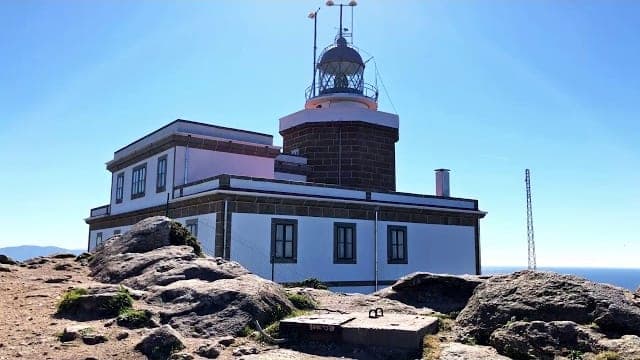
The lighthouse isn't in the town: it's 3.5 km uphill from Fisterra, about 45 minutes, and that's where the 0.00 km marker closes the Camino. Almost everyone walks up at sunset, which is when it makes sense — so plan on finishing your walking day well after you drop the backpack.
When to go
May to June and September work best, as on every Galician route. July and August concentrate most of the pilgrims, and on a route with a network this thin that shows more than it does on the Francés. In winter the problem isn't the rain — it rains in Galicia all year — it's that accommodation and roadside bars close, and the bus back thins out exactly when you have least margin.
Xacobeo 2027, with the Holy Door open from 31 December 2026, will be felt here too. This is a route a lot of people decide on the spur of the moment, already in Santiago — and in a Holy Year that means competing for beds with everyone who decided the same thing that morning.
Frequently asked questions
How long is the Camino to Finisterre?
About 90 km from Santiago to the town of Fisterra, plus 3.5 km if you walk up to the lighthouse. Sources range from 86 to a little over 100 km depending on where they measure and whether they count the lighthouse climb, so treat it as a planning figure. Adding Muxía after Fisterra makes it around 118 km.
How many days does it take?
Four days to Fisterra: Santiago–Negreira (21 km), Negreira–Olveiroa (33 km), Olveiroa–Cee (20 km) and Cee–Fisterra (15.5 km). Add Muxía and it's five or six. If you're starting to walk here rather than arriving off another Camino, split the second stage at Santa Mariña and count an extra day.
Does it count towards the Compostela?
No, and the reason is finer than "it has to be the last 100 km". Since February 2025 the Compostela no longer requires the 100 km to be the final ones: any continuous 100 km on one recognised route counts, provided the stage that closes the count is the one arriving at the Cathedral. That is where this Camino falls down, because it leaves Santiago: its final stage arrives in Fisterra or Muxía, not at the Cathedral. What you get are two free certificates of its own: the Fisterrana, at the albergue or tourist office in Fisterra, and the Muxiana, at the Casa da Cultura in Muxía. Both are issued against a stamped credencial.
How much is the bus back from Fisterra?
€7.35 one way from Fisterra and €6.85 from Muxía, with Monbus. There are eight daily services from Fisterra and five from Muxía. The fare doesn't change with the departure — the duration does, from 2h03 to 3h from Fisterra. Fares checked for September 2026 and indicative.
Can I get back to Santiago in the morning?
Not from Fisterra: the first bus leaves at 09:45 and arrives at 12:45. From Muxía you can, with a 07:30 departure arriving at 09:15. If you have an early flight or train, either finish in Muxía or sleep the last night in Santiago.
Fisterra or Muxía — which is better?
Fisterra has the more symbolic ending — the lighthouse, the 0.00 km marker, the sunset — and also more people and more services. Muxía is smaller, quieter, and ends at the Virxe da Barca sanctuary out on the rocks. If you can only do one and want quiet, Muxía; if you want the recognisable close of the Camino, Fisterra.
Can you burn your clothes at the Fisterra lighthouse?
No, it's prohibited. There were small fires and a build-up of rubbish, and the council now watches the area with cameras and patrols, with fines for anyone doing it. Walking up for the sunset is still the part worth doing.
Can I get to Fisterra without walking?
Yes. The Monbus service from the Intermodal station takes 2h10 on the fastest departure and costs €7.35. It's the usual option for anyone with a spare day in Santiago who wants to see the lighthouse; it's covered in our day trips guide.
Keep reading
Choosing a route
Every Camino route compared
Distances, days and character of the eight main routes, so you can decide how you arrive.
Getting home
How to leave Santiago
Madrid, Porto, Ferrol and the coast: buses, trains and checked fares once the Camino ends.
Without walking
Day trips from Santiago
Fisterra by bus, the Rías Baixas, Padrón and A Coruña, with times and prices.