The minimum stretch
Camino de Santiago from Sarria: the five stages
Five days, one hundred and fourteen kilometres, and the most walked stretch of the entire Camino Francés. Here is each stage on its own, with what you will actually find on it.
By Cesar Rodriguez · updated
On this page
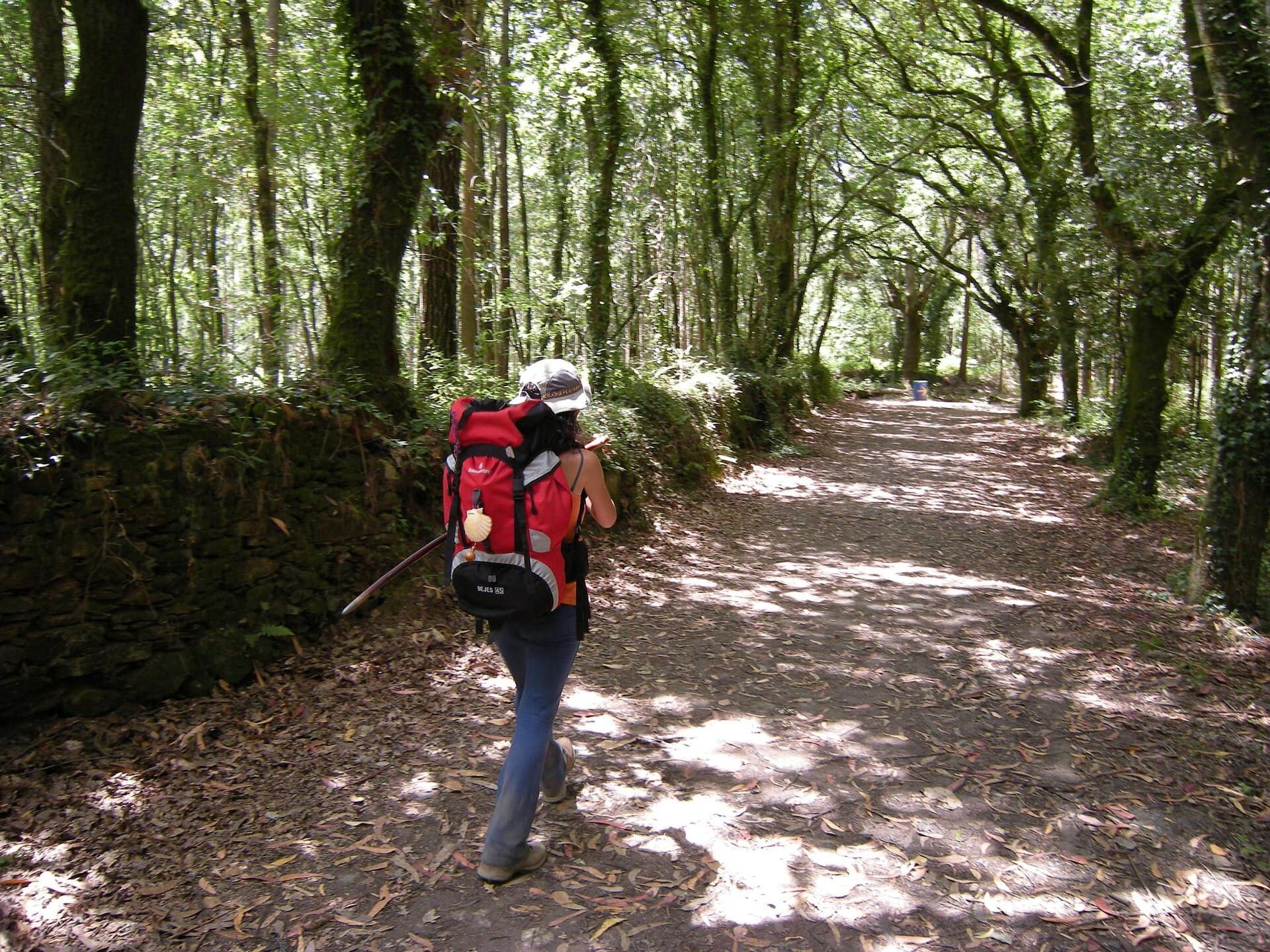
Sarria is by a wide margin the most popular starting point on the Camino de Santiago: it is the hundred-kilometre minimum that the Compostela requires, it fits into a week of holiday, and it asks nothing special of your fitness. That comes at a price — it is also the busiest stretch in the whole Camino network — but day by day it is still a beautiful walk: oak woods, stone villages, the Belesar reservoir and the final approach over Monte do Gozo.
These five days are the last stretch of the Camino Francés, which from Saint-Jean-Pied-de-Port runs 763.7 km over 33 stages: the 28 before this page are not on it. If you are still deciding how far back to start — León leaves 304.5 km and thirteen days, Ponferrada 203.6 and nine, O Cebreiro 152.6 and seven — our guide to the whole Camino Francés puts those distances next to how many people actually set out from each place.
Before you set out: getting to Sarria
Sarria is not on the same railway line as Santiago — it belongs to the Lugo–Monforte–Ourense axis, not the Vigo–A Coruña one — so there is no direct train between the two. The usual way is the coach, 1h30 to 2h10 depending on how many stops it makes, from 10-14 €: there is only one direct service a day, at 11:00 (€11.05, calling at the airport), and the rest change in Lugo; the Santiago–Sarria timetable tells you how early you need to have landed to get there the same day. Coming from Madrid, Renfe runs a connecting combination (ALVIA/AVE/AVLO) of about 3h45, with promotional fares from 8 € and a normal price around 25-31 €; there are also direct long-distance coaches, slower but with no change. If the plan is to land or step off the train in Santiago and go up to Sarria from here, the high-speed trains, coaches and flights are in how to get to Santiago de Compostela. And if the connection your app offers depends on a rural bus, check it twice: getting to the starting point collects the traps of that last leg, starting with the lines that only run Monday to Friday.
The Camino leaves from the upper part of Sarria's old town, beside the Monastery of La Magdalena (13th century, of the Order of Mercy, with Romanesque, Gothic and Baroque elements) and the church of Santa Mariña. From there you go down the Sarria steps and cross the medieval Áspera bridge towards Barbadelo. The first stamp in your credential comes from your own accommodation, the tourist office or any bar in the old town: you will not have to look hard.
The five stages at a glance
| Stage | Distance | Approx. time | Elevation | Difficulty |
|---|---|---|---|---|
| Sarria → Portomarín | 22.2 km | ~5 h | +398 / −457 m | 2/5 |
| Portomarín → Palas de Rei | 24.8 km | 5h45-6h30 | +519 / −353 m | 2/5 |
| Palas de Rei → Arzúa | 28.5 km | ~6h45 | +491 / −653 m | 3/5 |
| Arzúa → O Pedrouzo | 19.3 km | ~4h30 | +351 / −447 m | 2/5 |
| O Pedrouzo → Santiago | 19.4 km | ~4h30 | +318 / −345 m | 2/5 |
| Total | 114.2 km | 5 days | — | — |
This five-day split is the classic one, but not the only one possible. If your days are not five, the split changes: in six stages the longest day drops to 22.3 km, and in seven no day goes past 20 kilometres.
Where the 100 km marker actually stands
There is a common mix-up about this: the famous stone marker carved with the shell and the yellow arrow is not in Casanova — there is a village by that name, but it belongs to the Palas de Rei–Arzúa stage, further on. The real 100 km marker is on the first stage, Sarria–Portomarín, in the Ferreiros and A Pena area (parish of Paradela), between kilometres 12 and 14 out of Sarria. It is the classic photo stop of the Camino: a queue of pilgrims waiting their turn to sit on the stone.
Why it gets so crowded (and how to dodge it)
This stretch concentrates everyone who only has a week, so in high season — summer, Holy Week — the Xunta's public hostels, which take no bookings and are handed out in order of arrival, fill by mid-morning and leave whoever turns up late without a bed. The advice repeated on every stage is the same: leave before 7:30-8:00 if you want a bed for certain, especially before Portomarín, Palas de Rei and O Pedrouzo. From Melide onwards the numbers step up again, because the pilgrims arriving on the Camino Primitivo join in.
And if what you want is a final stretch with fewer people and the same Compostela, there are two five-to-six-day alternatives that meet the 100 km minimum: the Portugués from Tui (116 km, flatter) and the Inglés from Ferrol (111.5 km, the quietest of the three).
Frequently asked questions
How many days does it take from Sarria to Santiago?
With the classic five-stage split it takes five walking days. You can compress it into four by lengthening one stage, or spread it over six by breaking the stretch at Santa Irene, near O Pedrouzo.
Do I need to book a hostel?
The Xunta's public hostels (around 10 € a night) take no bookings: they are handed out in order of arrival. Private ones can be booked and it is worth doing so in July and August or at Easter, when the stretch fills up.
Where exactly is the 100 km marker?
On the first stage, between Sarria and Portomarín, in the Ferreiros and A Pena area, between km 12 and 14 from the start. It is not in Casanova, a different village you cross three stages later.
How much does each walking day cost?
Counting a public hostel (10 €), simple meals and the odd bar along the way, 25 to 35 € a day is realistic, which is the range we use throughout the guide. With a private hostel or guesthouse and eating à la carte it goes to 55-90 €. Guide prices for 2026.
Can it be done in four days instead of five?
Yes, though it asks for decent fitness: it is usually done by joining Sarria–Palas de Rei on the first day (longer) or by stretching the last day to Santiago from Arzúa. Most people prefer the five-stage split for comfort.
The five stages
Stage 1
Sarria → Portomarín
22.2 km to a village moved stone by stone in 1963. The 100 km marker is on this stage.
Stage 2
Portomarín → Palas de Rei
24.8 km with the hardest climb of the stretch: the Alto de Ligonde, at 725 metres.
Stage 3
Palas de Rei → Arzúa
28.5 km, the longest and most demanding day. It goes through Melide and its legendary octopus.
Stage 4
Arzúa → O Pedrouzo
19.3 km through eucalyptus woods, comfortable, with Santa Irene as an optional stop.
Stage 5
O Pedrouzo → Santiago
19.4 km to the Obradoiro, passing Lavacolla and Monte do Gozo on the way.