The route that arrived by sea
Camino Inglés: Ferrol to Santiago in 5 stages
111.5 kilometres between shipyards, Galician rivers and small hamlets: the route followed by the English and Irish pilgrims who arrived by sea. What it is, how many days it takes, what it costs and what each stage is like.
By Cesar Rodriguez · updated
On this page
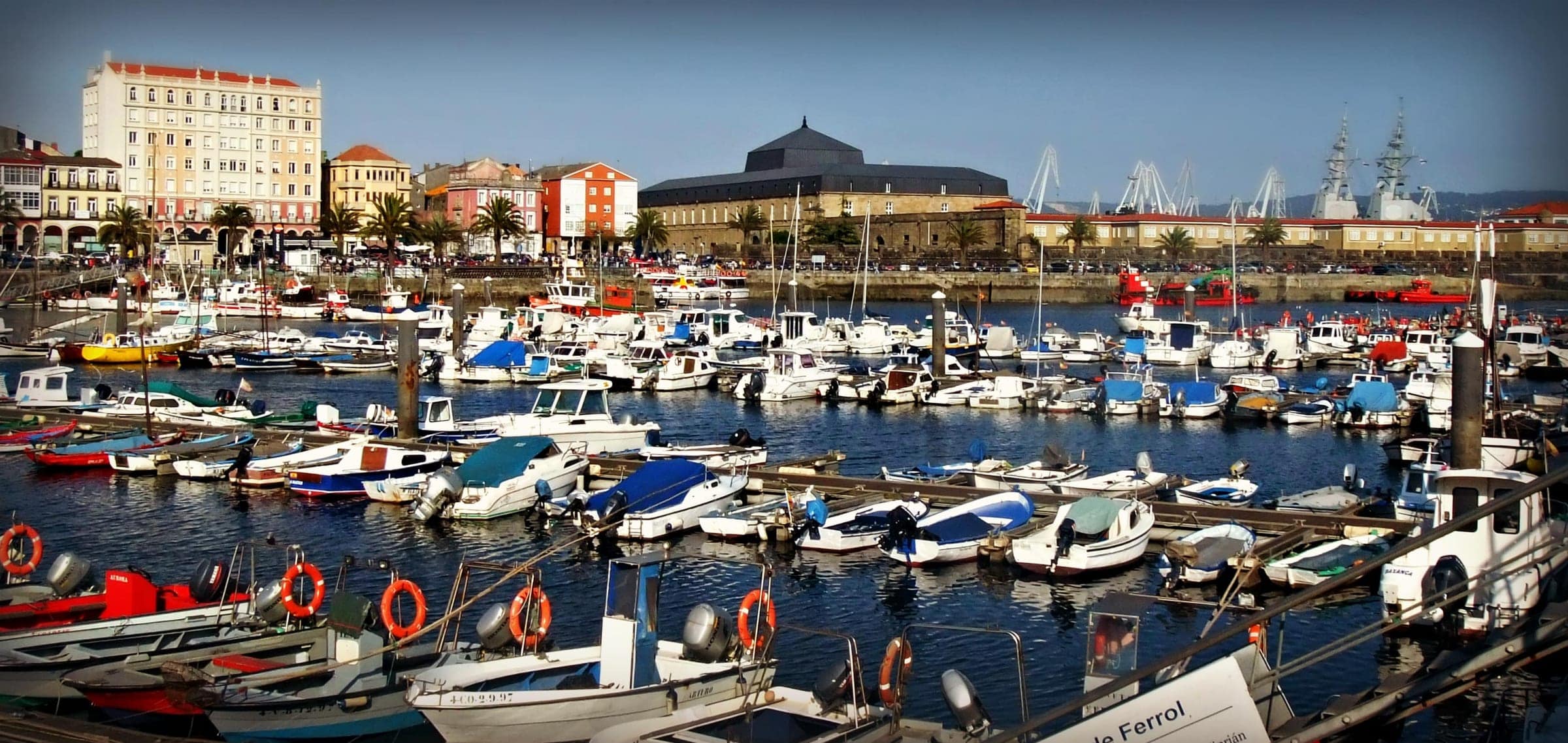
The Camino Inglés owes its name to the people who invented it: pilgrims from England and Ireland who, in the Middle Ages, avoided the walk across France and Spain and took a ship to the Galician coast instead. They landed in Ferrol or A Coruña and walked from there to the Apostle's tomb. Today it is the fourth most walked routeinto Santiago, with around 30,200 pilgrims in 2025 — roughly 5.7-6% of the total, according to the press figures citing the Pilgrim's Office, and a record for this route. It is still, by a wide margin, a quiet path: nothing like the 100,000-plus a year on the central Portugués. The figures for every route, year by year, are in the pilgrim statistics.
Ferrol or A Coruña: why the start matters
The classic route, and the one this guide covers, starts in Ferrol, with stages adding up to 111.5 km: that is what the five days in the table below give, and exactly the total gronze.com publishes. If you want to see that same split worked out day by day, with the hostels on record at each stop, it is in the five-stage plan from Ferrol. You will see it rounded to 112 km in many places, and 118 km too — which is what our own Camino map said until August 2026, with no source behind it that we could check; now corrected. That distance clears the 100 km the Compostela requires with room to spare, so leaving from Ferrol poses no problem at all.
How to get to Ferrol
The most practical option is the direct Monbus coach from Santiago, 1h20 to 1h30, guide prices of 8-9 € and up to 10 services a day: that is what we recommend. The train, by contrast, requires a change in A Coruña and takes over 2h20, so it is impractical if you are short on time. If you are moving between A Coruña and Ferrol, the direct train between the two takes around 1h10 and costs 5-7 €. All these figures are indicative and worth confirming at monbus.es or renfe.com before travelling. The other starting points — and the common traps of that last leg — are in getting to the start of the Camino.
The five stages at a glance
| Stage | Distance | Approx. time | Elevation | Difficulty |
|---|---|---|---|---|
| Ferrol → Pontedeume | 27.7 km | ~7 h | +392 / −379 m | 3/5 |
| Pontedeume → Betanzos | 19.7 km | ~5 h | +523 / −509 m | 2/5 |
| Betanzos → Hospital de Bruma | 24.0 km | ~6 h | +630 / −273 m | 3/5 |
| Hospital de Bruma → Sigüeiro | 24.4 km | ~6 h | +213 / −374 m | 2/5 |
| Sigüeiro → Santiago | 15.7 km | ~4 h | +255 / −227 m | 1/5 |
| Total | 111.5 km | 5 days | — | — |
How many days the Camino Inglés takes
Five is the standard split, and the one this guide follows. But it is not compulsory: the route stretches or compresses according to what your legs will take and the days you have.
- In 6 or 7 days, which is what we recommend if you do not walk often. The natural break is at Neda (14.6-15 km from Ferrol, with a Xunta hostel), which splits the first stage, the longest of the five, in two. Miño, on the second, has every service and does the same job.
- In 5 days, the classic split: days of 15 to 28 km, with two consecutive 24 km stages in the middle of the route.
- In 4 days only if you are trained and have margin: it forces days of around 28 km back to back, exactly on the stretches with the fewest bars and hostels. This is not the place to try long distances for the first time.
What the Camino Inglés costs
Five stages mean four nights on the route — Pontedeume, Betanzos, Hospital de Bruma and Sigüeiro — plus the night before in Ferrol if you arrive the day ahead, which is normal. With a public hostel (10 €) and simple food, the budget we use for the whole Camino in Galicia is 25-35 € a day, the floor that real pilgrim budgets confirm; moving up to private accommodation or a guesthouse and eating à la carte, it goes to 55-90 €. For five days that is around 125-175 € in the frugal version, plus the 8-9 € coach to Ferrol. Guide prices for 2026.
When to go
May to June and October is when the sums work best: Galician weathergives you fewer surprises than in winter and the route stays quiet. August and September are this route's peak months (5,103 and 4,790 compostelas in 2025, against about 3,900 in May and June), which on a route with a hostel network as tight as this one shows more than on the Francés. In winter the problem is not the rain — it rains all year in Galicia — but the services: there are guesthouses and roadside bars that close out of season, so it is worth phoning ahead before counting on a particular stop. The month-by-month calendar is in when the Camino opens and closes.
Where to sleep: the Xunta's public network
As on the other Galician routes, the Xunta's public hostel network charges a standard 10 €/night, takes no bookings and works on a first-come basis. They open at 13:00 and close at 22:00. The difference from the Francés or the Portugués is that the network here is tighter: on some stretches the only public hostel is halfway through the stage, and if it fills you can end up without a bed, with no plan B on the route.
That tightness shows the moment a link drops out: the public albergue in Ferrol, where the route starts, has been closed since 14 August 2026 after a bedbug infestation, with no reopening date — it was treated once and came back — leaving Neda as the public alternative, and Neda was filling up in the early hours in August. Confirm that first night before you count on it; and if you do sleep somewhere you have doubts about, our bedbug guide covers what to do and, above all, where to dry your gear when you reach Santiago.
Xacobeo 2027 — the next Holy Year, with the Holy Door open from 31 December 2026 — will be felt here too: if you plan to walk that year, expect more people than usual and book the private hostels on the stages with fewest public beds. The full calendar is in the Xacobeo 2027 guide.
Frequently asked questions
How long is the Camino Inglés?
From Ferrol, 111.5 km adding up the five stages, which is also the total gronze.com publishes. It is often rounded to 112 km; the 118 km figure circulating out there is not supported by any source we have been able to check. It is the shortest of the routes that give comfortable access to the Compostela without cutting the 100 km fine.
How many days does the Camino Inglés take?
Five is the standard split, with stages of 15 to 28 km. If you do not walk often, better in six or seven days by breaking the first stage at Neda, which has a Xunta hostel. Four days is possible, but it forces back-to-back days of around 28 km exactly on the stretches with fewest services.
What does the Camino Inglés cost?
With a public hostel and simple food, between 25 and 35 € a day, so around 125-175 € for the five days, plus 8-9 € for the coach to Ferrol. With private accommodation or a guesthouse and eating à la carte it rises to 55-90 € a day. Count on at least one private night: Sigüeiro has no public hostel. Guide prices for 2026.
Can I start in A Coruña and get the Compostela?
It depends where you first started walking. If A Coruña is your starting point and you have walked nothing abroad, no: it is 72.4 km adding up the stages and the general minimum is 100. But the Pilgrim's Office allows for a route started on foot outside Spain, and in that case 'the required distance in Spain shall be no less than 70 kilometres' — a floor A Coruña clears. That is what the 'Celtic Camino' rests on, which also asks for 25 certified kilometres on any Jacobean route recognised by the Cathedral, not only in Ireland (confirmed by the Asociación de Concellos do Camiño Inglés on 21 September 2026), so that the total reaches 100; that 25 km requirement is set by the agreement with the Cathedral, not by the Compostela page.
How do I get to Ferrol?
The most practical way is the direct Monbus coach from Santiago, 1h20-1h30 and around 8-9 €, with up to 10 services a day. The train requires a change in A Coruña and is impractical, taking over 2h20.
Which is the hardest stage?
The third, Betanzos–Hospital de Bruma: it has the route's biggest cumulative climb and an opening stretch of around 11 km without a single bar. The first stage, Ferrol–Pontedeume, is the longest in kilometres but with less climbing.
Is the Camino Inglés crowded?
No, it is one of the quietest routes: around 30,000 pilgrims a year against the 100,000-plus on the central Camino Portugués. That said, it has less infrastructure, so the quiet comes with less margin if a hostel fills up.
The five stages
Stage 1
Ferrol → Pontedeume
27.7 km, the longest of the five, with an industrial start and the Andrade tower house at the end.
Stage 2
Pontedeume → Betanzos
19.7 km with the route's hardest climb out of town and the capital of Galician Gothic as the destination.
Stage 3
Betanzos → Hospital de Bruma
24 km over the route's biggest cumulative climb, with almost 11 km without a single bar at the start.
Stage 4
Hospital de Bruma → Sigüeiro
24.4 km short on services and with no public hostel at the end: you have to plan where to sleep.
Stage 5
Sigüeiro → Santiago
15.7 km, the gentlest stage, with a final urban stretch that is not remotely bucolic.