Accessibility
Accessible Santiago: the city in a wheelchair
Santiago is a medieval city of granite and slopes, and being a World Heritage site puts real limits on what can be adapted. Even so, there is more room to move than it looks: here is what actually works.
- Cathedral access
- Praza da Quintana door
- Adapted taxi
- +34 981 56 92 92 (24 h)
- Airport to centre
- around €21
By Cesar Rodriguez · updated
On this page
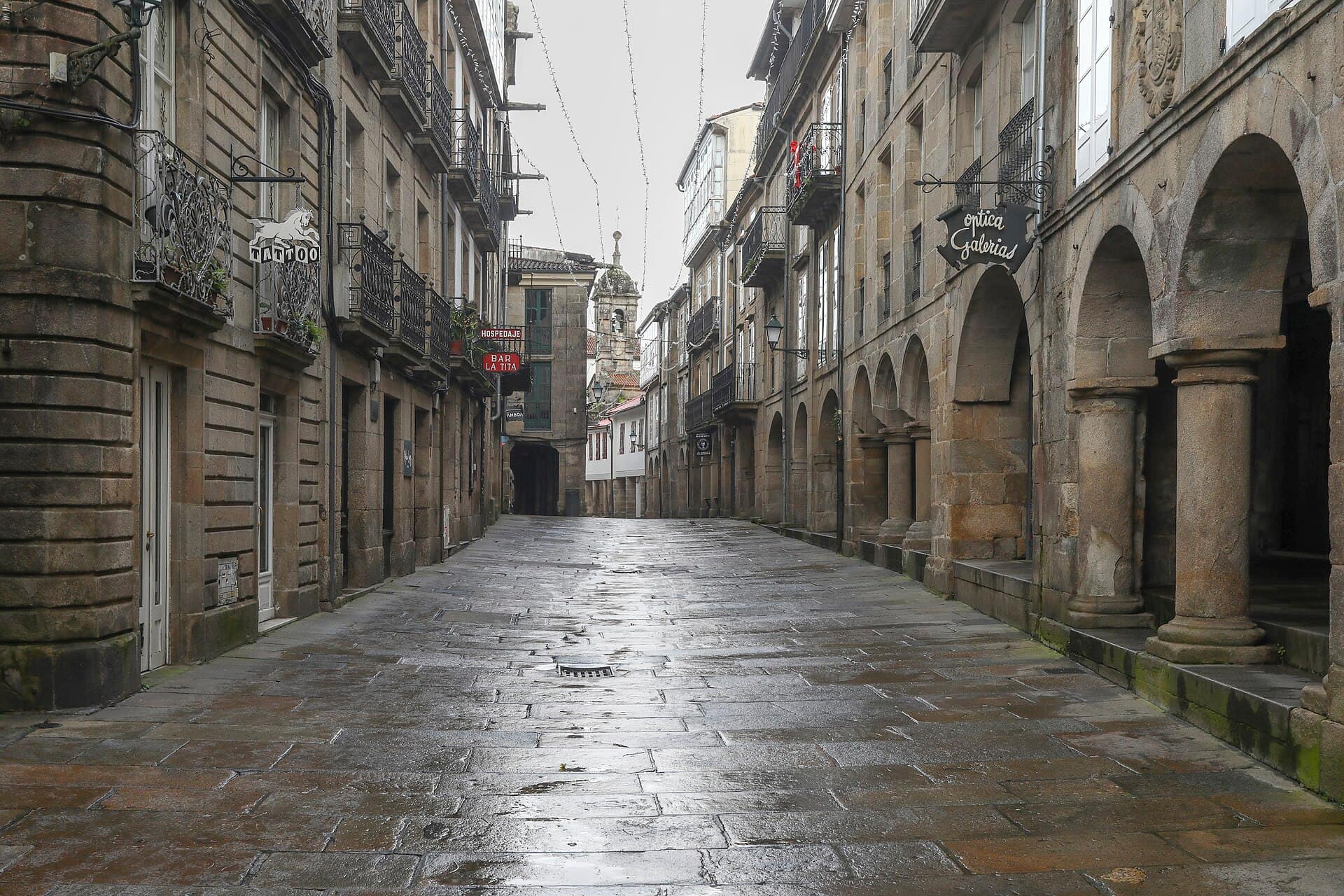
Start with the uncomfortable part: the old town of Santiago is granite and cobble, with constant changes of level, and no refurbishment is going to change that at root. What has changed in recent years is the number of resources, routes and transport options designed for getting around the city in a wheelchair or with reduced mobility. It is not an easy city, but it is not a closed one either.
A route that avoids the worst of it
Specialists in accessible tourism recommend one route that links the key points of the centre without kerbs or significant changes of level: from the area around the Hotel Compostela, Rúa das Orfas → Cantón do Toural → Rúa do Vilar → Travesía do Franco → Rúa do Franco, as far as the Parque de la Alameda (which has an adapted toilet) or Praza do Obradoiro. From there, Rúa de Fonseca → Praza de Praterías → Rúa da Conga → Praza da Quintana → Praza de Abastos, or Rúa de San Paio de Antealtares → Vía Sacra → Praza da Inmaculada. It is essentially the same circuit any visit to the old town makes, but chosen for having more even paving and no steps. It is also the best route in the city for a pushchair, for exactly the same reasons — the rest of the family version is in Santiago with kids.
The Concello —the city council— has spent around €300,000 on accessibility improvements at 17 points in the city between 2025 and March 2026: streets such as do Río, do Lavadoiro, Betanzos and Xeneral Pardiñas, and the Hórreo/Gómez Ulla area. So the map is improving, but slowly and in disconnected stretches rather than all at once.
The Cathedral: which door to use
The main door of the Cathedral has steps and is not accessible. Wheelchair access is from Praza da Quintana, through a door with 1.20 m of clear width and a threshold of about 15 cm. Once inside, the central nave, the side domes, the route through to the inner courtyard, the archive, the toilets (one of them adapted) and the shop are all accessible, though the lighting is poor in places.
The Cathedral Museum is, by its own official website's account, only partly adapted: its rooms are spread across several buildings in the complex —the archbishop's palace among them— whose historic structure does not allow a full adaptation. There is a single lift, in the Pazo de Xelmírez, giving access to the Espacio Maestro Mateo and the temporary exhibitions. The Cathedral rooftops cannot be visited in a wheelchair under any circumstances. To settle a specific question before you travel, the direct contacts are atencionvisitante@catedraldesantiago.es and +34 981 55 29 85.
Getting around: bus and adapted taxi
The city bus is still run by TUSSA, and it is worth not assuming an improvement that has not arrived yet. The new service contract —13 years and about €119 million (it went out to tender at €128.5 million)— was awarded in July 2026 to a consortium of companies from the Monbus group, not to TUSSA, and its specification does explicitly require a continuous low floor and a double ramp —manual and automatic— across the whole fleet, including any vehicles brought in temporarily, plus optical and acoustic guidance and signage in braille.
But that contract is not running yet. An appeal by another bidder before the Galician public procurement tribunal (Tribunal Administrativo de Contratación Pública de Galicia) had it on hold until the tribunal dismissed it on 3 September 2026, and the council signed it in mid-September; the operator then has at most three months to start running it, so the new service arrives by mid-December 2026 at the latest. Even then, the permanent fleet will not be on the road for a while: the operator has a year to bring in the 67 new buses, and until then it runs a second-hand transition fleet (7.9 years old on average) which, according to the council, will be fully low-floor and all fitted with a ramp, though only some with a double ramp. Until the switch, the fleet you will find today is the old one, and not every line guarantees a low floor. If you depend on the ramp, ask the driver or call TUSSA first on +34 981 581 815.
For an adapted taxi, Radio Taxi Compostela (+34 981 56 92 92, 24 hours, every day) runs a Eurotaxi service —the Spanish term for a taxi with wheelchair access— with five regulation seats, bookable by phone or through their own app. The trip between the airport and the centre costs around €21, according to tur4all.com, the Spanish accessible-tourism portal. That is an indicative figure, not a fixed fare.
Official resources
santiagoturismo.com/accesibilidad, the city's official tourism site, is open about the limits that World Heritage status imposes, but it does set out the progress made on access to monuments, streets and museums, and it offers video guides in sign language and an interactive accessible map. turismo.gal, the regional tourist board, has its own accessible tourism section, including a part devoted to the accessible Camino de Santiago that links to the Galician Tourism Accessibility Plan and to the Accessible Camino de Santiago Guide, produced with Fundación ONCE, the Spanish foundation for blind and disabled people.
The Camino, in a wheelchair
The final stretch of the Camino Francés, from Monte do Gozo to Praza do Obradoiro, is between 4 and 4.7 km and mixes historic cobbles around San Lázaro and Porta do Camiño with asphalt in the outer sections. There is no official assessment of how practicable it is in a wheelchair, so treat it as a mixed stretch rather than a guaranteed route.
The association DisCamino, based in Vigo (discamino@discamino.org), has been organising Caminos for people with physical, intellectual, sensory and psychosocial disabilities since 2009, using tandem tricycles, handbikes and off-road wheelchairs: more than a hundred Caminos completed and hundreds of pilgrims accompanied. It is still active and its support is free.
The Pilgrim's Office (Rúa das Carretas, 33), where you collect the Compostela, has step-free access from the street and an obstacle-free route inside, according to Fundación ONCE's own checklist, though it has no hearing induction loop and no adapted toilet in its public areas.
| Resource | Contact | What for |
|---|---|---|
| Cathedral — visitor services | +34 981 55 29 85 · atencionvisitante@catedraldesantiago.es | Access questions for the church and the museum |
| Radio Taxi Compostela (Eurotaxi) | +34 981 56 92 92 (24 h) | Adapted taxi, by advance booking |
| DisCamino | discamino@discamino.org | Free support on the Camino with adapted equipment |
| Pilgrim's Office | Rúa das Carretas, 33 · 9:00-19:00 | The Compostela, step-free access |
Frequently asked questions
Can you get into Santiago Cathedral in a wheelchair?
Yes, but not through the main door, which has steps. Accessible entry is from Praza da Quintana, through a door 1.20 m wide with a threshold of about 15 cm. Inside, most of the church is accessible; the museum only partly, and the rooftops not at all.
Are there wheelchair-accessible taxis in Santiago?
Yes. Radio Taxi Compostela runs a Eurotaxi service —the Spanish term for a wheelchair-accessible taxi— 24 hours a day, bookable on +34 981 56 92 92 or through their app. It is the most reliable option for trips such as the airport to the centre.
Are Santiago's city buses accessible?
Partly, and not yet fully. The service is still run by TUSSA with the same old fleet, in which not every line guarantees a low floor. The new contract, awarded in July 2026 to a consortium from the Monbus group, does require a continuous low floor and a double ramp across the whole fleet. It was signed in mid-September 2026, after an appeal was dismissed, and the new service has to start within three months, so by mid-December at the latest; the permanent fleet arrives within a year, and until then a transition fleet runs, fully low-floor and with a ramp according to the council. Until the new fleet arrives, ask the driver if you depend on the ramp.
Can you walk the Camino de Santiago in a wheelchair?
The final stretch, from Monte do Gozo, is passable but mixed, with no official guarantee of full accessibility. The association DisCamino organises complete Caminos with adapted equipment (tandem tricycles, handbikes, off-road wheelchairs), free of charge and with experience going back to 2009.
Which parts of the old town are hardest with reduced mobility?
The streets outside the recommended route (Orfas-Toural-Vilar-Franco-Praterías-Quintana) tend to have steeper gradients and worse paving. Parque de Bonaval, for example, is designed in terraces with notable changes of level, and is worth avoiding if you want a flat walk.
Keep reading
Visiting
What to see in Santiago de Compostela
The essential circuit through the Cathedral, the squares and the museums of the old town.
Getting around
Getting around Santiago
City bus, taxi fares, car parks and the rules of the car-free old town.
Camino
Arriving in Santiago
The Compostela, the embrace of the Apostle and what to expect on arrival day.