Checked in August 2026
When the Camino de Santiago opens and closes
The Camino never closes: it is a network of public paths and you can walk it on 2 January. What closes are the services that make it comfortable, and each one has its own date. This is the calendar almost nobody publishes in one place.

By Cesar Rodriguez · updated
On this page
"Can you walk the Camino in March?" has no yes-or-no answer. You can walk any day of the year, but in March one specific stretch is closed by administrative order, the mountain refuges have not opened, luggage transfer only runs on two sections and the bus that gets you to the start is on its winter timetable. None of those four things is published together anywhere, so here they are with their dates and their sources.
1 April is the date that matters
At the start of the Camino Francés, the real calendar is set by the mountain accommodation. Refuge Orisson opens on 1 April and closes between the 18th and the 31st of October depending on the year; Auberge Borda, a few metres away, runs from 1 April to 21 October. Between them they hold a few dozen beds, reservation only, and they are the only accommodation between Saint-Jean-Pied-de-Port and Roncesvalles.
That explains something that looks odd from outside: why almost nobody sets off from Saint-Jean in February or March. It is not superstition or tradition — it is that most accommodation in the area does not open until 1 April and the mountain route is closed. Jean-Philippe Rigaud, secretary of the Association Les Amis du chemin de St Jacques Pyrénées-Atlantiques, confirmed it to us by email with the statistics from the association's annual review, Le Petit Bourdon.
The Napoleon route closes from 1 November to 31 March
It is the only stretch of the Camino with a genuine administrative closure. Every winter the Government of Navarre shuts the variant crossing the Lepoeder pass between Saint-Jean-Pied-de-Port and Roncesvalles — the Napoleon route — on safety grounds: it is fog and snow country where rescues are expensive and dangerous. For those five months you must take the Valcarlos and Ibañeta variant, which stays closer to the road and climbs less. The rule has teeth: fines of up to €12,000 are on the books.
One odd consequence of that closure: the pilgrim office in Saint-Jean warns all year round that the mountain route "is more dangerous", and people who hear it in August assume something is wrong that particular day. Nothing is: the warning comes from the same reason as the winter closure, and the real summer risk is not the climb, it is the fog. What is worth knowing in any month is that between Orisson and Roncesvalles there are some 17 kilometres with no shop, no bar and nowhere to stop.
Somport does not close, but the snow decides
The other Pyrenean pass, the one on the Camino Aragonés, has no administrative closure: nobody forbids leaving Somport in January. What you have is a pass at roughly 1,630 metres and a first stage of 30 kilometres down to Jaca that in winter can wake up under snow or ice, with no office to warn you. The practical difference from the French route is not the pass but the beds: on the Aragonés a good share of the pilgrim albergues do not operate between October and March — the one in Arrés, for instance, closes from early November to late March — so a stage that sorts itself out in May can leave you with nowhere to sleep in January. If the snow forecast is against you, the fallback is to start at Canfranc-Estación or Jaca, both served by the regional train from Zaragoza; and in any case the rule of the Aragonese winter is not to leave Somport or Jaca without that night's bed already confirmed.
What shuts down out of season
- Luggage transfer, on seven of the nine routes. Correos' Paq Mochila runs from 16 March to 31 October on nine routes. From 1 November only Sarria–Santiago and Tui–Santiago remain, but those two do not stop for winter: the only days Correos closes them are 24, 25 and 31 December and 1 January. So in January and February there is a transfer from Sarria and from Tui, and on no other route. The Francés from Somport and the Camino de Invierno run Monday to Friday only and are booked by email. The detail, with prices and companies, is in the luggage transfer guide.
- The buses that get you to the start. County lines run winter timetables, and many do not operate on Saturdays or Sundays at any time of year. It is the single most common planning failure, and it has its own page: how to reach the start.
- Private albergues in small villages. Many close from November to March, and they don't always announce it. The floor of the network is still the public albergue — €10 in Galicia, no booking, first come first served — which means that in winter there are fewer beds and they are more concentrated: where beds run out explains how that network behaves.
- What doesn't close: the Pilgrim's Reception Office in Santiago, at Rúa das Carretas 33, opens every day from 9:00 to 19:00 all year, except 25 December and 1 January. Whenever you get here, your Compostela is waiting.
The two waves: early May and early September
If we had to sum up the Camino year in one sentence, it would be this: there is no high season, there are two waves. The first fortnight of May and the first fortnight of September concentrate the departures of everyone with flexible holidays who wants to avoid the heat, and those people stay bunched together stage after stage for weeks. The Pyrénées-Atlantiques association confirms it from the French side, and it fits what came out of our own August 2026 survey: May shows up more often than August in accounts from pilgrims who could not find a bed.
Which produces the most practical piece of advice on this page, and it is Rigaud's: don't start on the 1st of the month, and don't start at a weekend. An ordinary Wednesday or Thursday sees far fewer departures, and that difference travels with you all the way to Santiago — because what fills the albergues is not the month, it is how many people set off the same day you did.
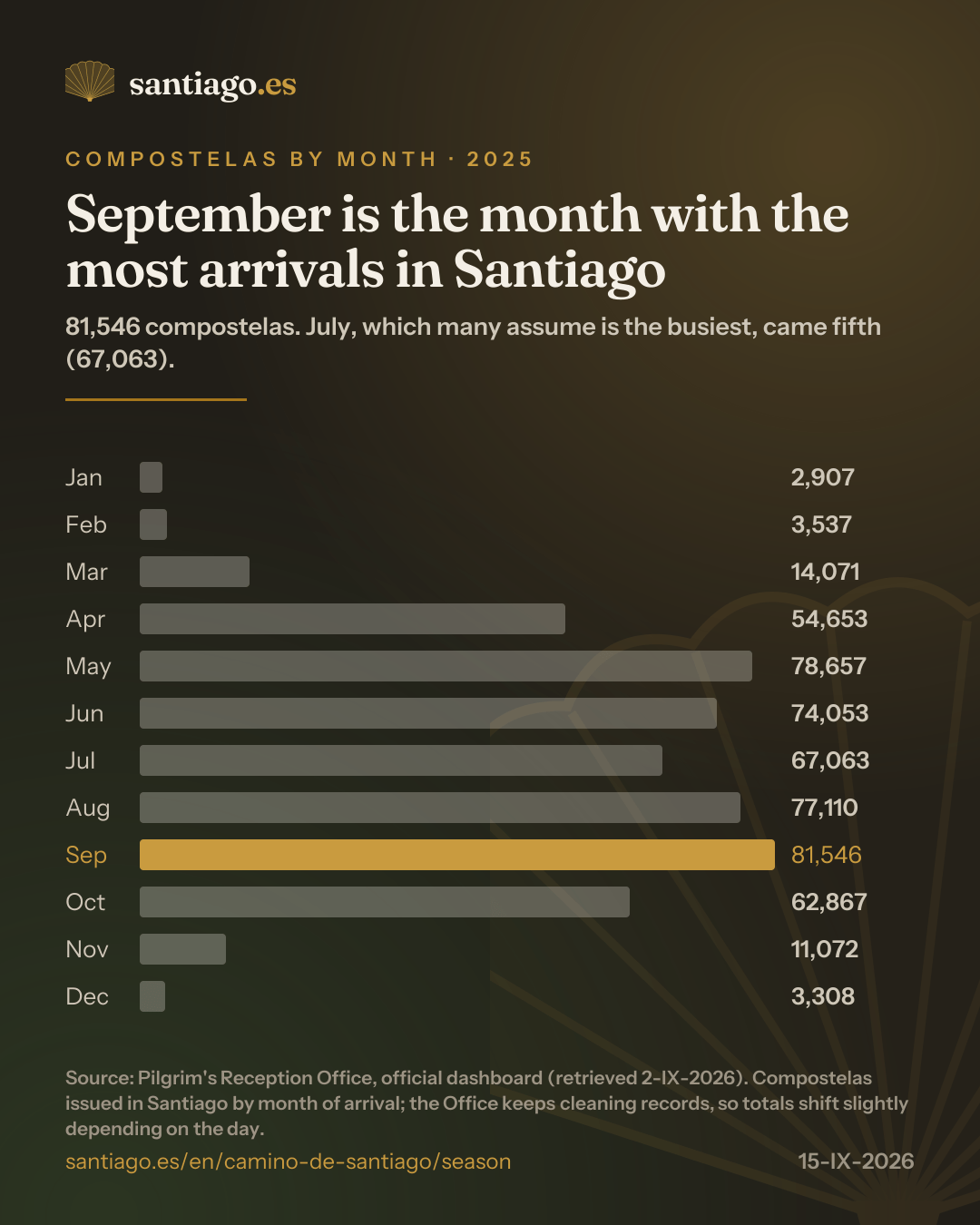
The official numbers back that second wave. In 2025, according to the Pilgrim's Reception Office dashboard, the month with the most compostelas was September, with 81,546; then May (78,657) and August (77,110). July, which almost everyone assumes is the fullest, came fifth (67,063), behind June too. This is the spread of arrivals in Santiago, not departures: whoever starts in Sarria in mid-September is in that peak, and so is whoever leaves Saint-Jean in late August, because they arrive in September. The breakdown by route and by year is in the pilgrim statistics, and the year that set the record has its own piece with what changed in 2025.
October, and the cut-off on the 31st
October is still full season: 62,867 compostelas in 2025, not far off September's 81,546 and well above November's 11,072. Again, these are arrivals in Santiago, not departures: whoever leaves Saint-Jean in late October reaches Santiago in late November and counts in November's figure. In Galicia there are fewer people and more rain, but everything is still open; it is at the French start that the month winds things down. Orisson closes between 18 and 31 October depending on the year and Borda on the 21st, luggage transfer ends on the 31st on almost every route, and the next day, 1 November, the Napoleon route closes: from then on, the only way from Saint-Jean to Roncesvalles is via Valcarlos.
| When | What to expect | What is closed or reduced |
|---|---|---|
| January and February | Winter walking in the full sense: few pilgrims, a lot of rain in Galicia and possible snow in the mountains of León and the Ancares. | Napoleon route closed. Luggage transfer only between Sarria and Santiago and between Tui and Santiago. A good share of village albergues shut. |
| March | Still low season however sunny it looks. Anyone leaving Saint-Jean must go via Valcarlos. | Napoleon closed until the 31st. Orisson and Borda have not opened yet. |
| 1 April | The date that really opens the season on the French stretch: Orisson and Borda open, and so do most places around Saint-Jean. | Nothing much, except that Easter sometimes falls earlier and fills the cities before the rest of the system is running: in 2027 Holy Week is 21 to 28 March, in a Holy Year and with the Napoleon route still closed, so Santiago will fill while the French stretch is only half open. |
| May | The year's first wave, above all in the first fortnight. It is the month that appears most often in accounts of pilgrims left without a bed. | Nothing closed, but pressure on Saint-Jean and Roncesvalles is at its peak. |
| June | A comfortable month: everything open, long days and fewer people than May or August. | Nothing. |
| July and August | August was the third-busiest month of 2025 for arrivals (77,110 compostelas) and July only the fifth (67,063): hard heat on the Meseta and lots of Spanish pilgrims on school holidays. | Nothing closed, but county buses thin out in August and the northern coastal towns compete with beach tourism. |
| September | The busiest month of the year for arrivals (81,546 compostelas in 2025), concentrated in the first fortnight. After that, one of the best moments of the year to walk. | Nothing, beyond some mountain refuges winding down after the 20th. |
| October | Fewer people and more rain in Galicia, but still full season until the end of the month: 62,867 compostelas in 2025, against 11,072 in November. | Orisson and Borda close between the 18th and the 31st. Luggage transfer ends on the 31st on almost every route. |
| November and December | A quiet, cold Camino with short stages because of the daylight. Perfectly doable, but every night needs planning. | Napoleon closed from the 1st. Luggage transfer down to Sarria–Santiago and Tui–Santiago. Many private albergues closed until spring. |
Like anything that depends on small businesses, this expires: the opening dates of any given albergue shift from year to year and are worth confirming before you count on them. What does not shift so fast are the two underlying rules: the winter closure of the Napoleon route, which is administrative, and 1 April as the real gateway to the season on the French stretch.
And 2027, which changes the maths
The Holy Year pushes all of this upward: more people in the same months, and accommodation opening its bookings later than usual because prices are being redone. If your Camino falls in 2027, choosing when to come is no longer just a weather decision — we go into it in the Xacobeo guide, with the months likely to saturate and the ones still worth taking.
Frequently asked questions
Can you walk the Camino de Santiago in winter?
Yes — it is a network of public paths and you can walk any day of the year. What changes is the service: the Napoleon route is closed from 1 November to 31 March, luggage transfer shrinks to Sarria–Santiago and Tui–Santiago, many private albergues close and county buses run winter timetables. You have to plan every night rather than improvise.
Why is the Napoleon route closed?
Because the Government of Navarre closes the variant over the Lepoeder pass between Saint-Jean-Pied-de-Port and Roncesvalles every winter, from 1 November to 31 March, because of the risk of fog and snow. In those months you must take the Valcarlos and Ibañeta variant. Fines of up to €12,000 apply to anyone using it anyway.
Is Somport closed in winter?
No. The pass on the Camino Aragonés has no administrative closure like the Napoleon route: you can leave Somport on any day. It sits at roughly 1,630 metres, so the first stage down to Jaca can carry snow or ice from December to March, and many albergues on the Aragonés do not open between October and March (the one in Arrés closes from early November to late March). If the forecast is bad, start at Canfranc-Estación or Jaca instead, both reachable by regional train from Zaragoza, and have each night's bed confirmed before you set off.
When do the Orisson and Borda refuges open?
Refuge Orisson opens on 1 April and closes between 18 and 31 October depending on the year; Auberge Borda runs from 1 April to 21 October. They are the only accommodation between Saint-Jean-Pied-de-Port and Roncesvalles, hold a few dozen beds between them and work by reservation only.
Which month is busiest on the Camino?
In arrivals into Santiago, September: 81,546 compostelas in 2025 according to the Pilgrim's Office dashboard, ahead of May (78,657) and August (77,110); July came fifth. The crowded feeling also concentrates in two shorter waves, the first fortnight of May and the first fortnight of September, and in accounts from pilgrims who ran out of beds, May appears more often than August.
What is the best day of the week to start the Camino?
A Wednesday or a Thursday, and never the 1st of the month. What fills albergues is not the month but how many people started the same day as you, and departures cluster at weekends and at the start of each month. It is the advice given by the Pyrénées-Atlantiques association of friends of the Camino.
Keep reading
The first thing that breaks
How to reach the start of the Camino
Sarria, Ferrol, Tui, O Cebreiro: what actually gets there, and on which days.
Where the wave bites
Where pilgrims actually run out of beds
63 accounts with town, route and month, plus a protocol for six in the evening.
Next year everything rises
When to come for Xacobeo 2027
The Holy Year months likely to saturate, and the ones still worth taking.