Journey's end
Arriving in Santiago: what to do in the first hours
From the first glimpse of the Cathedral's towers from Praza do Obradoiro to the pilgrim's mass, the Botafumeiro and the embrace of the Apostle.
By Cesar Rodriguez · updated
On this page
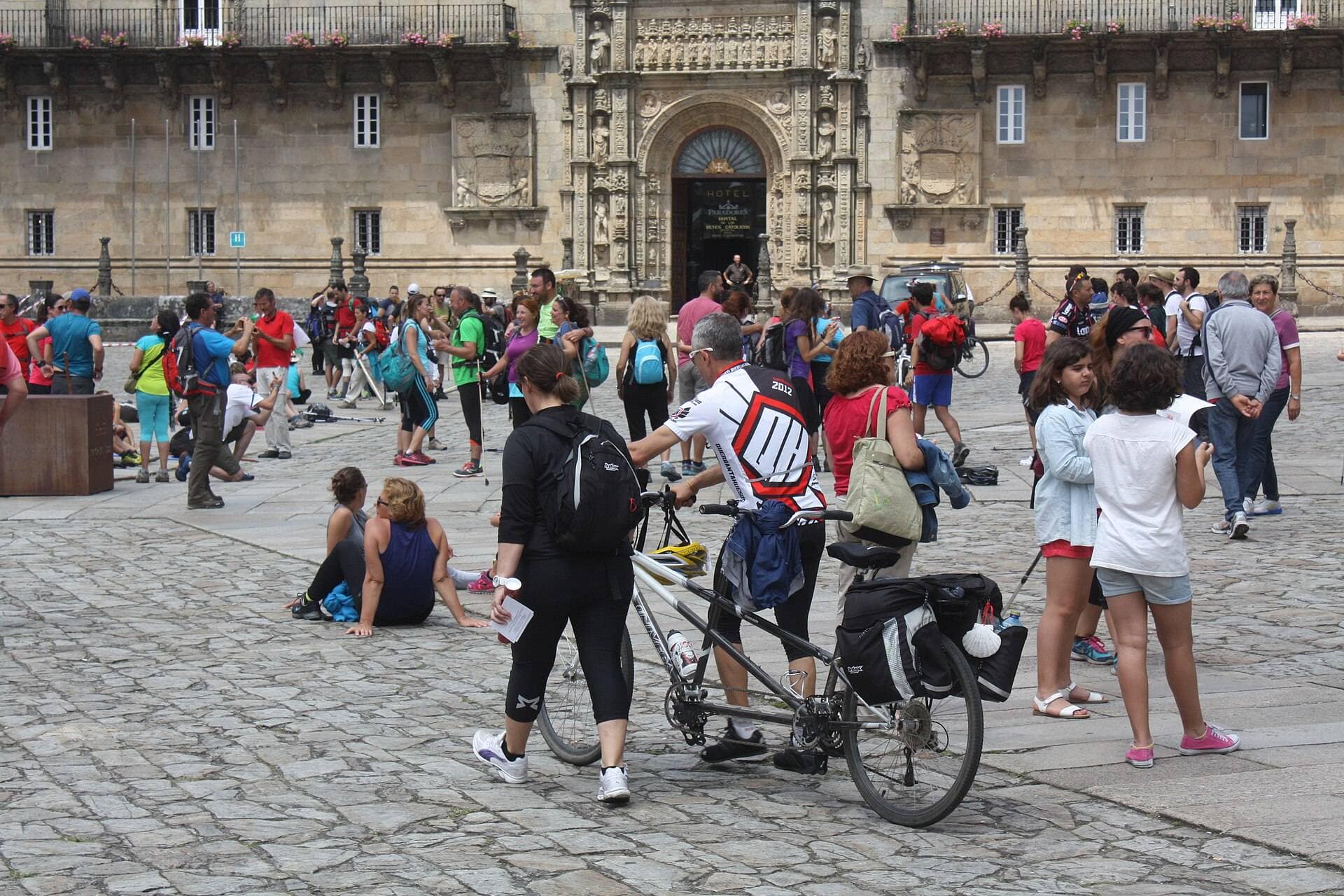
You enter Praza do Obradoiro through a narrow arch, and the same thing almost always happens: the square opens up all at once, the Cathedral's baroque façade fills your entire field of vision, and no matter how many photos you've seen beforehand, the effect still lands. It's common to see pilgrims sitting on the ground, some stretched out flat, letting their bodies register that there are no more stages left. It's a good place to linger a while before dealing with logistics. You won't be alone: the Pilgrim's Office hands out Compostelas every day and publishes how many pilgrims arrive, so you can know in advance whether your day is a quiet one or one of the thousand-pilgrim ones.
First, the Compostela
The logical next step is to head to the Pilgrim's Reception Office, at Rúa das Carretas 33, to collect the document certifying the route you've walked. It's open every day from 9:00 to 19:00. For the full detail on requirements and stamps, see our guide to the Compostela and the credencial.
Breakfast at the Parador, at pilgrim rate
A tip that circulates among pilgrims (August 2026, not independently verified by this guide): with your Compostela freshly collected, the Parador de Santiago — the Hostal dos Reis Católicos, right on the Obradoiro, built in 1501 as a pilgrim's hospital — will let you eat its guest buffet breakfast at pilgrim rate, around €16, on the day you arrive. Ask for a table by the window overlooking the square: you'll watch other pilgrims walking in while you eat.
The pilgrim's mass
There are four masses a day, all of them at the Cathedral's High Altar: 7:30, 9:30, 12:00 and 19:30. The midday mass draws the most recently arrived pilgrims and, on dates the Cathedral Chapter schedules it, is also when the Botafumeiro is most likely to swing. The split between San Francisco and San Fiz de Solovio still circulating online belongs to the 2019-2021 interior restoration and no longer applies. There's usually also a mid-morning mass in English aimed specifically at international pilgrims. Even so, major feast days can bring one-off changes: check the day's actual schedule before building the rest of your day around it. How long each mass runs, which ones are said in other languages and when to turn up if you want a seat are all in the Cathedral mass guide.
The Botafumeiro
For many, it's the moment that crowns the whole trip: a 53-kilogram censer, a metre and a half tall, suspended 20 metres beneath the crossing dome, which eight men — the tiraboleiros — swing from one end of the transept to the other in a spectacular arc. The Cathedral Chapter guarantees it at the High Mass of the calendar's major liturgical solemnities. Outside those dates, it can be requested privately by writing to botafumeiro@catedraldesantiago.es, at an indicative cost of €450-500, usually split among a group. When it swings, it happens at the end of the mass, adding around five minutes to the service. Important: right now it is not swinging. The Cathedral itself confirmed to santiago.es in writing on 5 September 2026 that it is still out of service because the scaffolding for the cimborrio restoration covers the mechanism it hangs from, and there is no date for its return. If you finish the Camino in these months, don't build your arrival day around seeing it. The full calendar of the twelve guaranteed dates, and the detail on this stoppage, is in the botafumeiro guide.
The embrace of the Apostle
Behind the high altar, a narrow staircase climbs to the image of the Apostle, where tradition calls for embracing the figure from behind. Access, unrestricted since 2023, has run since August 2025 through the Puerta de Abades, on Praza da Quintana, within the Cathedral's general opening hours. The same route lets you descend to the crypt and venerate the relics kept beneath the high altar — the point that gives the whole journey its meaning.
The Holy Door: only in a Holy Year
On Praza da Quintana there's a door that stays shut the vast majority of the time: the Holy Door, or Puerta del Perdón, which only opens during a Jacobean Holy Year — that is, when 25 July falls on a Sunday. 2026 isn't one. The next Holy Year, Xacobeo 2027, will begin with the solemn opening of this door on the afternoon of 31 December 2026, in a ceremony where the archbishop strikes the wall three times with a silver hammer. From there, the door stays open all 365 days of the following year, until it's sealed again on 31 December 2027.
After the Cathedral: octopus, cake and the end of the world
The most common custom among newly arrived pilgrims is to sit down and celebrate with a plate of pulpo á feira and a slice of tarta de Santiago at one of the taverns on Rúa do Franco. And for anyone not ready for the Camino to end just yet, there's the option of continuing on foot to Fisterra and Muxía: 87 to 118 km more, over 3-6 days with barely any elevation, ending at the lighthouse that medieval tradition held to be the edge of the known world. That stretch doesn't count towards the Compostela, but it does earn you the Fisterrana, a second certificate many consider the trip's real closing point. The stages and the bus back are in our guide to the Camino to Finisterre and Muxía.
Frequently asked questions
What time is the pilgrim's mass?
There are four daily masses — 7:30, 9:30, 12:00 and 19:30 — and they are held at the Cathedral's high altar. The widely shared notice that restoration work moved them to San Francisco or San Fiz dates from the 2019-2021 works and no longer applies. Major feast days can still shift things, so it's worth confirming the day's schedule on arrival.
When does the Botafumeiro swing?
Right now it doesn't: it is temporarily out of action because the scaffolding for the cimborrio restoration covers its mechanism, as the Cathedral itself confirmed to santiago.es in writing on 5 September 2026, and there is no date for its return. Normally it's guaranteed at the High Mass of the calendar's major liturgical solemnities, and outside those dates it can be requested privately for an indicative €450-500 by writing to botafumeiro@catedraldesantiago.es.
How do you do the embrace of the Apostle?
By climbing the staircase behind the high altar, accessed since August 2025 via the Puerta de Abades, on Praza da Quintana. The same route lets you descend to the crypt with the relics.
Is the Holy Door open in 2026?
No. The Holy Door only opens during a Jacobean Holy Year, and 2026 isn't one. It will open on 31 December 2026 to mark the start of Xacobeo 2027.
Is it worth continuing on to Fisterra and Muxía?
For anyone with the time, yes: it's 87 to 118 km more, over 3-6 days with barely any elevation, ending at the Fisterra lighthouse and earning you the Fisterrana, a separate certificate from the Compostela.
Can I have breakfast at the Parador the day I arrive?
It's a tip that circulates among pilgrims, not independently verified by this guide: with your Compostela freshly collected, the Parador (Hostal dos Reis Católicos, the pilgrim hospital built in 1501) will let you eat its guest buffet breakfast at pilgrim rate, around €16, on the day you arrive. Ask for a table by the window overlooking the square.
Keep reading
The destination
The Cathedral of Santiago: hours and tickets
The Pórtico de la Gloria, the museum, the rooftops, and every updated official price.
Paperwork
The Compostela and the credencial, step by step
Requirements, stamps, and how the Pilgrim's Reception Office works.
To celebrate
Where to eat in Santiago
Pulpo á feira, tarta de Santiago and the taverns of Rúa do Franco for that first day without a backpack.