The paper that gives the trip its meaning
The Compostela and the credencial, without last-minute surprises
The exact requirements, how many stamps you need, and where to collect it in Santiago, so a silly detail doesn't leave you empty-handed at the door.
By Cesar Rodriguez · updated
On this page
Every year, some pilgrim arrives at the Reception Office convinced they're about to be handed the Compostela and walks away disappointed — a missing stamp, or 199 km cycled instead of 200. Small details, but they matter, so let's go through them one by one.
The minimum distance
- On foot or on horseback: at least 100 km continuous, on one and the same recognised route and in the direction of Santiago.
- By bicycle: at least 200 km continuous, same condition. E-bikes don't count towards this total — conventional bikes only.
- If you began on foot outside Spain on a recognised route, the rule sets a different floor: the continuous kilometres on Spanish soil shall not be less than 70. That is all the Office publishes for that case; it does not say whether the total must still reach 100, and we have asked without an answer yet (10 September 2026). Until this week this page claimed it did: that was our reading, not the rule.
Since February 2025, that distance no longer has to be the literal final stretch before Santiago: any continuous 100 km on one and the same recognised route counts, as long as the stage that completes that count is the one immediately before arrival at the Cathedral — your pilgrimage still has to end in Santiago. That clause is the one doing all the work, and the one that trips up almost everyone, so here's the example that confuses people most: walking Logroño to Burgos (120 km) and then travelling to Santiago to walk in from Lavacolla doesn't qualify, because that last short stretch from Lavacolla doesn't complete the 100 km count — the stage that closes it out has to be the one that reaches the Cathedral. If the certificate matters to you, the safe rejoin point is still Sarria (114.2 km), Tui (116 km) or Ferrol (111.5 km, where the English Way starts) — or further back — because there the final stage genuinely is the one that completes the 100 km (more on this stretch in our guide to the last 100 km). On the Camino del Norte the margin is far tighter and worth checking before you book: Baamonde leaves 100.5 km, fifty metres of slack per kilometre, and the As Cruces variant out of Baamonde drops the total to 92.7 km, which means no certificate. Cyclists hit the same wall at Ribadeo, 192.9 km of the 200 required. If you're starting in Sarria, the stage planner splits that stretch across however many days you choose, without dropping below the minimum. None of this stops you walking the Camino in phases, even across different years: only that final stretch — the one that adds up to 100 km on foot or 200 km by bike into Santiago — has to be walked in one continuous go.
Worth knowing: even the Office's own site isn't fully consistent here. Its Compostela page already carries the new wording ("100 continuous km on one and the same route"), but the credencial page on the same domain still talks about "the last 100 kilometres" (checked August 2026). If this nuance affects your plan, ask at the Office itself when you arrive.
The stamps: proof that you actually walked
The credencial is that folded, accordion-style card you get stamped at every albergue, bar or church you pass. The requirement that applies at the counter is at least two stamps a day within the 100 km that count towards the Compostela on foot (or the 200 km by bike) — one in the morning and one in the afternoon is the usual pattern — while a single daily stamp is enough for the rest of the route. It is worth knowing where that comes from, because plenty of pilgrims are convinced the rule is a rumour. It is published, but not in those words and not where you would look for it: the Pilgrim's Office website never says «two stamps a day», and its credencial page mentions no minimum at all. The Compostela page is the one that states it, framed as a condition on stages rather than as a daily count — anyone walking only the minimum distance «must always get a stamp at the start and at the end of each stage, including the date» (checked on 28 August 2026). Start and end of a stage is two stamps a day, so it is the same rule, just worded so that almost nobody finds it. In high season it pays to get stamped as soon as you can rather than leaving it for the end of the day, since some places close earlier than you'd expect.
Compostela, Welcome Certificate, Distance Certificate: three different things
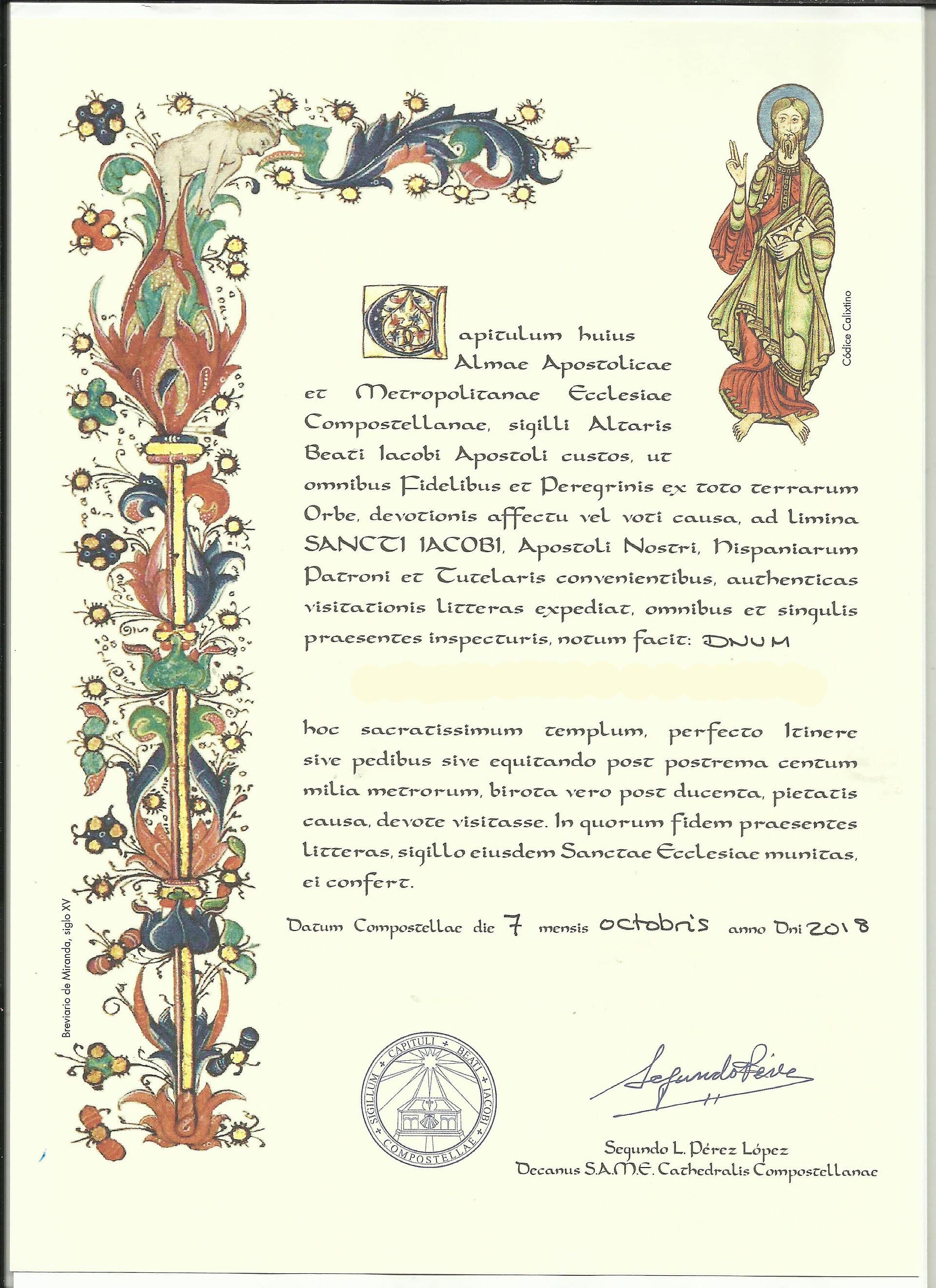
Here's a distinction plenty of people don't discover until they're standing at the counter, and it is told wrong almost everywhere — by us too, until August 2026. There are three separate documents, not two.
- The Compostela, free, in Latin. It requires declaring a religious or spiritual motivation, captured in the formula devotionis affectu, voti vel pietatis causa.
- The Welcome Certificate, also free. This is what you receive if you walked for reasons that aren't religious or spiritual. It records that you reached the Cathedral, and asks for the same minimum: 100 km on foot or 200 by bike.
- The Distance Certificate, €3, and this is the one people confuse. It replaces neither of the others: it's an additional document anyone can buy at the same office once they already hold the Compostela or the Welcome Certificate. It comes on parchment paper, slightly larger, and adds the day and place you started, the distance walked, your arrival date and the route. The price is published by the Pilgrim's Office itself.
There's nothing wrong with taking the Welcome Certificate instead of the Compostela. It simply answers honestly what actually brought you here.
The Pilgrim's Reception Office
It's at Rúa das Carretas, 33 (also accessible via García Sabell), a short walk from the Cathedral. Open every day from 9:00 to 19:00, with the sole exception of 25 December and 1 January. The queue system runs on a ticket and QR code that lets you track your place from your phone instead of standing in line the whole time; in high season, though, same-day collection isn't guaranteed, so if you're racing a flight or train, build in some margin. The contact phone is +34 981 568 846, and for email queries: oficinadelperegrino@catedraldesantiago.es or credencialesperegrinos@catedraldesantiago.es.
If what you want is to work out how long the queue will be, the Pilgrim's Office publishes the Compostelas it hands out each day, and we read our figures straight from that panel: how many pilgrims arrive in Santiago, by day, by month and by route. It tells you whether your arrival date falls on a peak or a lull, which is the difference between half an hour and coming back tomorrow.
What happens after you collect the Compostela
Document in hand, the natural next step is to cross Praza do Obradoiro and step into the Cathedral for the pilgrim's mass, see whether the Botafumeiro swings that day, and give the traditional embrace to the Apostle. All of that — including the restoration works that are shifting schedules through 2025 and 2026 — is covered in detail in our guide to arriving in Santiago.
Frequently asked questions
What's the minimum distance I need to walk?
100 continuous km on one recognised route, on foot or on horseback (or 200 km by conventional bicycle — e-bikes don't count), as long as the final stage arrives at the Cathedral. If you began on foot outside Spain on a recognised route, the Office publishes only a floor: the continuous kilometres on Spanish soil shall not be less than 70. It does not say whether the total must still reach 100; we have asked and had no answer.
How many stamps do I need in my credencial?
At least two stamps a day within the 100 km that count towards the Compostela on foot (or the 200 km by bike), and one daily stamp for the rest of the route. The Pilgrim's Office website never uses the phrase 'two stamps a day', which is why many pilgrims think the rule does not exist, but it does publish it: its Compostela page says anyone walking only the minimum distance 'must always get a stamp at the start and at the end of each stage, including the date' (checked on 28 August 2026). Start and end of a stage is two stamps a day.
What's the difference between the Compostela and the Distance Certificate?
There are three documents and they get mixed up constantly. The Compostela is free and requires declaring a religious or spiritual motivation. Anyone who doesn't declare it receives the Welcome Certificate, which is also free and asks for the same 100 km on foot or 200 by bike. The Distance Certificate replaces neither: it costs €3, you buy it separately at the same office once you already hold one of the others, and it adds where and when you started, the distance and the route.
Where and when do I collect the Compostela in Santiago?
At the Pilgrim's Reception Office, Rúa das Carretas 33, open every day from 9:00 to 19:00 (closed 25 December and 1 January). You take a ticket and follow a QR-code queue.
Do I have to walk the whole Camino in one go?
No: you can complete it in phases and across separate trips, as long as the stretch that adds up to 100 km on foot (or 200 km by bike) into Santiago is walked in one continuous go and its final stage is the one that reaches the Cathedral. The catch: walking Logroño to Burgos and then walking in separately from Lavacolla, for instance, doesn't qualify, because that final stretch doesn't complete the 100 km count.
Where do I get the credencial before I start walking?
At the Reception Office, at authorised parish churches, at Friends of the Camino associations, or at many albergues along the route, for 1 to 10 € depending on the issuer. The free Credencial Digital del Peregrino app is also an option.
Keep reading
Choose your route
All Camino routes, compared
Distance, stages and difficulty for every route, so you can work out whether you'll reach the required minimum.
Journey's end
What to do on arrival in Santiago
The pilgrim's mass at the High Altar, the embrace of the Apostle, and why the Botafumeiro is out of action right now.
The destination
The Cathedral of Santiago: hours and tickets
Everything on the Pórtico de la Gloria, the museum and guided visits, with updated official prices.