Practical guide · September 2026
Eating on the Camino: kitchen hours, the menú del día and where to buy food on the last 100 km
You arrive at six, hungry, and the kitchen is closed; at nine, when the good restaurant opens, the albergue is about to lock its door. In between, ham and bread. This page explains when Galicia actually eats, what separates the menú del día from the pilgrim menu, and which towns on the four final routes have a supermarket, a bakery or a greengrocer, counted from OpenStreetMap rather than from memory.
- Lunch
- 13:30-15:30 approx.
- Dinner
- from 20:30 approx.
- Pilgrim menu
- €12-18 (readers)
- Sunday
- shops shut in the afternoon
By Cesar Rodriguez · updated
On this page
In the third week of September 2026 five threads appeared on r/CaminoDeSantiago within two days about the same thing, and no guide answers it in one place: when you can get a hot meal, why the restaurants everyone recommends open at nine at night, whether the pilgrim menu is a rip-off, and where to buy a salad that didn't come in a bag. The most upvoted comment of the lot, at 58 points, puts it bluntly: «the pilgrim menus are a scam, ask for the menú del día». It's partly right and partly a misunderstanding, and the first thing to grasp is the timetable, because nearly everything else follows from it.
When Galicia eats (and why there's no kitchen at six)
The usual pattern in a Galician town, and broadly across Spain, is this, with the caveat that every bar does as it pleases and August changes everything:
- Breakfast, from 7 or 8. Bars open early and breakfast is coffee with toast, a pastry or a slice of tortilla. It's the cheapest meal of the day and almost always the easiest to find; in the hamlets on the Francés there are bars that open before the albergue you're leaving does.
- Lunch, 13:30 to 15:30 or 16:00. This is the window when the kitchen is on and there's a set menu. Before half past one you'll be told «the kitchen isn't open yet»; after four, «it's closed».
- In between, the bar counter. From four until half past eight a bar serves a bocadillo, tortilla, a tapa or a ración of whatever it has, but not a cooked dish and not a menu. It's the hour most pilgrims arrive, and the hour when the «lots of ham and bread» complaint comes true.
- Dinner, from 20:30 or 21:00. An ordinary restaurant, the one locals use, doesn't fire up the kitchen at night before then. So the place someone recommended on the forum «opens at nine»: it isn't opening late, it's opening at Spanish dinner time.
- The exception: albergue towns. In Portomarín, Palas de Rei, Arzúa, O Pedrouzo and the stage ends on the other routes, many places serve the pilgrim menu from seven or half past, because albergues lock their doors around ten and nobody sits down to a starter at nine. That early dinner exists by and for pilgrims, and it's why in those same towns the «good» restaurant and the pilgrim-menu one are so often two different places.
All of this is indicative: it's custom, not a published timetable, and a village bar run by one person closes when it's their turn to eat. If the kitchen matters to you on a given day, the question on arrival is «what time is the kitchen open?», not «are you open?».
Menú del día and pilgrim menu: not the same thing
Both have the same shape: a starter, a main, bread, a drink and dessert or coffee, at a fixed price. The difference is who it's for and when.
- The menú del día is the weekday lunch, Monday to Friday, and it's what people who work in the town eat. It usually has several choices of starter and main chalked on a board, and it's only offered in the lunch window. At weekends many places drop it or charge more.
- The pilgrim menu (menú del peregrino) is the same format, but built for someone who arrives mid-afternoon and eats at seven: it's served in the evening too and in many places at any hour, every day, sometimes with less choice — the dishes that hold well in a kitchen and go out fast to twenty people at once. It costs €12 to 18, with €15 the figure that comes up most: that's what our readers report, and we publish it as indicative, not as a tariff.
With that in hand, the advice pilgrims give on the forums makes more sense: if you're eating at midday on a weekday, ask for the menú del día, which costs the same or less and is usually better, because the town eats it. The pilgrim menu isn't a scam; it's what exists at seven in the evening, and at that hour there's no competition. Whoever calls it a rip-off is usually comparing a pilgrim dinner in Arzúa with the lunchtime menu at a roadside bar, and those are two different products. What is true, and the real budgets we collected say so, is that prices climb as you near Santiago: the coffee and tortilla that cost €4 early on the Francés go for €7-8 on the last stages.
Where to buy food: supermarkets, bakeries and greengrocers, town by town
The question underneath almost every thread is where to buy fruit, vegetables or the makings of a dinner. These tables count, for the stage ends and larger towns on the four routes that enter Galicia on their last 100 km, how many supermarkets, bakeries, greengrocers, restaurants and bars OpenStreetMap has mapped within 700 m of the point where the Camino passes, as of 16 September 2026. The chains that keep appearing are Froiz, Dia, Eroski, Gadis, Covirán, Familia and Mercadona; in the smaller towns the supermarket is a Covirán, a Claudio or a grocer's with its own name.
Camino Francés, Sarria to Santiago
| Town | Supermarkets | Bakeries / greengrocers | Restaurants / bars |
|---|---|---|---|
| Sarria | 6 | 3 / 5 | 17 / 41 |
| Portomarín | 4 | 1 / 0 | 8 / 7 |
| Palas de Rei | 3 | 2 / 0 | 5 / 5 |
| Melide | 5 | 5 / 4 | 13 / 28 |
| Arzúa | 4 | 3 / 1 | 11 / 12 |
| O Pedrouzo | 3 | 1 / 0 | 7 / 8 |
| Santiago de Compostela | 6 | 17 / 25 | 155 / 168 |
Sarria and Melide are the towns on this stretch with the most greengrocers; Arzúa has one on the map, and Portomarín, Palas de Rei and O Pedrouzo have supermarkets but no mapped greengrocer, so there fruit comes from the supermarket or from Sarria. Melide is also where most pilgrims choose to eat a hot lunch, for the octopus.
Camino Portugués, Tui to Santiago
| Town | Supermarkets | Bakeries / greengrocers | Restaurants / bars |
|---|---|---|---|
| Tui | 6 | 2 / 0 | 12 / 16 |
| O Porriño | 7 | 10 / 6 | 15 / 35 |
| Redondela | 5 | 2 / 2 | 9 / 14 |
| Pontevedra | 15 | 14 / 9 | 72 / 66 |
| Caldas de Reis | 2 | 1 / 2 | 9 / 14 |
| Padrón | 4 | 1 / 1 | 14 / 15 |
| O Milladoiro | 5 | 4 / 3 | 8 / 20 |
| Santiago de Compostela | 6 | 17 / 25 | 155 / 168 |
It's the best-served of the four: it passes through two cities (Pontevedra and O Porriño) and through sizeable towns, and there is no night without a supermarket if you sleep at the stage ends. Caldas de Reis is the thinnest entry on the list and still has everything.
Camino Inglés, Ferrol to Santiago
| Town | Supermarkets | Bakeries / greengrocers | Restaurants / bars |
|---|---|---|---|
| Ferrol | 2 | 3 / 1 | 12 / 24 |
| Pontedeume | 2 | 4 / 1 | 7 / 19 |
| Betanzos | 6 | 12 / 2 | 24 / 42 |
| Hospital de Bruma | 0 | 0 / 0 | 1 / 0 |
| Sigüeiro | 3 | 2 / 3 | 6 / 10 |
| Santiago de Compostela | 6 | 17 / 25 | 155 / 168 |
Camino Primitivo, Lugo to Santiago
| Town | Supermarkets | Bakeries / greengrocers | Restaurants / bars |
|---|---|---|---|
| Lugo | 5 | 7 / 7 | 61 / 85 |
| Melide | 5 | 5 / 4 | 13 / 28 |
| Arzúa | 4 | 3 / 1 | 11 / 12 |
| O Pedrouzo | 3 | 1 / 0 | 7 / 8 |
| Santiago de Compostela | 6 | 17 / 25 | 155 / 168 |
From Melide the Primitivo walks along the Francés, so the last three rows are the same. What differs is the two days between Lugo and Melide, through hamlets where the map records no shop at all: whatever you want to eat in San Román da Retorta or As Seixas, you buy in Lugo.
Vegetables and fruit: the most repeated complaint
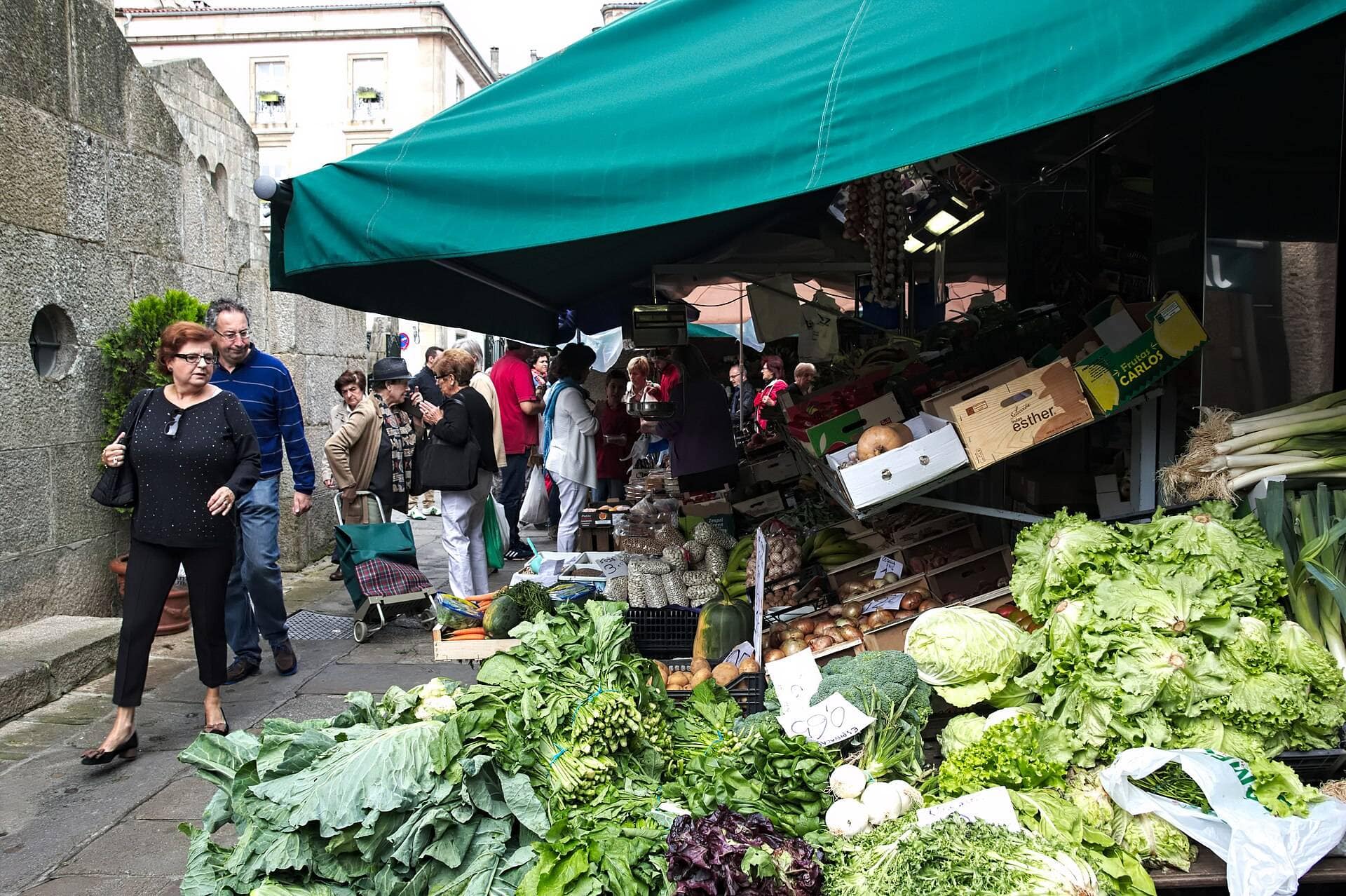
«Vegetable gardens everywhere and not a vegetable on the plate» is, word for word, the complaint that drew the most votes after the one about menus. It's fair, and there's a reason: the plots you see from the Camino are for home use, and their grelos and beans go to the family kitchen, not the bar's. A Galician set menu is meat, fish and potato, and vegetables turn up as a side — the peppers, the salad — not as a dish.
That said, there's more than it looks if you know what to ask for. Caldo gallego is a soup of turnip greens or cabbage, potato and white beans, and it's on almost every menu in the cold months; it's made with pork fat and often a bit of chorizo or ham, so it's vegetables but not vegetarian unless they make it separately. The ensalada mixta exists in every bar, and ordered without tuna it's lettuce, tomato, onion, egg and olives. Pimientos de Padrón are on the menu from summer into early autumn, which is their season, and on the Portugués you walk through Padrón itself. And empanada comes as tuna, meat, salt cod with raisins or scallop almost everywhere, and as vegetable only in some bakeries, which is where to ask.
The rest gets solved by shopping, and it's what the pilgrims who write about it do: the bagged salad, the fruit and the yoghurt from the supermarket in the table above. What you can no longer take for granted is cooking: as a reader warned in the budget survey, albergue kitchens are getting rarer, and a plan built on a hot dinner every night needs checking albergue by albergue before you buy the pasta.
Eating vegetarian on the Camino
It can be done, by asking, and without expecting a vegetarian menu as such outside the cities. What a village bar will have for certain is tortilla de patatas (ask whether it has onion or chorizo, which it sometimes does), ensalada mixta without tuna, Padrón peppers in season, cheese — tetilla, or Arzúa-Ulloa, which is where you're walking through — with quince paste or honey, and bread. On a set menu you can ask for two starters instead of a starter and a main, and hardly anyone will argue. The Galician menu is meat and fish, and in a village of two hundred people there is no second menu: that's what there is, not a lack of goodwill. Vegan is a different league — cheese and eggs are half of the vegetarian answer in Galicia — and there the supermarket and the cities (Lugo, Pontevedra, Santiago) do the work the villages can't.
Sundays, holidays and the weekly closing day
The general rule, worth writing down: small supermarkets close on Sunday afternoon and many all day Sunday, and in a village the one that opens on Sunday morning is one. Public holidays are the same or worse. If your Sunday stage ends in a hamlet or your plan is a supermarket dinner, shop on Saturday. In cities and the bigger stage ends there's usually a chain open on Sunday morning, but don't count on the afternoon. And bars and restaurants generally close one day a week — often Monday or Tuesday — which no app shows reliably: the mesón in Presedo, on the Inglés, closes on Mondays, and it isn't the only one.
Frequently asked questions
What time is dinner on the Camino de Santiago?
In an ordinary Galician restaurant the evening kitchen starts around 20:30-21:00, which is Spanish dinner time. In the albergue towns (Portomarín, Palas de Rei, Arzúa, O Pedrouzo and the stage ends on the other routes) many places serve the pilgrim menu from 19:00-19:30, because albergues lock their doors around 22:00. It's custom, not a published timetable: ask «what time is the kitchen open?».
What's the difference between the menú del día and the pilgrim menu?
The format is the same: starter, main, bread, drink and dessert at a fixed price. The menú del día is the weekday lunch and it's what locals eat; the pilgrim menu is also served in the evening and at all hours in Camino towns, sometimes with less choice. It costs €12 to 18 according to our readers, with €15 the most common figure. If you're eating at midday on a weekday, order the menú del día.
Can you eat vegetarian on the Camino?
Yes, by asking and without expecting a vegetarian menu outside the cities: tortilla de patatas, ensalada mixta without tuna, Padrón peppers in season, cheese with quince paste, vegetable empanada where a bakery makes it, and two starters instead of a starter and a main. Caldo gallego is made with pork fat and often chorizo, so it doesn't count unless made separately. The Galician menu is meat and fish; vegan is harder and leans on supermarkets and the cities.
Is there a supermarket in Hospital de Bruma?
No. OpenStreetMap records 0 supermarkets and 0 bakeries in Hospital de Bruma, the end of the third stage of the Camino Inglés, and only 1 restaurant; the stage page adds the Casa Graña bar next to the albergue. Whatever you want for dinner or breakfast, buy it in Betanzos before setting off, and do it early, because the stage has eleven kilometres without a bar.
Are supermarkets open on Sundays on the Camino?
Small ones generally close on Sunday afternoon and many all day; in cities and the bigger stage ends there's usually a chain open on Sunday morning. Public holidays are the same or worse. If your Sunday stage ends in a hamlet, shop on Saturday.
How this was put together. The meal times are the general customs of Galicia and Spain, written as indicative and without opening hours for any particular place. The pilgrim-menu and coffee-and-tortilla prices are the ones our readers reported in the September 2026 budget survey and on the FAQ page; we've added none. The shop counts are from OpenStreetMap (ODbL), as of 16 September 2026, within 700 m of the point where the Camino passes through each town, and only towns where the map is complete enough not to mislead are published. The complaints and advice quoted come from five r/CaminoDeSantiago threads in the third week of September 2026. If a supermarket in the table has closed, or you've found a greengrocer the map doesn't see, the correction button at the foot of the page gets it to us.
Related guides
What people actually spend
How much does the Camino cost per day?
Sixteen real budgets, from €30 to €120 a day, and the cost nobody plans for.
The final stretch
The last 100 km: crowds and how to handle them
What changes from Sarria, and why sleeping outside the standard stage towns fixes most of it.
What to carry
The pilgrim's packing list
What you actually need, with weights, and what stays at home.
Before you set off
Camino FAQ
Budget, insurance, credential, cash machines, bedbugs and albergue etiquette, with figures.