Camino de Santiago statistics
How many pilgrims arrive in Santiago today
The official Camino statistics, starting with the last closed day's figure, read straight from the Pilgrim's Office dashboard and refreshed every six hours, with the day-by-day series of the last few weeks. And behind it, the whole year: 530,987 pilgrims in 2025, the highest figure ever recorded.
By Cesar Rodriguez · updated
Last closed day
How many pilgrims arrived on 17 September
3,160
pilgrims collected their Compostela in Santiago on Thursday 17 September, the last day the Pilgrim’s Office has closed.
21
days with no new data from the panel
2,870
a day on average, last three weeks
3,785
the busiest day, 11 September
| Day | Pilgrims |
|---|---|
| Friday 4 September | 3,611 |
| Saturday 5 September | 3,307 |
| Sunday 6 September | 3,252 |
| Monday 7 September | 2,782 |
| Tuesday 8 September | 2,587 |
| Wednesday 9 September | 2,678 |
| Thursday 10 September | 3,238 |
| Friday 11 September | 3,785 |
| Saturday 12 September | 3,525 |
| Sunday 13 September | 2,916 |
| Monday 14 September | 2,641 |
| Tuesday 15 September | 2,413 |
| Wednesday 16 September | 2,432 |
| Thursday 17 September | 3,160 |
Download the full daily series (CSV), from 1 January last year.
There is no figure for today, and nobody has one. The Pilgrim’s Office dashboard closes the previous day. Right now there is no figure for yesterday either: the dashboard has not loaded a new day since 17 September, 21 days ago, and the Pilgrim’s Office has not said why. The number above is the latest it publishes, not yesterday’s. This page reads that dashboard directly and refreshes every six hours. One thing worth knowing before you use these numbers: the date is the day the Compostela was issued in Santiago, not the day anyone set out. For arrivals that is exactly right; for «how many started in Sarria in October» it is not, because from Saint-Jean the gap is about five weeks.
2025, a record year
530,987
pilgrims received the Compostela in 2025, the official certificate that records having completed the Camino.
+6%
more pilgrims than in 2024
53.45%
were women
57%
came from outside Spain
By route
Almost half walk the Camino Francés
| Route | Pilgrims | % of total |
|---|---|---|
| Camino Francés | 242,040 | 45.6% |
| Portugués Central | 100,815 | 19.0% |
| Portugués Coastal | 89,512 | 16.9% |
| Camino Inglés | 30,205 | 5.7% |
| Camino Primitivo | 27,873 | 5.25% |
| Camino del Norte | 21,521 | 4.05% |
| Vía de la Plata | 8,838 | 1.7% |
| Camino de Invierno | 2,759 | 0.5% |
| Muxía-Fisterra | 2,382 | 0.4% |
The split by route comes from the Pilgrim's Reception Office dashboard, read on 25 August 2026, and the percentages are worked out against that same dashboard's total: 530,844. There is a discrepancy here worth saying out loud: the office's January 2026 press release gave 530,987, the headline figure at the top of this page and the one everyone quotes, while the dashboard adds up to 530,844 — 143 fewer pilgrims. Nobody has made a mistake: the office keeps cleaning up records for months after the year closes, so the exact figure moves depending on the day you read the dashboard. The nine routes in the table add up to 525,945; the remaining 4,899are not a nameless remainder, and from today we spell them out: the dashboard splits them into nine smaller buckets, led by «other routes» (1,677), followed by 892 pilgrims who did not state a route, Geira e Arrieiros (757), Camino del Barbanza (755), Muros-Noia (572), Camino del Mar (179), Miñoto Ribeiro (30), San Rosendo (24) and Vía Céltica (13). That «other routes» bucket is where the Camino de Madrid lands, among other historic routes: 323 km of waymarked trail with its own albergues that the dashboard has never broken out, so nobody knows how many people walk it.
Trend
One more year of growth
| Year | Pilgrims |
|---|---|
| 2024 | 499,241 |
| 2025 | 530,987 |
The year under way
2026 is heading for another record
With the Holy Door opening on 31 December, 2026 is working as the run-up to the Holy Year: 395,963 Compostelas were issued between January and August, 6% more than the same period of 2025. August alone accounted for 84,861, the second busiest month in the whole series: only August 2022, a Holy Year, is ahead, and by 980 Compostelas.
There is a far fresher figure than the ones in this table, and it does not come from the panel: on 4 October 2026the Cathedral announced that the Pilgrim’s Office had issued the 500,000th Compostela of this year, handed over by the archbishop to a Mexican pilgrim who had walked from Sarria on the Camino Francés. Read it for what it is: not a cleaned-up monthly close like the ones above, but the Office’s own live count on the day it crossed the round number. It is useful for placing the pace — the panel is still stuck on the 444,255 of 17 September, so right now this is the most recent figure that exists — not as a replacement for the series. Cathedral announcement.
You will also run into another, much larger figure, and it measures something else. On 22 September 2026 the Xunta announced that «the sensors installed at various points along the Camino put the number of pilgrims this year at 736,000», while the Compostelas in that same release stood at 454,000. The two do not contradict each other: one counts people who collect the Compostela in Santiago, the other estimates footfall along the routes, which includes anyone walking a single stretch, anyone short of the 100 km, anyone who arrives and never asks for the certificate, and anyone carrying on to Finisterre or Muxía. The release says so itself: «not everyone who walks the route collects the accreditation at the end». The ratio the Xunta works with is about 1.6 to 1.7 pilgrims per Compostela— in total, not «extra» — so that larger number is largely the Compostelas multiplied by that factor, not a head count. Two honest caveats you will not find elsewhere: the Xunta has published that factor with three different values between 2025 and 2026, and it has never published the methodology, so there is no public record of whether the sensors count passes, distinct people or footfall. That is why the figure this page leads with is the Compostela, which can be counted one by one.
| Period | 2025 | 2026 |
|---|---|---|
| January–August | 372,051 | 395,963 |
| August | 77,110 | 84,861 |
Pilgrim's Reception Office figures as of 31 August 2026.
Per day
How many pilgrims arrive in Santiago today
The last closed day is at the very top of this page: 3,160 pilgrims on 17 September. What follows is the context that figure cannot give on its own, because a daily number without a season beside it cannot be read. Across the whole of 2025 the totals give 1,450 Compostelas a day on average, but the average misleads: the Camino is seasonal and the gap between February and August is enormous. The most recent closed month, August 2026, works out at around 2,740 a day — against 2,490in the same month of 2025 — and at the height of summer there are days well above that average. It is the order of magnitude worth having if you are going to queue at the Pilgrim's Office or look for a bed without booking in summer.
| Period | Compostelas | Daily average |
|---|---|---|
| Full year 2025 | 530,987 | 1,450 |
| August 2025 | 77,110 | 2,490 |
| August 2026 | 84,861 | 2,740 |
The daily averages are our own calculation from the official totals, not a figure the office publishes: they are indicative. The month-by-month breakdown and the figure for today are published by the office itself on its statistics dashboard.
Route and month
How many people you will actually meet, by route and month
The two tables above each answer half the question: one says how many people walk each route over a whole year, the other how many arrive each month across all routes. What almost nobody publishes is the cross-tab, which is exactly what you want before booking a flight. Here it is, for the five months when the Camino empties out.
| Route | August | September | October | November | December |
|---|---|---|---|---|---|
| Francés | 34,499 | 35,645 | 29,895 | 5,433 | 1,477 |
| Portuguese Central | 14,693 | 15,744 | 11,556 | 2,109 | 680 |
| Portuguese Coastal | 11,173 | 16,071 | 11,493 | 1,456 | 450 |
| Inglés | 5,103 | 4,790 | 2,797 | 548 | 222 |
| Primitivo | 5,218 | 4,261 | 3,000 | 501 | 132 |
| Norte | 3,976 | 3,075 | 2,381 | 473 | 100 |
| Vía de la Plata | 1,115 | 847 | 850 | 223 | 99 |
The pattern is the same on all seven routes, and it is sharper than it feels from the inside: October to November drops between 74% and 87%, depending on the route. There is no gradual slide from summer into winter, there is a step, and it always falls in the same place. If what you want is to walk without queuing for a bunk, the first week of November is already a different Camino; if what worries you is finding things open, that is precisely when they stop being open. What closes and when is in the season guide.
Computed by us from the official dashboard, not transcribed. These are dates of Compostela issue in Santiago, that is of arrival rather than departure: someone leaving Sarria in late October counts in November, and so does someone leaving Saint-Jean in late September. The Winter Way and Muxía-Fisterra are left out, their monthly figures being too small for the month to mean anything.
Starting point
Where people started walking in 2025
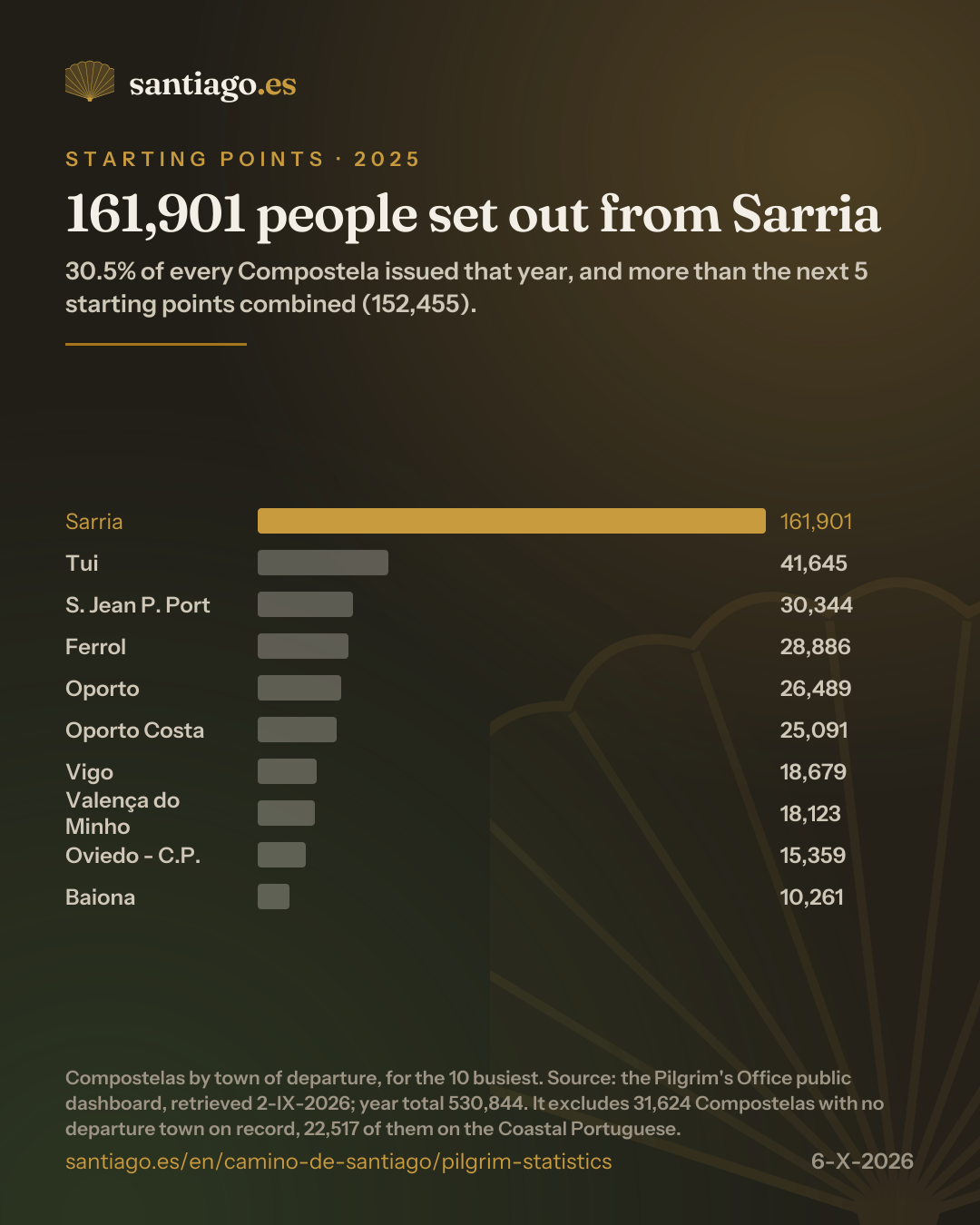
This is the figure that most reassures anyone setting off afraid of the crowds, because it says where the crowd is and where it is not. 161,901 people started in Sarria: 30.5%of all the year's Compostelas and 66.89% of those on the Camino Francés. Saint-Jean-Pied-de-Port, the start you see in the films, contributed 30,344. Put the other way round: whoever starts in Saint-Jean walks three weeks almost without a queue and meets it in the last quarter of the trip; whoever starts in Tui or Ferrol never sees it.
| Starting point | Route | Compostelas | % of the year |
|---|---|---|---|
| Sarria | Francés | 161,901 | 30.5% |
| Tui | Portuguese Central | 41,645 | 7.85% |
| S. Jean P. Port | Francés | 30,344 | 5.72% |
| Ferrol | Inglés | 28,886 | 5.44% |
| Oporto | Portuguese Central | 26,489 | 4.99% |
| Oporto Costa | Portuguese Coastal | 25,091 | 4.73% |
| Vigo | Portuguese Coastal | 18,679 | 3.52% |
| Valença do Minho | Portuguese Central | 18,123 | 3.41% |
| Oviedo - C.P. | Primitivo | 15,359 | 2.89% |
| Baiona | Portuguese Coastal | 10,261 | 1.93% |
| Lugo - C.P. | Primitivo | 9,391 | 1.77% |
| León | Francés | 7,604 | 1.43% |
Official Pilgrim's Office dashboard, read on 2 September 2026; percentages over the dashboard total that day (530,844). The dashboard labels the two departures from the city «Oporto» and «Oporto Costa», by the Central and the Coastal route. A further 31,624 Compostelas on the Portuguese Coastal have no recorded starting town and are left out.
Who walks
Who actually walks the Camino: age, sex and means of travel
Three cuts of the dashboard that rarely get published, each of which corrects an expectation. The first: the Camino is not a trip for twenty-somethings. In 2025 the over-65s numbered 60,664, a little more than one pilgrim in nine (11.43%), and putting the two top bands together — 46 to 65 and over 65 — takes you past half the year: 267,430 people, 50.38%. At the other end there are more than you notice on the path: 46,722 under-18s, 8.8% of the year.
| Age band | Pilgrims | % of the total |
|---|---|---|
| Under 18 | 46,722 | 8.8% |
| 18 to 45 | 216,692 | 40.82% |
| 46 to 65 | 206,766 | 38.95% |
| Over 65 | 60,664 | 11.43% |
The second: there are more women than men, and not by a hair. 284,902 women against 245,942 men, that is 53.67% against 46.33%. It is not a one-year blip either: women are the majority in all four years the dashboard breaks down, from 2023 on.
| Sex | Pilgrims | % of the total |
|---|---|---|
| Women | 284,902 | 53.67% |
| Men | 245,942 | 46.33% |
And the third, the one that changes most plans: cycling is a narrow minority. 21,083 pilgrims arrived by bike in 2025, 3.97%, against 494,743 on foot (93.2%). And it is not only small: it is fewer bikes than in 2023 (23,694) even though the dashboard has added 84,751 Compostelas over those two years. Fewer people arrive by bike every year while the Camino grows. The rest of the split is small in number and not for that reason irrelevant: 725 on horseback, 310 by sail and 257 by wheelchair.
| Means | Pilgrims | % of the total |
|---|---|---|
| On foot | 494,743 | 93.2% |
| By bike | 21,083 | 3.97% |
| Not stated | 13,726 | 2.59% |
| On horseback | 725 | 0.14% |
| By sail | 310 | 0.06% |
| By wheelchair | 257 | 0.05% |
2026 is still running, so it is not compared with a closed year: the dashboard stood at 395,963 Compostelas from January to August when we read it. On that basis the split barely moves — 53.7% women, 3.75% by bike — and the one visible change is that the under-18s (41,315, 10.43%) have moved ahead of the over-65s (40,675, 10.27%), which in 2025 was the larger of the two bands. With autumn uncounted that does not mean anything yet.
Official Pilgrim's Office dashboard, read on 2 September 2026. All the Camino de Santiago statistics on this page are worked out from that dashboard, not transcribed, and the percentages in these three tables are our own arithmetic, not a figure the office publishes: they are taken over the dashboard total for each year (530,844 in 2025 and 395,963 in 2026, January to August), and every cut adds up to exactly that total, so nobody is left over or missing. Two caveats. One: the means-of-travel split has 13,726 Compostelas from 2025 with no means recorded, and they stay in the table as "not stated" rather than being spread across the other rows. Two: the dashboard's split by sex gives 53.67% women, two tenths above the 53.45% in the January 2026 press release quoted elsewhere on this page, for the same reason as the total: the office keeps cleaning up records months after the year closes.
On this page
What these numbers actually say
The striking part is not the record itself — every year has beaten the one before since 2012, apart from the pandemic pause — but who is doing the walking. For the first time in a settled way, most pilgrims are not Spanish: 228,527 were Spanish, 43% of the total, which leaves the other 302,460— 57% — arriving from abroad. That second number is our own subtraction, not a published figure: the press coverage of the report says "more than 297,000 foreigners", correct as a floor but it does not add up to the total. We use the subtraction because it is the only one that reaches 530,987. The gender balance has flipped too: women are now 53.45% of pilgrims against 46.55% of men, unthinkable two decades ago, when the Camino was overwhelmingly male. We wrote up what the 2025 record means for anyone walking now as a separate piece, including the month that is actually the busiest.
The stated motivation does not quite match the cliché of the purely religious pilgrim either. Around 44% say they walk for strictly religious reasons and 32% combine faith and culture, but 18.58% declare non-religious reasons — cultural or sporting — and another 5.29% leave the question blank, which are two different things and the dashboard keeps them apart. The Camino is a Christian pilgrimage in origin, and it stopped being only that a long time ago.
The split by route holds few surprises at the top: the Camino Francés takes 45.6% of pilgrims, almost one in two, on the strength of its infrastructure and its reputation. Fourth place does say something: the Camino Inglés, which leaves from Ferrol and is walked in five stages, drew 30,205 pilgrims, 5.7%, ahead of both the Primitivo and the Norte despite being the shortest route that still earns the Compostela. Further down there is a surprise. The Camino Primitivo is the fifth busiest route with 27,873 pilgrims, 5.25%, and the Camino del Norte the sixth with 21,521, 4.05%: a gap of 6,352 pilgrims, 29.5% more for the Primitivo. They are not level, though in 2023 they very nearly were, 20,715 against 20,583. The Norte was the larger of the two every year from 2003 to 2020; the Primitivo overtook it in 2021 and has been pulling away since. And the Norte is not having one bad year: its share has fallen for nine straight years, from 6.22% in 2016 to 3.81% so far in 2026, and between January and July it is down 2.1% while the routes as a whole are up 5.5%. All of this has a very concrete effect on the ground. The final stretch from Sarria, where most people join to cover the minimum 100 km the Compostela asks for, carries a crowding you do not feel at all over the first 600 km, where you can walk for hours without meeting anyone. And the busiest month is not July: in 2025 it was September (81,546 compostelas), followed by May (78,657) and August (77,110); July came fifth, with 67,063. Anyone after quiet does well to look at June or the second half of October, to read the real Camino calendar, or to pick less travelled routes such as the Primitivo or the Vía de la Plata, where the summer peak is not even the same one: in July 2026, 83 people set off from Seville and 1,174 from Ourense.
The other figure worth carrying if you are planning a trip: 2027 is a Holy Year, the first since the extraordinary 2021-2022 cycle and the nearest one after this 2025 record. Nobody has published a forecast of how many that will be, and the figures going around are not what they look like: how many pilgrims are expected in the 2027 Holy Year. Previous jubilee years point to heavier traffic still, with more pressure on albergues and accommodation over the summer months, above all on the final stretch from Sarria. If the plan is to walk in a Holy Year, booking ahead — outside the public albergues, which take no reservations — stops being optional.
Where these Camino de Santiago statistics come from, and where they do not
Everything on this page comes from the Pilgrim's Reception Office (Oficina de Acogida al Peregrino, Archdiocese of Santiago), which counts every Compostela it issues. The breakdown by route, starting point, age, sex and means of travel is above on this page, worked out from the office's own dashboard rather than copied from a summary; the only figure we still take from its annual report is the split by nationality. Two things are worth knowing before you quote any of it:
- There is no documented public API.The office's own dashboard is an embedded Power BI, and we used to say here that it refused non-browser clients. It does not: its backend answers a plain request and returns the full breakdown by route, year, month, age, sex and reason for walking. The route figures on this page were read from it on 25 August 2026. The 2026 monthly figures still come from the office's statements to the Galician press in August 2026, and we are moving the rest off hand-transcription, because copying numbers by hand is how we published the Camino del Norte's total as if it were the Primitivo's.
- The daily averages are ours, not the office's. The office publishes totals; dividing a monthly or annual total by its number of days is our arithmetic, rounded to the nearest ten. Treat it as an order of magnitude, not as an official count — the real spread between a February day and an August day is wide enough that no single average describes both.
Everything else — annual totals, the split by route, the gender and nationality shares — is the office's own published figure, and we say so each time rather than round it into something tidier.
How to cite these figures
The figures are the Pilgrim's Reception Office's: annual totals from its report, and the day-by-day series from its public dashboard, which this page reads directly every six hours. If you use a figure, the source is the office. If the cleaned-up series or the arithmetic we do on top of it (averages, route shares, the foreign-pilgrim subtraction) is what you need, cite this page.
- The daily series, as CSV: peregrinos-diarios-santiago.csv, one row per day from 1 January last year to the last closed day, two columns (date and pilgrims). It regenerates with the page.
- To cite: “Pilgrim's Reception Office, via santiago.es (https://santiago.es/en/camino-de-santiago/pilgrim-statistics)”, with the date you looked it up.
- Before you publish: each row's date is the day the Compostela was issued in Santiago, so arrivals, not departures. And the series summed day by day does not match the official annual total to the pilgrim (the dashboard is missing 1 January 2025, for one): for a full year, use the report's total.
- Need a cut that isn't here? By route, country, month or starting point, the dashboard has it. Email rasekrodriguez9@gmail.comand we'll pull it for you.
Frequently asked questions
How many pilgrims arrive in Santiago each year?
In 2025, 530,987 pilgrims arrived with a Compostela, the highest figure recorded so far and 6% more than in 2024. The trend has been sustained growth for more than a decade, with the pandemic as the exception.
Which route is the most popular?
The Camino Francés, with 45.6% of pilgrims in 2025. Next come the two variants of the Camino Portugués, Central and Coastal, which together account for close to 36%.
Are there more men or more women walking the Camino?
In 2025 women were clearly the majority for the first time: 53.45% against 46.55% of men.
What is the Xacobeo 2027?
The Xacobeo, or Holy Year, falls whenever 25 July, the feast of Saint James, lands on a Sunday. The next one is 2027, and a Holy Year usually brings even heavier pilgrim traffic than an ordinary year, with more pressure on albergues and accommodation.
How many pilgrims have arrived so far in 2026?
From January to August 2026, 395,963 Compostelas were issued, 6% more than in the same period of 2025. If the pace holds, 2026 will beat the annual record again, before the 2027 Holy Year even starts.
How many pilgrims arrive in Santiago today?
There is no figure for today, and nobody has one: the Pilgrim's Reception Office dashboard closes the previous day. The last closed figure is 17 September, when 3,160 pilgrims arrived in Santiago, and this page reads it from the official dashboard every six hours. For the rest of the year: August 2026 worked out at around 2,740 Compostelas a day and the average across the whole of 2025 was far lower, about 1,450 a day, because the Camino is strongly seasonal: September, May and August are the busiest months and winter drops away sharply.
For websites and blogs
Put these figures on your own site
If you write about the Camino, you can embed our figures card for free — the 2025 record, the 2026 pace and the countdown to the Xacobeo — by copying this code. The card updates itself whenever we add a new figure from the Pilgrim's Office; all we ask is that you keep the attribution link. The card text is in Spanish, but the numbers are the same ones on this page. See the widget.
<iframe
  src="https://santiago.es/widget/peregrinos"
  width="360" height="440" loading="lazy"
  style="border:0;border-radius:12px;overflow:hidden"
  title="The Camino de Santiago in figures — santiago.es">
</iframe>
Quick answers on the headline figures
How many pilgrims arrived in Santiago in 2025?
530,987 pilgrims received the Compostela in 2025 according to the Pilgrim's Reception Office: the highest figure ever recorded, above the 499,241 of 2024.
Which Camino route has the most pilgrims?
The Camino Francés, with 242,040 pilgrims in 2025, 45.6% of the total. Then the Portugués Central (100,815) and the Portugués Coastal (89,512). These are the figures on the Pilgrim's Office dashboard as read on 2 September 2026, whose total is 530,844.
Is 2026 on course for a record?
395,963 Compostelas were issued from January to August 2026, more than in the same period of 2025. With the 2027 Holy Year about to start, everything points to a new record.
Keep reading
Choose your route
All Camino routes, compared
Distance, stages, difficulty and character of the eight main routes into Santiago.
The Holy Year
Xacobeo 2027, explained
What a Holy Year is, when the Holy Door opens, and what it usually does to pilgrim numbers.
Full guide
The Camino de Santiago
Routes, the credencial, albergues and everything worth knowing before you set off.