Choosing a route
Every Camino route, side by side
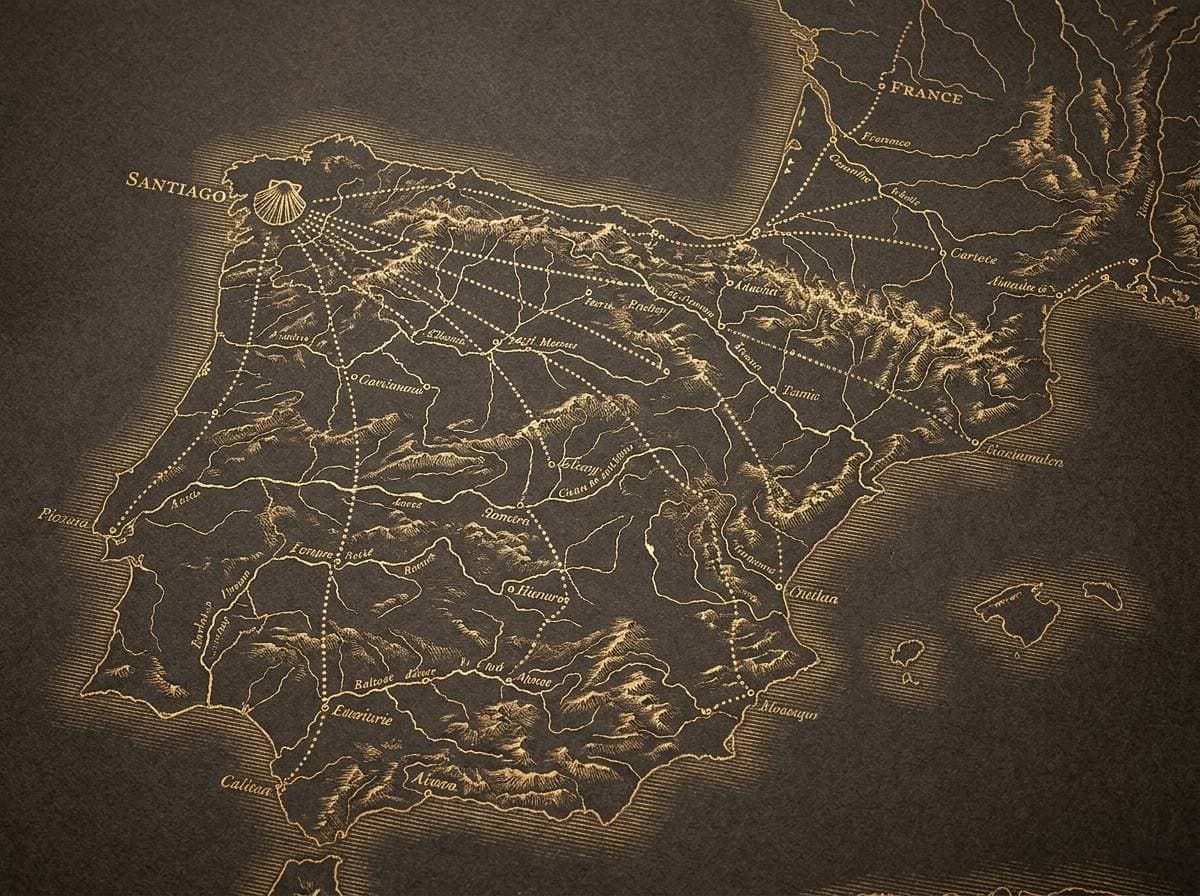
Eight roads into Santiago, one that runs into another, and one that leaves the city. Here are the distances, the days and the character of each route, so you can decide with your eyes open.
By Cesar Rodriguez · updated
On this page
There's no single "best" route — there's the one that fits the time you have, your fitness, and what you're actually looking for. The table has ten rows: the eight routes that reach Santiago, the Camino de Madrid, which does not get there on its own but runs into the French Way at Sahagún, and, at the bottom, the walk out to Fisterra and Muxía, which goes the other way and does not count towards the Compostela. The percentages come from the Pilgrim's Office dashboard for 2025, read on 25 August 2026 and worked out against that dashboard's own total of 530,844; the distances are the sum of our own stage tables, which is what you can check for yourself in each guide. Below, we get into the character of each one, which is where the real difference shows between ten days across the Castilian meseta and five along the Galician coast.
| Route | Distance | Typical days | Usual start | Difficulty | % of pilgrims 2025 |
|---|---|---|---|---|---|
| Camino Francés | 763-771 km from Saint-Jean · 114.2 km from Sarria | 33 stages (5-6 weeks) | Sarria (67% of its pilgrims), Saint-Jean-Pied-de-Port | Tough at the start (Pyrenees), then moderate | 45.6% |
| Portugués Central | 613-621 km from Lisbon · 116 km from Tui | 25-26 days from Lisbon · 6 stages (5-6 days) from Tui | Lisbon, Porto or Tui | Low-moderate | 19.0% |
| Portugués Coastal | 271 km from Porto | 13 stages | Porto, A Guarda or Baiona | Low | 16.9% |
| Camino Inglés | 111.5 km from Ferrol | 5 stages (4-7 days) | Ferrol | Low-moderate | 5.7% |
| Camino Primitivo | 306-311 km from Oviedo | 14 stages (11 to Melide) | Oviedo | High | 5.25% |
| Camino del Norte | 820-831 km from Irún | 36 stages (5-6 weeks) | Irún | High | 4.05% |
| Vía de la Plata | ~960-1,000 km from Seville | 36-38 stages (38-45 days) | Seville | High (distance and heat) | 1.7% |
| Camino de Invierno | 260-263 km from Ponferrada | around 10 stages | Ponferrada | Moderate-high (Ribeira Sacra) | 0.5% |
| Camino de Madrid | 323 km to Sahagún, where it joins the French Way | 13 stages | Madrid | High in the sierra, moderate after | not broken out |
| Fisterra-Muxía | 87-118 km (after reaching Santiago) | 3-6 days | Santiago | Low | 0.4% |
Camino Francés: the classic, for good reason
Nearly half of 2025's pilgrims walked this route, and it's no accident. It is 763.7 km over 33 stagesfrom Saint-Jean-Pied-de-Port, adding up Gronze's table day by day — up to 770.9 km if you go via Samos — and it crosses the Pyrenees on day one: 24.2 km with 1,419 metres of climb, the toughest stage of the entire route and rightly the most feared. It then eases into the Castilian meseta, where the challenge changes: no longer elevation but monotony and blazing summer sun. It turns serious again on the final stretch, between Villafranca del Bierzo and O Cebreiro, with a demanding climb at the gateway into Galicia. It's also the route with the most infrastructure: albergues every few kilometres, flawless waymarking, and the certainty of never quite walking alone.
And it is the route where the question that matters is not how long it is but where to start it: two of every three of its pilgrims set out from Sarria and only one in eight from Saint-Jean. What is left to Santiago from each start, how many people actually leave from each one, and what you gain and lose in every case is in our guide to the whole Camino Francés. If your stretch is the final one, we cover the five days from Sarria one by one in the Sarria to Santiago stages.
Camino Portugués: flat, in two flavours
The Portugués splits into two variants that share an origin but not a landscape. The Central route runs inland from Lisbon or Porto, with gentle elevation — our source data puts the maximum climb per stage at around 400 metres — passing through Tui before entering Galicia. The Coastal route follows the shoreline from Porto, with beach stretches and very little climbing, and it is not the short option many people assume: from the same Porto it is about 30 km and three days longer than the Central. Together the two variants account for more than a third of all 2025 pilgrims, and they converge at Redondela to share the final stretch into Santiago. The whole Coastal route — the 13 stages from Porto, the boat that crosses the Minho between Caminha and A Guarda, and how it differs from the Central — is in our Portuguese Coastal Way guide. From Pontevedra there's also the Spiritual Variant, a roughly three-day detour that follows the ría to Vilanova de Arousa, includes a stretch by boat along the Ulla river — the one that re-enacts the legend of the Apostle's traslatio — and rejoins the Portugués Central at Padrón. We cover it in full in the Spiritual Variant guide.
Camino Inglés: the short one that starts in Ferrol, not A Coruña
Here's a detail that catches out anyone who doesn't already know it: A Coruña sits 72.4 km from Santiago adding up the stages, below the general 100 km minimum for the Compostela, so anyone who starts walking there and wants the certificate has to set off from Ferrol, 111.5 km out: that is what our five stages add up to, and the same total gronze.com gives. It's a short route, five stages — four if you push, six or seven if you would rather not — well waymarked, and with fewer people than the Francés or Portugués — ideal for anyone with little more than a week to spare.
Camino Primitivo: the oldest, and it shows
This is the original route: the path King Alfonso II followed in the 9th century from Oviedo to venerate the newly discovered tomb of the Apostle. Oviedo to Melide is 253 km measured stage by stage — 257.7 km if you drop down to Pola de Allande instead of taking the Hospitales day — and Melide to Santiago is another 53 or so along the stretch shared with the Francés. That is where the 306-311 kmrange in the table comes from: it is the sum of our own stage table, not a borrowed figure. You will see up to 317 km elsewhere, because each guide splits the stages differently and they do not all start counting from the same point in Oviedo. It's also, by consensus among guides and pilgrims alike, the toughest of all: eight of its eleven Asturian and Galician stages climb more than 500 metres. In exchange, it offers some of the most solitary and least "themed" scenery on the entire Camino. We cover it in full in the Camino Primitivo guide, with the climb on every stage and why you start from Lugo — which is a bare 100 km in five days, the last 53 of them shared with the Francés. Anyone wanting another quiet stretch before setting out can first walk the Camino de San Salvador, a roughly 120 km branch between León and Oviedo, mountainous and fairly solitary, that joins the Primitivo right at its Oviedo starting point. It doesn't have its own guide here, but one pilgrim finishing it in August 2026 recommended it without reservations to anyone after a quieter route.
Camino del Norte: the Cantabrian coast, without a break
From Irún, right against the French Basque border, to Santiago runs 820 to 831 km hugging the Cantabrian Sea. The elevation is constant — in and out of every ría, up every headland — and the stretch through the Basque Country and Cantabria demands legs already broken in. In return, it delivers sea views no other route offers so consistently. The «~34 stages» quoted everywhere reach Arzúa, not Santiago: there are 36. The day-by-day breakdown, with the climb on each one, the four water crossings and why starting at Baamonde leaves just 500 metres of margin for the Compostela, is in our Camino del Norte guide.
Vía de la Plata: the route of solitude
At nearly 1,000 km from Seville, it's the longest route and the least walked: just 1.7% of 2025's pilgrims. The stages are long, towns are scarce, and summer is ruled out outright by the extreme heat of Extremadura, which can push past 35-44 °C. Those who choose it usually do so for exactly that reason: to walk full days without crossing paths with another pilgrim.
Camino de Invierno: the detour that skips O Cebreiro
It starts in Ponferrada and skips the climb to O Cebreiro by heading south along the Sil valley, entering Galicia through Las Médulas and the Ribeira Sacra before joining the Camino Sanabrés on the way into Santiago. That's, according to the sources we've been able to check, between 260 and 263 km over around 10 stages — plenty for the Compostela. It began as the variant pilgrims used whenever snow closed O Cebreiro, and today it's one of the least walked of the recognised routes — so minor it doesn't even show up as its own category in the official statistics — which is exactly what makes it a serious alternative to the crowding on the final 100 km of the Francés. We cover it in full, with its toughest stretches and what to know before deciding, in the Camino de Invierno guide.
Camino de Madrid: the sierra, and then Castile
It leaves from a church in central Madrid and never reaches Santiago: it runs into the French Way at Sahagún, 323 km and thirteen days later. Its big day is the fourth, crossing the Sierra de Guadarrama at the Fuenfría pass, 1,796 metres up on the line of a Roman road, which is the highest point of any pilgrim route in the interior of the peninsula. What follows is a different animal: nine plateau days through Segovia, Valladolid and Tierra de Campos, long and without shade. It is also the only route in this table where we do not know how many people walk it, because the official dashboard does not break it out. The thirteen stages, the albergues and where the water is on the mountain day are in our Madrid Way guide.
Fisterra and Muxía: the road after the road
It doesn't count towards the Compostela because it's walked backwards, out of Santiago towards the coast. It's 87 to 118 km by our own stage table, depending on whether you head to one destination or combine both, spread over 3 to 6 days with no notable elevation. Gronze puts Santiago-Fisterra at 86 km because it splits the last stretch through Corcubión rather than Cee: the difference is in the stage split, not the path. Whoever completes this stretch receives the Fisterrana, not the Compostela, but for many pilgrims standing before the lighthouse at Fisterra — the medieval "end of the world" — is the real close of the journey. We cover it in full in our guide to the Camino to Finisterre and Muxía, with the stages, both certificates and the bus times back.
The Camino starts at your front door: the European routes
Before Spain's "official" routes existed, the Camino was simply the walk from each pilgrim's own house. That network is still alive and waymarked across Europe: Germany's Jakobswege, the French ways from Vézelay, Le Puy, Arles and Tours, and the Via Jacobi crossing Switzerland from Rorschach to Geneva before joining France. If you want to start from Switzerland, the reference resource (in German) is pilgern.ch, with the Swiss stages documented in detail. If what you want is the GPS tracks, camino-europe.eu has the traces, maps and route descriptions for the European ways, free and without asking you to register. Any of these stretches earns stamps in your credential; the Compostela only requires proof of the final 100 km on foot into Santiago.
Frequently asked questions
Which route should I choose for my first Camino?
The Camino Francés from Sarria or the Portugués from Tui are the most recommended options for beginners: they're extremely well waymarked, have infrastructure to spare, and plenty of fellow pilgrims for company.
Which is the most scenic route?
It comes down to taste: the Camino del Norte offers the most consistent sea views, the Primitivo crosses the most solitary mountain landscapes, and the Francés combines varied scenery with the liveliest pilgrim atmosphere.
Which is the hardest route?
The Camino Primitivo has a reputation as the most demanding, thanks to its constant elevation, closely followed by the Camino del Norte. The Vía de la Plata isn't as steep, but its very long stages and extreme summer heat make it hard in its own way.
What's the shortest route to earn the Compostela?
The Camino Inglés from Ferrol (111.5 km) and the Portugués from Tui (116 km) are the shortest options that meet the required 100 km minimum. Both figures come from adding up our own stage tables.
Is it better to start in Sarria or in Tui?
Both have good infrastructure: Sarria (Camino Francés) is five stages and 114.2 km, Tui (Camino Portugués) six stages and 116 km. Sarria tends to have more atmosphere and more pilgrims, being the more popular gateway; Tui offers a flatter profile and is slightly less crowded, though still very well travelled.
Keep reading
Starting point
General guide to the Camino de Santiago
2025 figures, the best months, albergues and everything essential before choosing a route.
Paperwork
The Compostela and the credencial, step by step
Exact requirements depending on the route you choose, stamps, and where to collect it in Santiago.
Sleep
Where to stay in Santiago once you finish
From the 10 € pilgrim albergue to the 1499 Parador: every option for your last night.