What to see
What to see in Santiago de Compostela
You can walk the entire old town in twenty minutes, but it's worth getting lost in it without hurrying. This is the route that actually makes sense, square by square.
By Cesar Rodriguez · updated
On this page
Santiago makes more sense on foot than on a map. The old town, declared a UNESCO World Heritage Site in 1985, is compact: almost everything worth seeing sits within fifteen minutes' walk of the Cathedral, as the map of the old town shows. And a good part of the best of it — the squares, the porticoes, the viewpoints — costs nothing at all. What follows is a route with a logical order, not a loose list of places.
Praza do Obradoiro, the centre of everything
Every visit starts here, and not by convention: it's literally where the four Camino routes converge as they enter the city. The square is enclosed by four buildings that sum up seven hundred years of power in Galicia.
- The Cathedral, whose baroque facade dominates the eastern side.
- The Pazo de Raxoi, opposite, from the late 18th century: it now houses the city council and the presidency of the Galician regional government.
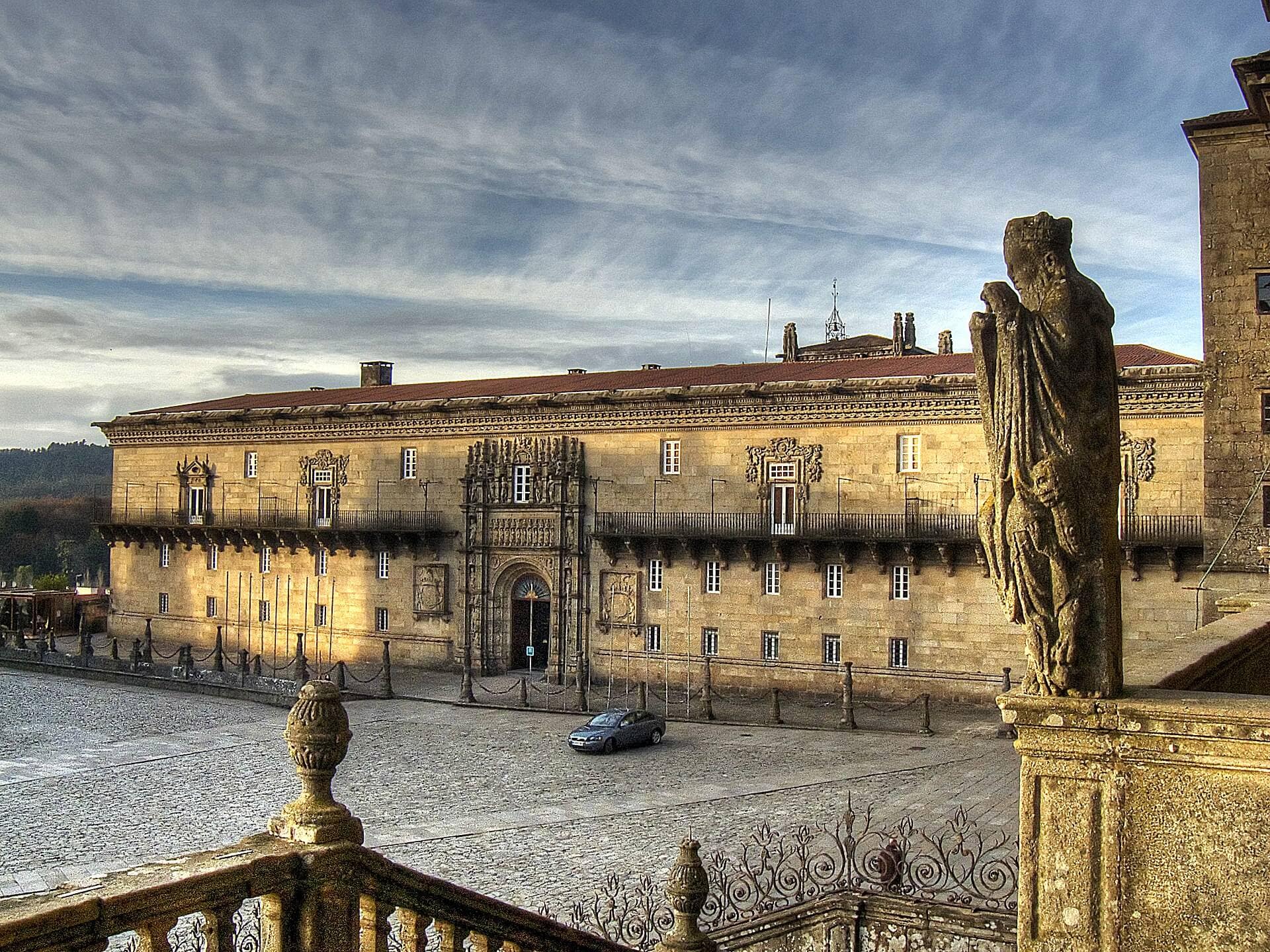
- The Hostal dos Reis Católicos, on one side: the former Royal Hospital founded in 1499 by the Catholic Monarchs to care for sick pilgrims, now a 5-star Parador and considered by many the oldest continuously operating hotel in the world. You can visit the interior (courtyards and chapel) for €3; in winter the visit is unguided, in summer it's guided.
- The Colexio de San Xerome, which closes off the square, now the university's rectorate.
We cover the Cathedral separately, with full detail on hours, prices and the botafumeiro, in the dedicated Cathedral guide. Here it's enough to know that access to the naves is free through the Praterías door, 7:00 am to 9:00 pm.
Praza da Quintana: the square that was a cemetery
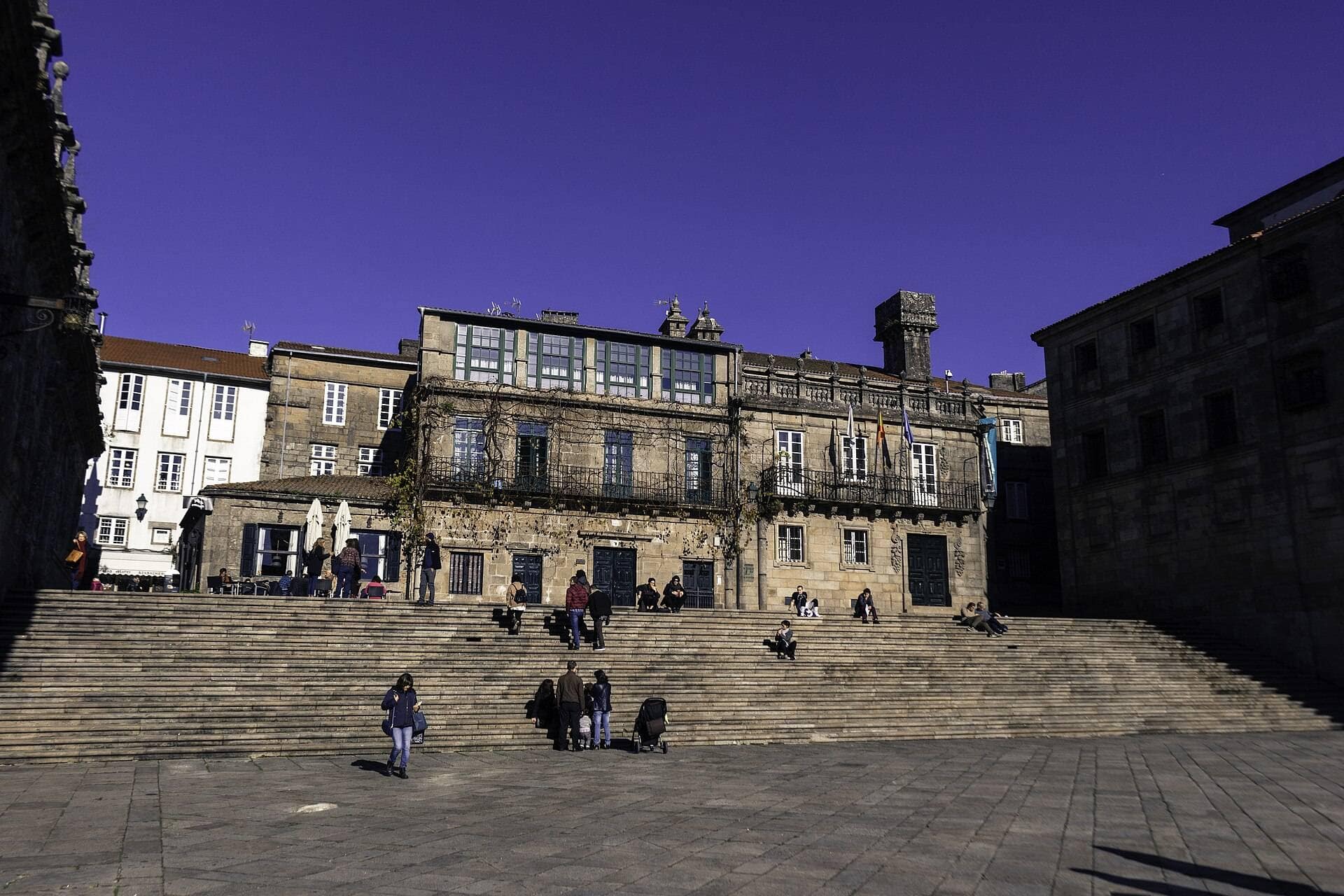
Walking round the Cathedral's east facade brings you to the Quintana, one of the most photographed squares in Spain and, for centuries, far less pleasant than it looks today. It splits into two levels joined by an early-17th-century staircase: the Quintana de Mortos (of the dead), the lower level, which was Santiago's main cemetery from 1075 until 1833, when burials moved to the Boisaca cemetery; and the Quintana de Vivos (of the living), the upper level. On the Cathedral wall facing this square is the Holy Door, which only opens during a Holy Year.
At night, with the stone lit up and the outdoor cafe tables gone, the Quintana is probably the quietest, most striking corner of the old town.
Praza das Praterías and the Fonte dos Cabalos
Heading south brings you to Praterías, the oldest square in Santiago's urban layout: it was laid out by archbishop Diego Gelmírez in the 11th century, and its name comes from the silversmith workshops that occupied it for centuries. At its centre stands the Fonte dos Cabalos, a bronze fountain from 1825 by José Pernas, with four sea horses holding up a female figure bearing the star of Compostela; it used to be known as the Fountain of the Star, and Federico García Lorca immortalised it in his poem Danza da lúa en Santiago. Along with the Pórtico de la Gloria, it's the Cathedral facade with the most sculptural character.
Tapas towards Franco and Vilar
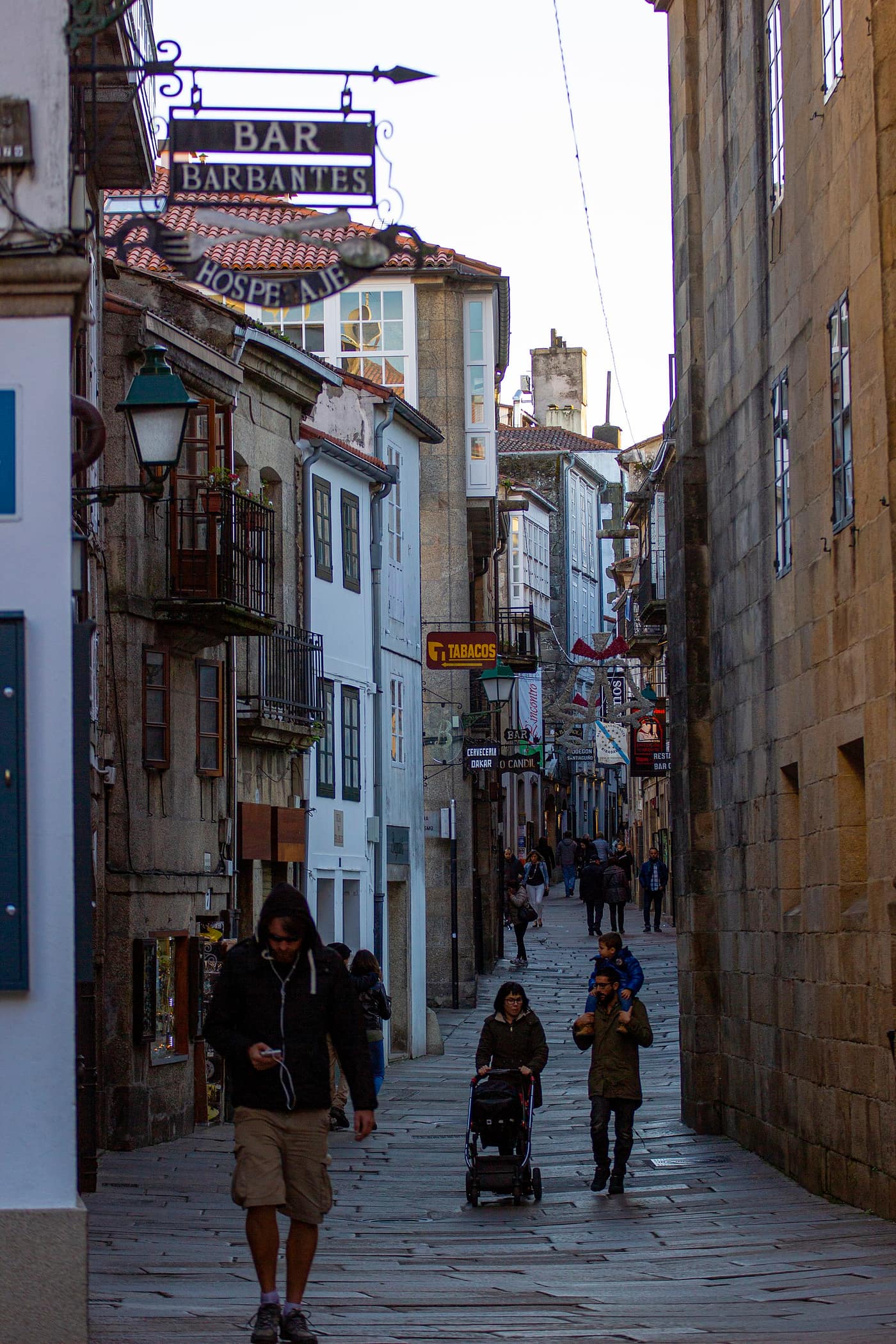
Rúa do Franco — recognised by Condé Nast Traveler as one of the best tapas streets in Spain — leads straight into the Obradoiro and owes its name to the "francos", the foreign pilgrims and merchants who settled here in the Middle Ages. It's home to the Colexio de Fonseca, the first building of the University of Santiago, founded in the first half of the 16th century by archbishop Alonso III de Fonseca. Running parallel is Rúa do Vilar, arcaded, with Renaissance and neoclassical facades and a similar concentration of bars and traditional shops: it's the best street to stop for a morning coffee before the midday rush.
San Martiño Pinario, the Cathedral's great neighbour
Almost touching the Cathedral's north facade stands the Monastery of San Martiño Pinario, one of the largest monastic complexes in Spain after El Escorial. Its church is open Tuesday to Saturday: November to May 11:00 am–7:00 pm, June to October 10:00 am–8:00 pm. Admission costs €4 (€3 reduced), and the guided visit, which includes the Diocesan Museum, costs €6 (€5 reduced), departing at 12:30 pm and 4:30 pm in winter, and 11:00 am, 12:30 pm, 4:30 pm and 6:00 pm in summer.
The Colegiata de Sar, a walk apart
A little away from the tourist core — figure on a fifteen-minute walk from the centre, either down Rúa do Franco or via Rúa do Home Santo — stands the Colegiata de Santa María de Sar, from the 12th century. Its 13th-century cloister preserves nine original arches with capitals attributed to the workshop of Master Mateo, the same sculptor behind the Pórtico de la Gloria. It's open daily 11:00 am–2:00 pm and 4:30 pm–7:30 pm; admission is €2, free if you already hold any Cathedral Museum ticket. It's the visit most rushed tourists skip, and probably the one enjoyed most in silence.
The Mercado de Abastos, the city's real pulse
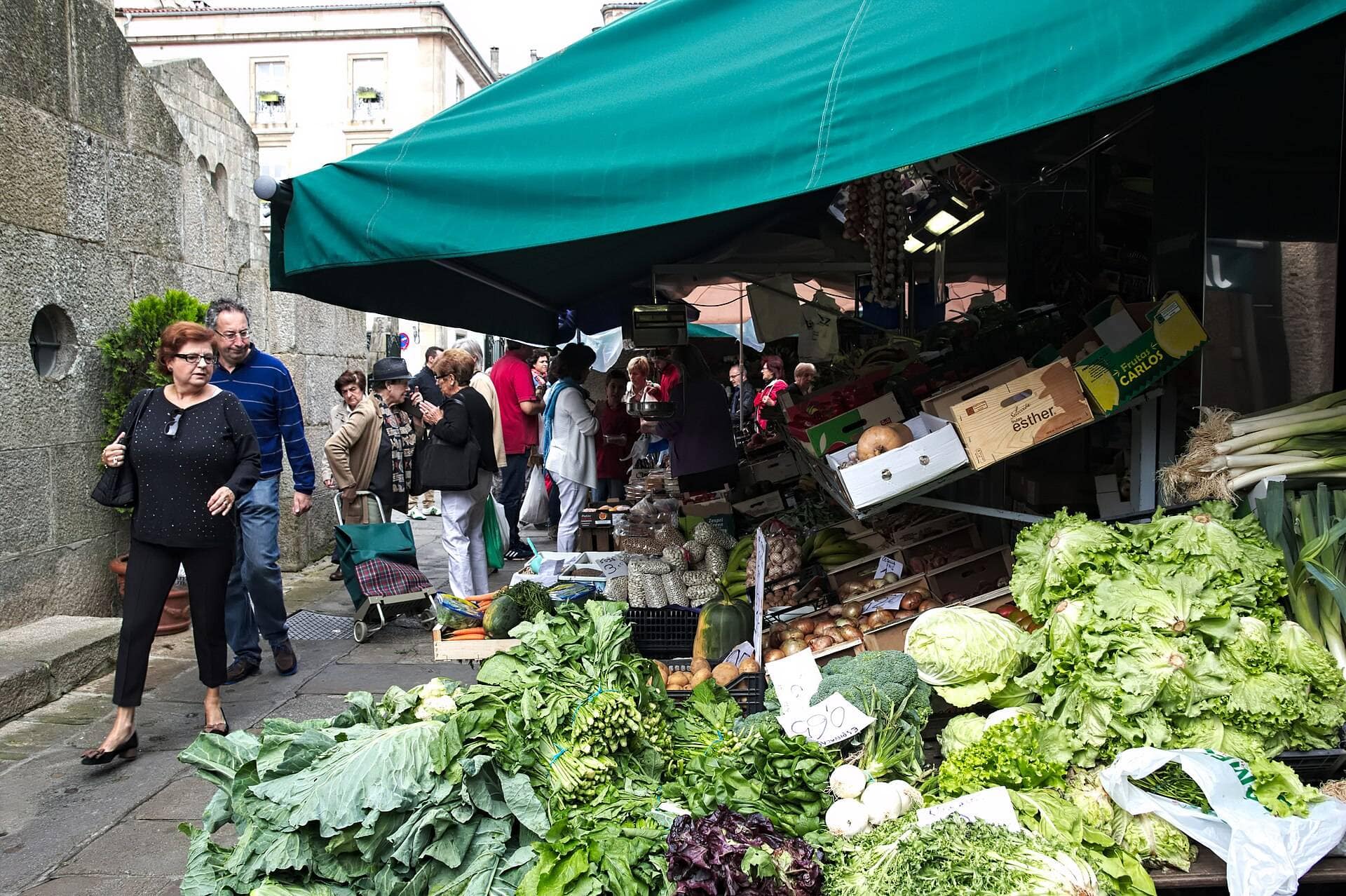
No walk through Santiago is complete without the Mercado de Abastos, open Monday to Saturday 7:00 am–2:00 pm (closed Sundays). This is where the city's restaurants source their fish, shellfish and local vegetables every day, and the liveliest hours run from 9:30 to 12:30, especially on Thursdays and Saturdays. The market's food stalls area is open 11:30 am–5:00 pm.
Museums: Pobo Galego, CGAC and Cidade da Cultura
For the afternoon, three very different options.
- Museo do Pobo Galego, housed in the former convent of Santo Domingo de Bonaval. It traces Galician material culture — trades, music, architecture — and has a triple spiral staircase worth the visit on its own. Open Tuesday to Saturday 11:00 am–6:00 pm and Sundays 11:00 am–2:00 pm (closed Mondays), admission €5, free on Sundays.
- CGAC (Galician Centre for Contemporary Art), right next door, by Portuguese architect Álvaro Siza. Always free, open Tuesday to Sunday 11:00 am–8:00 pm.
- Cidade da Cultura de Galicia, a little further out: Peter Eisenman's complex on Monte Gaiás. Its exhibitions are free and the grounds are open daily 8:00 am–11:00 pm. On weekends there are free guided tours with no booking needed, departing at 11:30 am and 5:30 pm from the information point.
Viewpoints: the Alameda, Monte do Gozo and Monte Pedroso
The classic postcard view of the Cathedral, framed by chestnut trees, is from the Paseo da Ferradura, in the Alameda park, at the so-called mirador dos Namorados (lovers' viewpoint). It's a public park, free to enter, open all day, with three distinct areas: the Paseo da Alameda itself, the Carballeira de Santa Susana, and the Paseo da Ferradura.
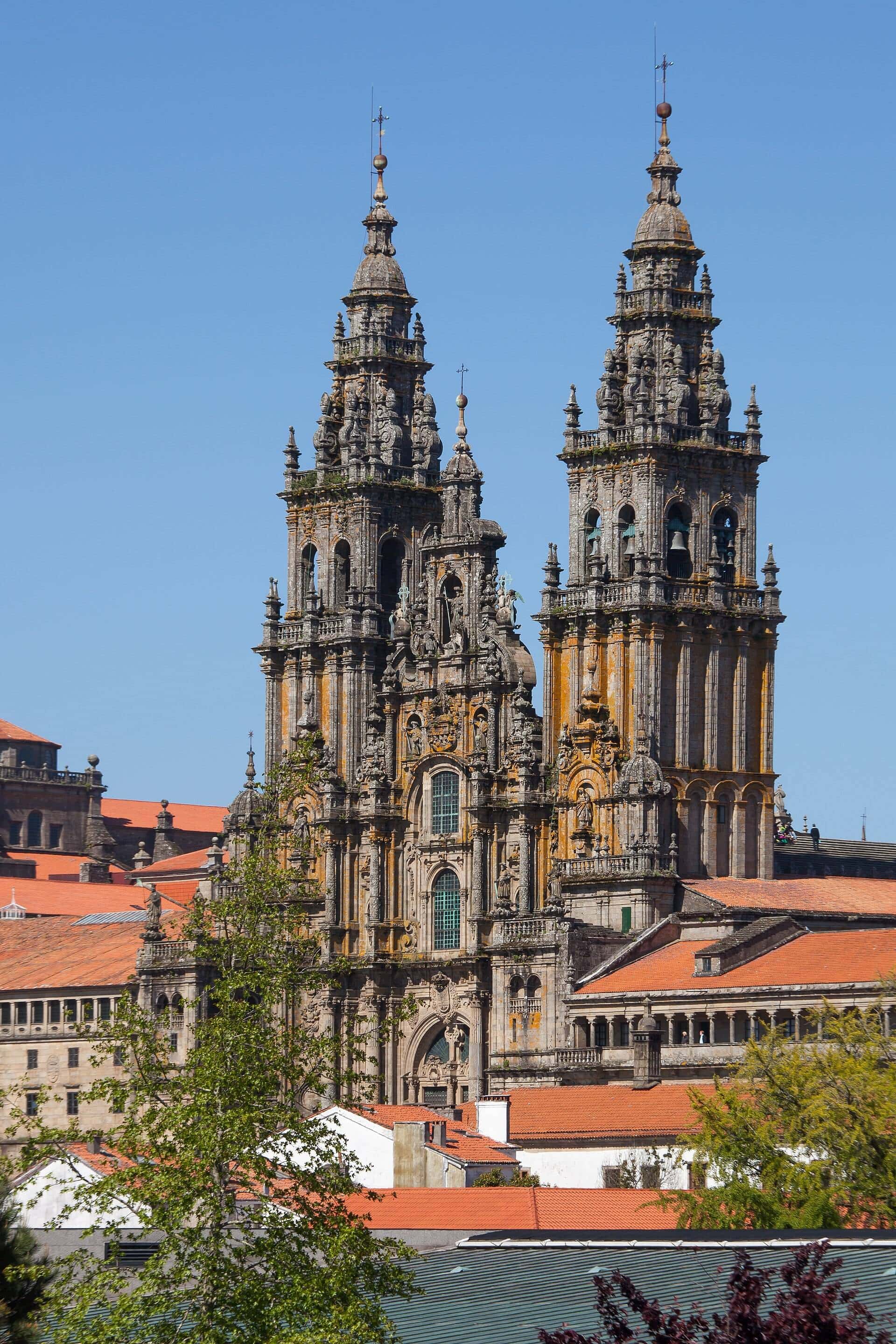
For those arriving on the Camino Francés, Monte do Gozo holds special meaning: it's the point, about 4.6 km from the centre, where the Cathedral's towers come into view for the first time. It's roughly an hour's walk from Praza da Concordia, or reachable by Monbus bus from the San Roque station. Monte Pedroso, about 3 km to the northwest, gives the most complete panorama of the whole city; by car it's about 20 minutes via the Vidán neighbourhood.
Got just one afternoon?
With limited time, the order that works best is this:
- Obradoiro.
- Inside the Cathedral.
- Praterías and the Fonte dos Cabalos.
- Quintana.
- Down Franco, stopping for something to eat.
If you have an extra hour, the Museo do Pobo Galego or the CGAC — both free — are the best use of it. For a more detailed day-by-day plan, the 1, 2 and 3-day itineraries string all this together with real opening hours. And if what you have spare is a whole day rather than an hour, the better return is usually to leave: Padrón is 15 minutes away by train and A Coruña 30-40, so you can go and come back without changing hotel. The options, with times and prices, are in day trips from Santiago.
Frequently asked questions
How many days do you need to see Santiago?
The essentials — the Cathedral and the old town — take one day. To fit in the Cathedral Museum at an unhurried pace, the Mercado de Abastos and a museum or two, two or three days is realistic, which is also what the city's own tourist office recommends.
What can you see for free in Santiago?
The interior of the Cathedral's naves, every square in the old town, the Museo do Pobo Galego on Sundays, the CGAC always, and the Cidade da Cultura's exhibitions always. It's easy to spend a full day without paying for a single ticket.
What's worth booking ahead?
The Pórtico de la Gloria and the rooftop (cubiertas) tour have limited capacity and are worth booking online a few days ahead, especially on weekends or in high season. Details are in the Cathedral guide.
What's the best viewpoint for the Cathedral?
The mirador dos Namorados, on the Paseo da Ferradura inside the Alameda park, gives the classic view through the chestnut trees. For a panorama of the whole city, Monte Pedroso is the better option, though it takes a car or a longer walk.
Is the Cidade da Cultura worth the trip?
If you're into contemporary architecture, or there's an interesting temporary exhibition on, yes: admission is free and Eisenman's building is itself the attraction. As a standalone plan without your own transport, it's skippable next to the rest of the old town.
Keep reading
Essential
The Cathedral of Santiago
Hours, museum prices, the Pórtico de la Gloria, the botafumeiro and the pilgrim's mass, including the 2026 works.
Plan ahead
1, 2 and 3-day itineraries
All of the above strung together with real opening hours, depending on how much time you have.
After the walk
Where to eat in Santiago
Octopus, tapas on Rúa do Franco, and the city's Michelin-starred tables.