Eating and drinking
Where to eat in Santiago de Compostela
From a plate of octopus served on wood at a standing bar to a tasting menu at a Michelin-starred table: that's how Compostela eats, street by street.
By Cesar Rodriguez · updated
On this page
In Santiago people eat two ways at once, and both are equally legitimate: standing up, vermouth in hand, with a plate of octopus at a bar on Rúa do Franco, or sitting down at a long tablecloth in one of the restaurants that have put Galicia on Europe's culinary map. The city doesn't choose between the two. They coexist two hundred metres apart.
The dishes you shouldn't skip
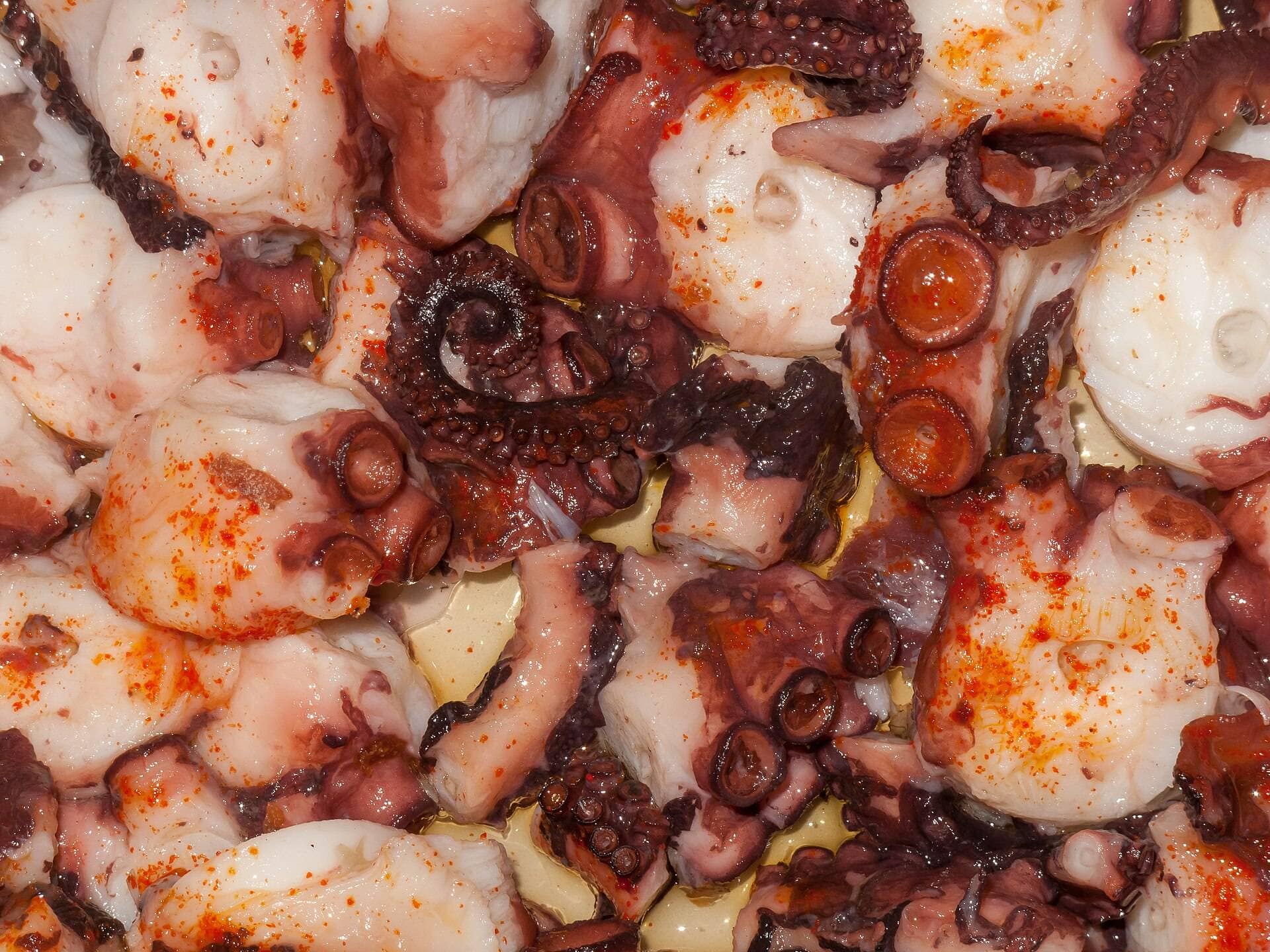
Pulpo á feira (octopus, fair-style) is by far the dish everyone associates with Galicia, and in Santiago it's served the traditional way: boiled, cut with scissors straight onto a wooden plate, dressed with olive oil, coarse salt and sweet and hot paprika. A full portion runs €14-16 in the old town; a half portion, €8-9. You won't have to look hard — almost every tasca downtown has it on the chalkboard, though if you'd rather go in with a plan we've picked out the best pulperías in the city.
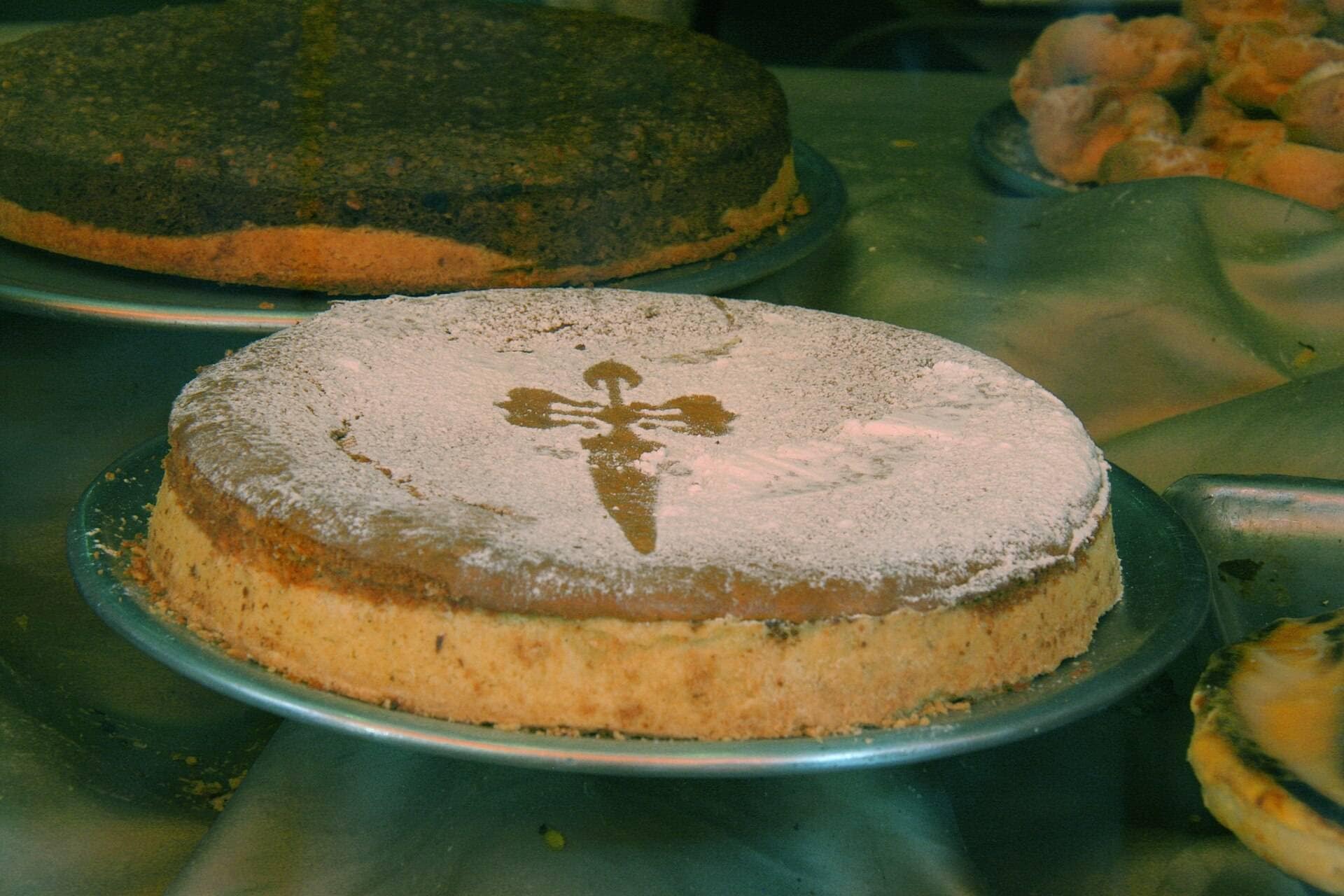
Tarta de Santiago is the city's official dessert, a dense almond cake made with ground almonds, egg and sugar, with a hint of lemon — sometimes cinnamon — finished with the cross of Santiago stencilled in icing sugar. It carries Protected Geographical Indication status, so the recipe doesn't allow much variation: you'll find it in any pastry shop downtown, and in our guide to the best Tarta de Santiago we compare which ones are worth your money.
Other classics worth ordering without hesitation:
- Empanada gallega, a thin-crusted pie filled with a sofrito of onion and pepper plus zorza, tuna, octopus or cod, sold by the slice in bakeries and markets.
- Zorza, pork marinated in paprika, garlic, oregano and white wine, fried and served as a tapa or stuffed into an empanada.
- Pimientos de Padrón, fried and salted, a summer-terrace staple.
- Budget permitting, shellfish — percebes (goose barnacles), nécoras (velvet crabs), centollo (spider crab), prawns, scallops — that arrive fresh each morning at the Mercado de Abastos.
- Lacón con grelos, salted pork shoulder boiled with turnip greens, potato and chorizo: the Carnival dish par excellence, though it appears on traditional menus year-round.
- Queso tetilla, a cone-shaped, mild cheese with its own Denominación de Origen, the perfect way to close any meal.
Two more sweets people ask about that are not the tarta: Pedras de Santiago, almond bonbons from the Pastelaría La Perla workshop, made since 1991 and sold at its two counters in the old town (San Francisco 30 and Rúa do Vilar 79), and the almond cake of the nuns of San Paio de Antealtares, bought through the revolving hatch at the back door: ring the bell, wait, and pay in cash, 9:00-14:00 and 15:00-18:30 (hours are indicative). It is the most Compostelan purchase you can make, and it is not a shop.
Wine, licor café and queimada
Around Santiago there are two wine regions worth knowing. Rías Baixas, with nearly 180 wineries across five sub-zones — Val do Salnés, O Rosal, Condado do Tea, Soutomaior and Ribeira do Ulla — is albariño country, Galicia's signature white: crisp, mineral, with pronounced acidity. Ribeiro, a little further inland, also blends albariño with native varieties like treixadura. Any wine list downtown will carry several glasses from both regions.
To close the meal, two Galician spirits: licor café, orujo brandy macerated with coffee for weeks, and queimada, flambéed orujo with sugar, lemon peel and coffee beans, traditionally stirred while still in flames in a clay bowl as someone recites the conxuro, a Galician incantation to ward off meigas (witches). It's a common after-dinner ritual for groups and celebrations — if you're travelling with a crowd, ask whether the restaurant prepares it.
Where to eat: the tapas streets
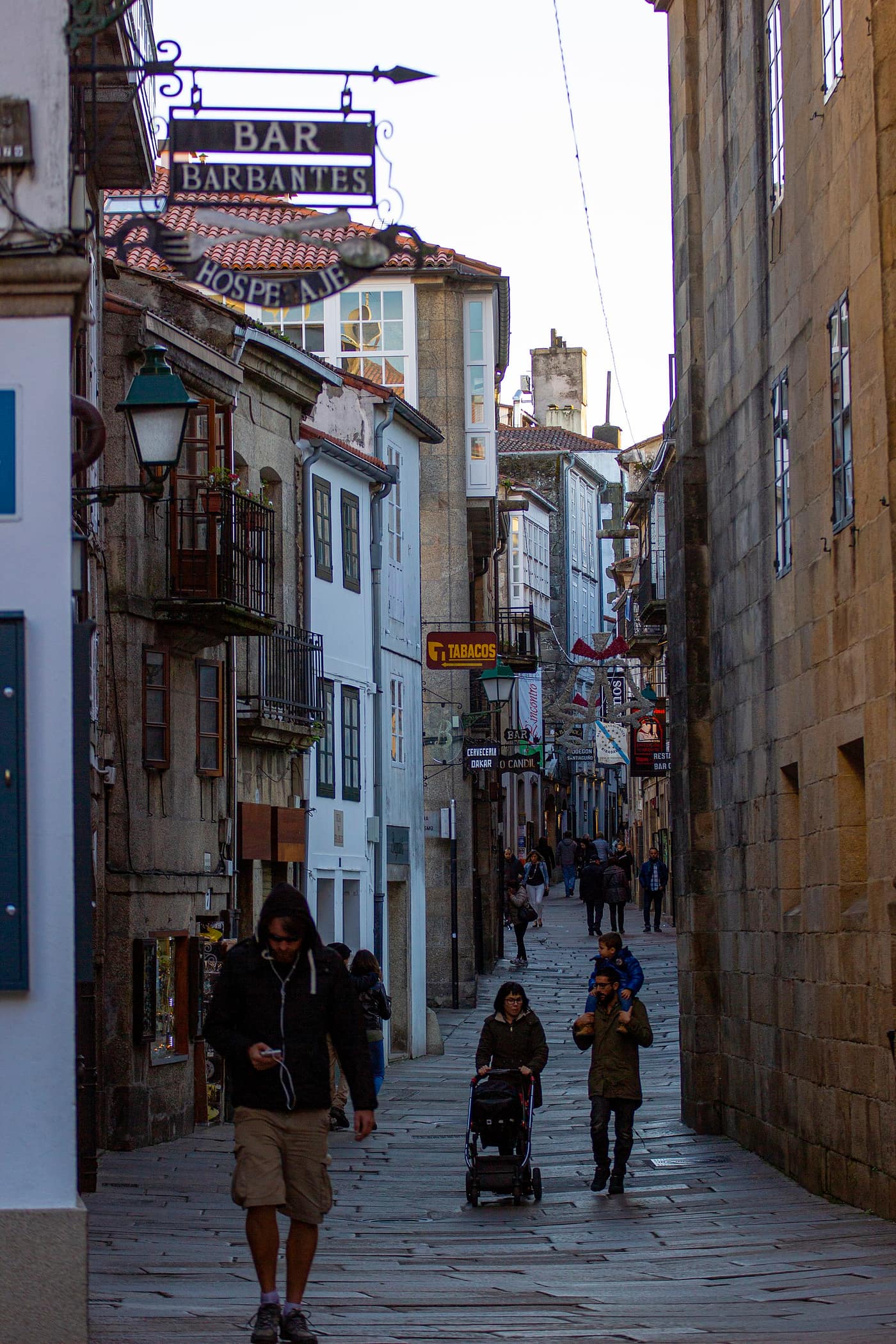
Rúa do Franco and Rúa da Raíña, running parallel just off the Praza do Obradoiro, together hold more than eighty bars and restaurants.
- Rúa do Franco takes its name from the "francos" — foreign pilgrims and merchants — who settled there in the Middle Ages, and today it's the most touristy stretch of the tapas scene: seafood restaurants, octopus bars, terraces.
- Rúa da Raíña offers a similar spread with more of a neighbourhood feel, less shop-window polish and slightly gentler prices.
The unwritten rule is simple: the further you walk from Praza do Obradoiro, the lower the price and the higher the share of local customers.
The Mercado de Abastos
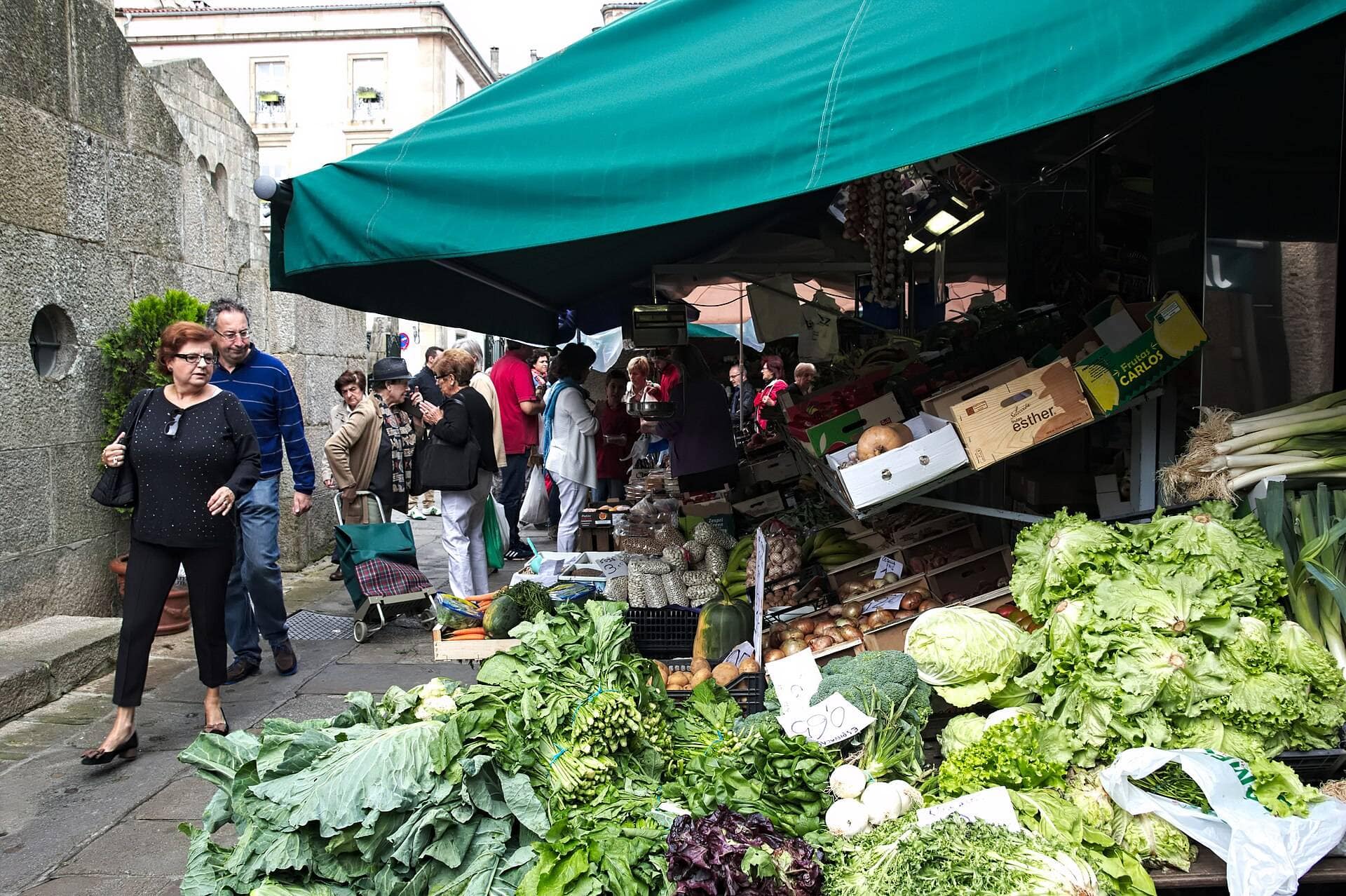
The Mercado de Abastos opens Monday to Saturday mornings. Stalls raise their shutters between 7:00 and 8:00 depending on the trade, and at 14:00 they all close: that hour is the fixed one, and the one that matters if you are walking in. It is the real heart of the city's food supply: fish, shellfish, meat and vegetables that later show up on menus across half of Santiago. Inside the market itself is Abastos 2.0, founded in 2009 by chefs Iago Pazos and Marcos Cerqueiro, who reinterpret the day's produce at a shared table and bar seating around twelve people. It runs by reservation only and offers personalised menus from around €50 per person; it holds a Michelin Plate. If you want to understand at a glance what Galicia eats and why, a walk through the market before noon — when it's busiest — is worth more than any explanation.
The long table: Michelin stars
Santiago has a fine-dining scene more serious than its size would suggest. Casa Marcelo, near Praza do Obradoiro, holds one Michelin Star and a Repsol Sun, with Galician-Asian fusion cooking and a tasting menu — "Rosalía" — around €135 per person. A Tafona, on Rúa da Virxe da Cerca, is chef Lucía Freitas's project: one Michelin Star since 2018 and three Repsol Suns in 2026, built on produce bought the same day at the Mercado de Abastos, with a tasting menu — "Limiar" — around €125. Recently joining that list is Simpar, run by Áxel Smyth and Claudia Merchán, with technical, Galician-rooted cooking and seasonal produce, added to the Michelin Guide in 2025. This is just a sample: the full rundown — twenty-eight addresses across four categories — lives in our guide to the best restaurants in Santiago.
Neighbourhood classics
You don't need to spend much to eat well. Four places that prove it:
- O Dezaseis, on Rúa de San Pedro: a traditional eatery with set menus from €11.50-12 and one clear specialty, chargrilled octopus.
- O Curro da Parra, near the Abastos market: Galician-rooted cooking with creative touches, tapas bar downstairs and dining room above.
- O Gato Negro, open since 1922 on Rúa da Raíña: the city's most storied tavern — a marble counter, rock octopus from Noia, Ribeiro wine served in ceramic cups — and no reservations, you queue like everyone else.
- María Castaña, on Rúa da Raíña: classic Galician cooking with the odd reinterpretation and an inner courtyard that's welcome on sunny days.
What you'll actually spend
A menú del día (fixed-price lunch — starter, main, drink and dessert or coffee) at popular spots downtown runs €10-20. A real example: Mesón O Bombero offers a €19.90 menu that includes caldo gallego, raxo (marinated pork loin) and Tarta de Santiago. At the other end, tasting menus at the city's Michelin-starred restaurants range, per recent reports, from €27 at the simplest proposals to over €130 at the most ambitious.
| Restaurant | What to expect | Indicative price |
|---|---|---|
| Abastos 2.0 | Market cooking inside the Mercado de Abastos, reservation only | Menu from €50 |
| Casa Marcelo | One Michelin Star, Galician-Asian fusion | “Rosalía” menu ≈ €135 |
| A Tafona | One Michelin Star, produce-driven (Lucía Freitas) | “Limiar” menu ≈ €125 |
| Simpar | Technical, Galician-rooted cooking, Michelin Guide 2025 | Check menu |
| O Dezaseis | Traditional eatery, chargrilled octopus | Set menus from €11.50-12 |
| O Curro da Parra | Galician-rooted cooking with a creative touch | Tapas & raciones |
| El Pasaje (Rúa do Franco, 54) | Pulpo á feira and fresh shellfish | Classic seafood house |
| O Gato Negro | Classic, storied tasca | Tapas & raciones |
| María Castaña | Classic Galician cooking, inner courtyard | Tapas & raciones |
Frequently asked questions
Where do you get the best pulpo á feira in Santiago?
Any tasca on Rúa do Franco or Rúa da Raíña will do it justice. A full portion costs €14-16, a half portion €8-9. If you'd rather see it made with produce fresh off the boat, the area around the Mercado de Abastos is a good bet.
How much does it cost to eat in Santiago de Compostela?
A menú del día downtown runs €10-20. For fine dining, tasting menus at the Michelin-starred restaurants go from about €27 at the simplest proposals to over €130 at the most ambitious, like Casa Marcelo or A Tafona.
Where can you try a good Tarta de Santiago?
Any pastry shop in the old town, since the recipe is protected by a Geographical Indication. It's worth trying two or three to compare the balance of almond and lemon.
Are there Michelin-starred restaurants in Santiago?
Yes, two: Casa Marcelo, with Galician-Asian fusion, and A Tafona, chef Lucía Freitas's restaurant. Alongside them, Simpar joined the Michelin Guide in 2025, and Abastos 2.0 holds a Michelin Plate inside the Mercado de Abastos itself.
What is queimada?
A Galician spirit made from flambéed orujo brandy with sugar, lemon peel and coffee beans. It's traditionally prepared by stirring the burning liquid while reciting the conxuro, a Galician incantation against witches, and it's usually kept for group dinners and celebrations.
Keep reading
Visit
What to see in Santiago de Compostela
The cathedral, the old town's squares and the viewpoints worth the walk.
Sleep
Where to stay in Santiago
From the world's oldest hotel to pilgrim albergues: real neighbourhoods and prices.
Events
Festivals and events in Santiago
The Fuegos del Apóstol, music festivals and the city's calendar, month by month.