Before you pack
Santiago's weather and when to visit
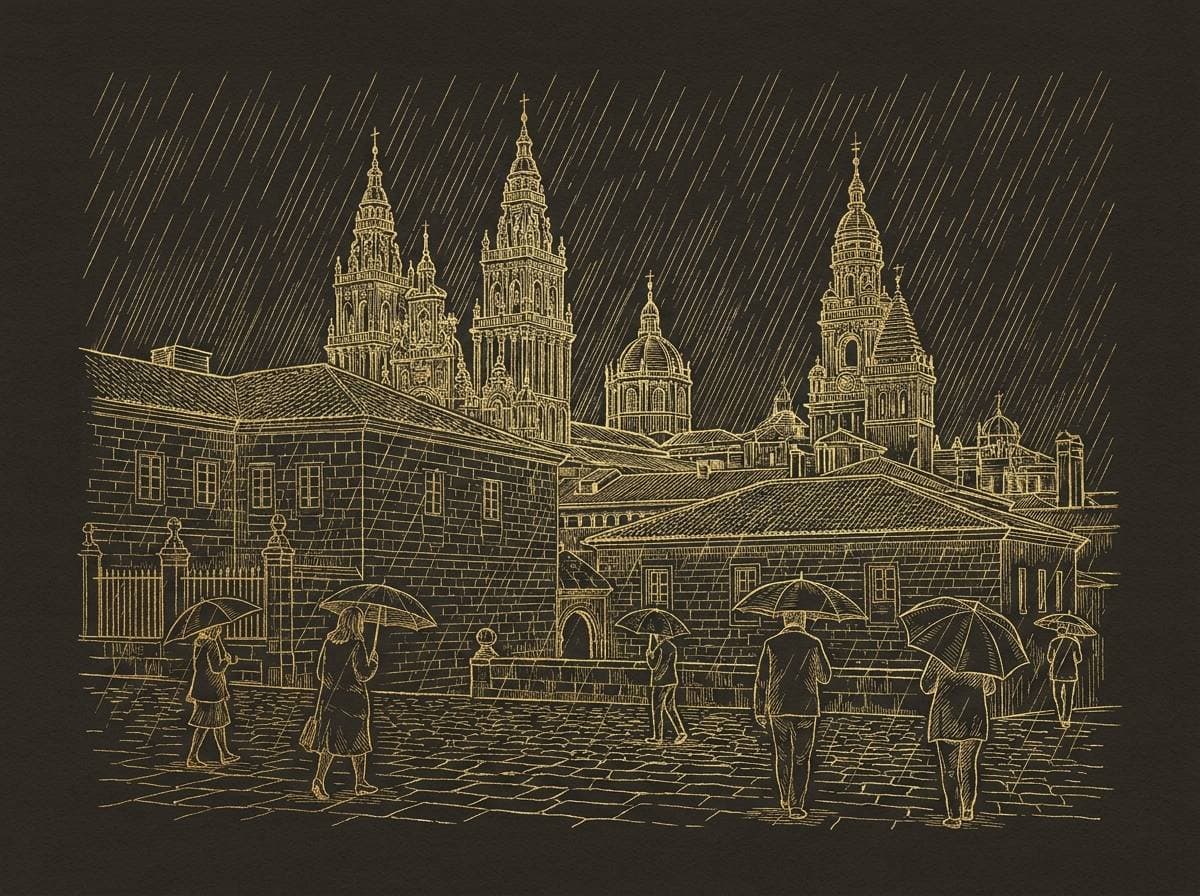
Santiago has a reputation as a rainy city, and it's a fair one. Here's what's actually worth knowing to pick your dates and pack properly.
By Cesar Rodriguez · updated
Right now in Santiago
33°
Clear sky
Feels like 34° · wind 2 km/h
Today
33° 13°
0% rain
Mon
32° 14°
0% rain
Tue
25° 14°
0% rain
Wed
21° 14°
0% rain
Thu
23° 14°
0% rain
Fri
23° 13°
0% rain
Sat
30° 9°
0% rain
Data: Open-Meteo · updates hourly
On this page
Santiago de Compostela has a temperate oceanic climate, with mild winters and moderate summers, but it's mostly known for its rain: somewhere between 1,400 and 1,900 mm a year, spread across around 140 wet days, which makes it Spain's second-rainiest city, behind only San Sebastián. That said, Compostela rain is rarely a downpour that ruins the whole day; it's usually a fine, intermittent drizzle, the famous Galician orbayo, that comes and goes several times in one afternoon.
Temperatures: nothing extreme, everything damp
The warmest month is July, running from about 14°C before dawn to 23°C in mid-afternoon; the coldest is January, 6-11°C. The two figures in the table below are exactly that, the overnight low and the daytime high, not an average: if you walk before sunrise or sleep with the window open, the first number is the one that matters. Through the whole year the city rarely strays outside a 5-25°C range, so you don't need to pack for extreme heat or cold. The real factor to watch isn't temperature, it's the constant humidity: even on a mild day, you'll feel the chill as soon as the sun goes down without a light layer on.
Month by month
This table is a guide, built from the city's average patterns; the actual weather on any given day can vary quite a bit from year to year.
| Month | Typical temperature | Rain | Our take |
|---|---|---|---|
| January | 6–11°C | Very high | Quiet city; good for museums and cider houses, bad for the outdoors |
| February | 6–12°C | High | Still damp and cold, but with more daylight hours |
| March | 7–14°C | High | Skies start to open up; the run-up to Holy Week |
| April | 9–15°C | High | Heavy Camino season; frequent but short downpours |
| May | 11–18°C | Medium | One of the best months: long light, very green countryside, no heat to speak of |
| June | 13–21°C | Medium-low | Compostela summer begins, good all-round balance |
| July | 14–23°C | Low (driest month) | Peak crowds: the Apóstol festivities and O Son do Camiño |
| August | 14–23°C | Low | Mild heat, a full city, the Feito a Man festival in the squares |
| September | 13–21°C | Medium-low | A local favourite: fewer people, still warm |
| October | 11–17°C | Medium-high | Rain creeps back in gradually; good autumn colour |
| November | 8–13°C | Very high | One of the wettest months; Cineuropa fills the cinemas |
| December | 6–11°C | Very high | Damp cold, but with the Christmas lights on Praza da Quintana |
The best time, depending on what you're after
There's no single "best time" — it depends on your priority. For general sightseeing, May to September offers the best balance of dry weather and a lively city, though July and August also bring the biggest crowds and the highest accommodation prices, especially around 25 July. For walking the Camino de Santiago, many pilgrims prefer May-June or September: good weather, long days and less extreme heat on the stages than in the middle of August. If saving money is the priority, winter (outside Christmas) brings the lowest hotel and hostel prices, a much quieter city, and, in exchange, more consecutive days of rain. That said, from November on many albergues and services along the routes close until spring, so walking the Camino in winter means planning your beds more carefully than in peak season.
What to pack
- A waterproof jacket or windbreaker — better than an umbrella if you'll be walking a lot.
- Footwear that won't soak through: the old town's wet granite is slippery.
- Layers: a t-shirt, a light jumper and a rain layer on top cover almost any day of the year.
- A spare change of clothes if you're walking the Camino: arriving soaked to a hostel with no dry clothes is no fun.
- Sun protection too, for the summer days when the sun really does have some bite.
The honest charm of the rain
Worth saying plainly: it's quite likely to rain during your visit, whenever you come. The good news is that Santiago is built for it. The arcades on Rúa do Vilar exist precisely so you can walk under cover from one end of the old town to the other, the taverns have the warmth and atmosphere to more than make up for a spell outside, and the wet granite, with that dark, glossy patina, is largely responsible for the look that makes this city recognisable in any photo. This isn't a city you enjoy despite the rain — you enjoy it with the rain. If a wet day does land on your trip, we've written down exactly what to do in Santiago when it rains: which museums and churches you can spend hours in, and where you can walk without an umbrella.
Frequently asked questions about Santiago's weather
Does it really rain every day in Santiago?
Not every day, but very often: around 140 rainy days a year, concentrated mostly between November and January. July and August are the driest months, though a passing shower can turn up at any time of year.
How many days a year does it rain in Santiago de Compostela?
Around 140 days a year on average, with 1,400-1,900 mm of accumulated rainfall: one of the rainiest cities in Spain. Most of it falls between October and March; in July and August rain is the exception.
What's the driest month to visit the city?
July, closely followed by August. For that same reason, it's also the period with the biggest crowds and the highest accommodation prices.
Do I need an umbrella or a rain jacket?
A waterproof jacket or windbreaker works better than an umbrella, especially if you'll be walking a lot or doing the Camino: it leaves your hands free and copes better with the Atlantic wind.
When is it coldest in Santiago?
January is the coldest month: 6°C overnight, 11°C at the top of the day. Those aren't extreme temperatures, but the constant humidity makes the cold feel sharper than the thermometer suggests.
Keep reading
Plan your trip
Santiago in 1, 2 and 3 days
Three complete itineraries, with a version adapted for rainy days.
The Camino
Complete Camino de Santiago guide
Routes, distances and the best time of year to set off.
What's on
Santiago's festivals and events
The calendar of festivals and celebrations through the year.