Sleeping in the city
Where to stay in Santiago de Compostela
From the world's oldest working hotel to a twelve-euro bunk in a pilgrim albergue: few cities offer a spread of beds this wide. Which neighbourhood you pick matters almost as much as the price.
By Cesar Rodriguez · updated
On this page
Santiago welcomes two very different kinds of traveller every year: the tourist who arrives by plane or train with a wheelie case, and the pilgrim who walks in along Rúa de San Pedro with mud still on their boots, already close to the rituals that mark the end of the walk. The city has, more or less successfully, worked out how to house both without one getting in the other's way. The result is a price map that runs from ten euros in a public albergue to several hundred for a suite on the Obradoiro, with almost everything imaginable in between.
The Parador: sleeping in a 1499 pilgrim hospital
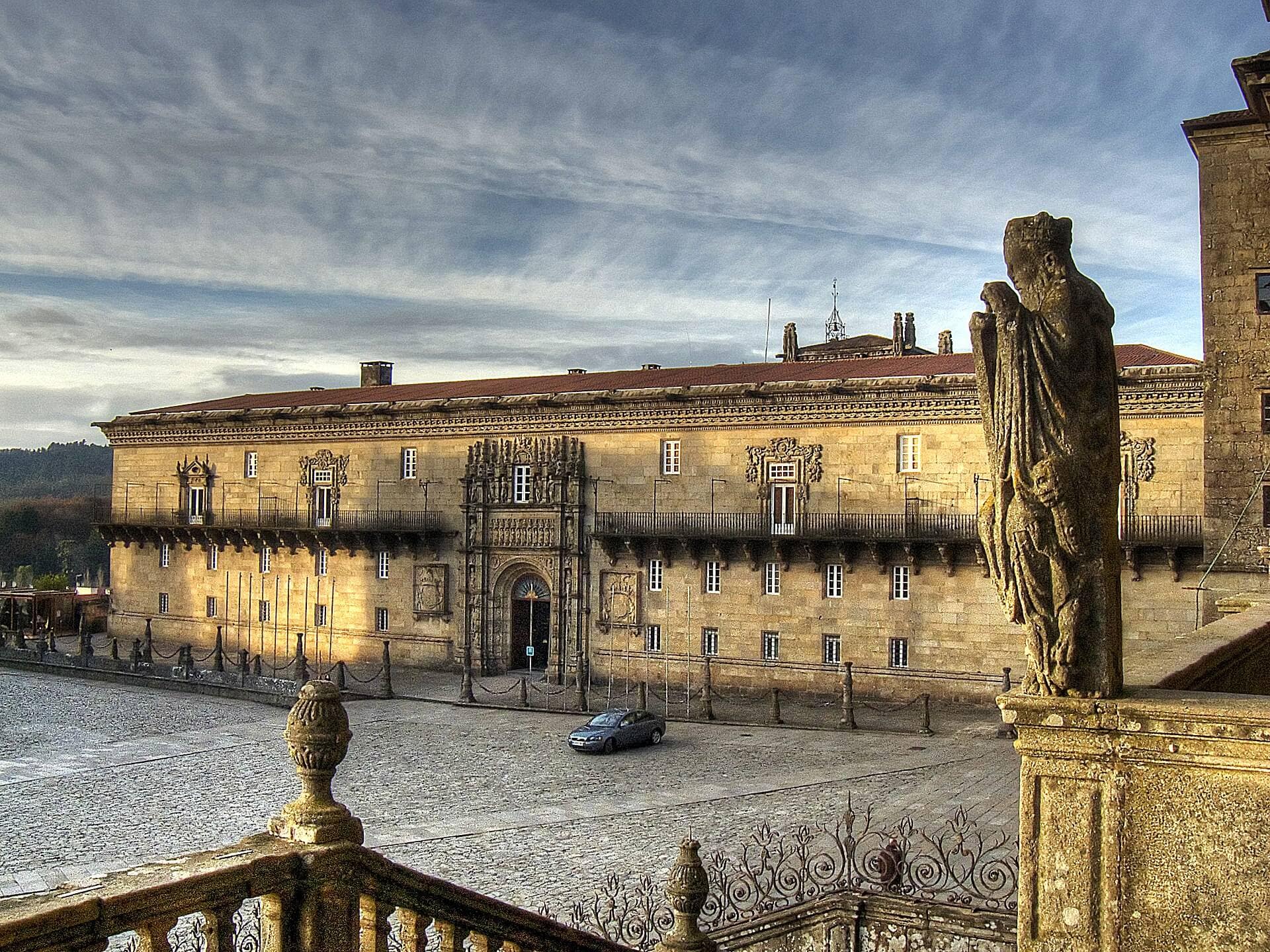
The Hostal dos Reis Católicos, today the Parador de Santiago, isn't a hotel with history — it's history itself, turned into a hotel. The Catholic Monarchs had it built in 1499 as a royal hospital, to take in, treat and, when needed, bury the pilgrims who arrived exhausted after the Camino. It has operated without interruption ever since, which makes it, depending on how you count, the oldest hotel still in business in the world. It occupies an entire corner of the Praza do Obradoiro, right against the cathedral's façade, with four historic cloisters and more than a hundred and forty works of art spread through its halls.
It's a five-star Gran Lujo property in the state-run Paradores network, and the price reflects that: between €150 and €350 a night depending on season and rate, averaging around €217. It's not within everyone's budget, but whoever sleeps there is literally staying inside the monument that everyone else can only photograph from outside.
Boutique and four-star hotels in the old town
A step below the Parador is a handful of hotels that have also converted historic buildings, at considerably friendlier prices. The AC Hotel Palacio del Carmen, part of Autograph Collection, occupies a former 18th-century Oblate convent and adds something almost no other hotel downtown has: a heated pool and spa. Rates swing widely with the season, from just over €55 in low season to €150–200 or more in August.
Hotel Costa Vella is smaller and more intimate — a boutique property built against the medieval city wall, with an apple-and-lemon-tree garden that surprises anyone who doesn't expect it right in the centre. It runs around €60 per person per night and has a well-earned reputation among travellers after something quiet without leaving the old town. Hotel Monumento San Francisco, set inside the convent of the same name with roots going back to 1214, follows the same formula of centuries-old stone with modern comfort. If you'd rather have something more functional and a little cheaper, Hotel Compostela and Hotel Gelmírez cover the stretch between the old town and the Ensanche. Our guide to boutique and heritage hotels gathers these and several more, with a guide price for the night.
Guesthouses (pensiones): for the budget-conscious traveller
Despite the rise of holiday apartments, pensiones remain a very reasonable way to sleep steps from the cathedral without paying hotel prices. A double room in a central pensión usually costs between €36 and €68, averaging around €45. Pensión Rúa Nova, barely 25 metres from the cathedral, or Pensión da Estrela, about 200 metres away, are examples of this discreet but very well-located offer. Hostal Mafer and Pensión Libredón, next to Praza de Fonseca, fall into the same bracket.
Pilgrim albergues: from €10 public bunks to private rooms
If one thing sets Santiago apart from any other Spanish city, it's its network of albergues — pilgrim hostels built for those arriving on foot or by bike with a stamped credencial. The cheapest and most contested is the Residencia de Peregrinos San Lázaro, run by the Xunta de Galicia: eighty beds across six dormitories, free kitchen and laundry, and a price of €10 a night. It only admits pilgrims with a credencial and caps stays at three nights, so it doesn't work as a base for anyone wanting to explore the city for a week.
Among private options, Albergue Seminario Menor occupies a former seminary about fifteen minutes' walk from the cathedral, facing Belvís park, and combines shared dorms from €15 with private rooms up to €55–70. The Last Stamp, right in the old town, has sixty-two beds across eight dormitories, each bunk with its own locker, socket and reading light: beds run €20 to €26 depending on season, with capsule-style doubles from €44. The full roundup of the best albergues in the city covers beds and atmosphere one by one.
The San Martín Pinario pilgrim room, which no booking site will show you
There is a third option between a dorm bunk and a hotel, and almost everyone misses it because it appears on no booking site at all. The Hospedería de San Martín Pinario, the Benedictine monastery twenty metres from the cathedral’s Azabachería door, runs two kinds of room: the hotel rooms, which you can book online like anywhere else, and fifty-seven plainer roomsthat the house itself describes as the ones «usually used by the pilgrim who arrives in Santiago on foot». Single, spare, breakfast in the refectory.
The part that matters: those rooms can only be requested by email or phone, at reservas@sanmartinpinario.eu or +34 981 560 282. They are not in the monastery’s own booking engine, they are not on Booking, and that is why nobody searching for a cheap room in the centre of Santiago ever finds them. The phone is often engaged and the answering machine points you back to the email, so writing is what works.
Holiday apartments
Apartments are the logical choice for multi-day stays or family trips. The simplest studios start around €25 a night, and a full apartment in the old town in high season can reach €100–170. Worth knowing: in April–May and September–October, when the bulk of pilgrim traffic coincides with good weather, apartment prices can climb up to 20% above low season.
| Type | Indicative price/night | Best for |
|---|---|---|
| Parador (5* Gran Lujo) | €150 – €350 | A special occasion, or sleeping inside the monument itself |
| Boutique / 4-star hotel | €55 – €200 | Comfort in a historic building, without Parador prices |
| Pensión (guesthouse) | €36 – €68 | Budget travellers who want to stay in the centre |
| Public albergue | €10 | Pilgrims with a credencial, 3-night maximum stay |
| Private albergue | €14 – €26 (dorm) / €44 – €70 (private) | Pilgrims or backpackers who value flexibility and atmosphere |
| Holiday apartment | €25 – €170 | Longer stays, families, groups of friends |
Which neighbourhood to choose
Location changes the experience more than the hotel's star rating does. There's no objectively best area — it depends on what you're after, and on where each of these sits on the map of the city centre.
Old town (Zona Vella)
The obvious choice if you're staying a short time and want everything within walking distance: the cathedral, the museums, the Obradoiro, Quintana and Praterías squares, and the highest concentration of tapas bars in the city. Staying here costs more than elsewhere in Santiago, and there's a real trade-off: streets are narrow, car access is heavily restricted, and on spring and summer weekends the bar scene runs well into the night. Anyone who's a light sleeper booking a room over Rúa do Franco on a Saturday in July will notice.
Ensanche / new town
South of the old town, on the way to the station, the Ensanche offers a wide hotel range — from five-star down to pensiones and albergues — at somewhat gentler prices. You lose part of the medieval charm but gain quieter nights and a five- to ten-minute walk to the centre, which in a city this size is nothing.
San Pedro and Belvís
San Pedro is the neighbourhood the Camino Francés enters through on its final stretch, with a cobbled pedestrian street and a strong local identity, well away from the tourist circuit. It's among the cheapest parts of the city, with old-school bakeries and neighbourhood bars, and it's a short — if uphill — walk from the old town.
Near the station
For anyone arriving or leaving by train or bus who'd rather not haul a suitcase too far, there are functional hotels ten to fifteen minutes' walk from the historic centre, with reasonable value for money and none of the Zona Vella's night-time noise.
Frequently asked questions
What's the best area to stay in Santiago if I only have one night?
The old town, without question: with a single night you want the cathedral and main squares within walking distance, even if the price is a bit higher and the bar scene is noticeable on weekends.
Can I stay in a pilgrim albergue without having walked the Camino?
The public San Lázaro albergue requires a pilgrim credencial. Private albergues tend to be more flexible and accept travellers without one, though their atmosphere and logistics — shared dorms, curfews — are built around people arriving on foot.
How much does a standard double room cost in Santiago?
In a central pensión, between €36 and €68 a night. In a three- or four-star hotel, the usual range runs €60 to €150, depending on season and how close you are to the cathedral.
Is the Parador worth the money?
If your budget allows, yes: it's not just a five-star hotel, it's sleeping inside a 1499 pilgrim hospital with historic cloisters and original art on the walls. For a purely functional stay, there are much cheaper alternatives a few steps away.
Is it better to stay near the station or in the centre?
It depends on trip length. For a one- or two-day visit, the centre is worth the premium. For longer stays, or a late train arrival, the station area and the Ensanche offer good value and quieter nights.
Keep reading
The Camino
Camino de Santiago guide
Routes, the final stages, the credencial and how to get the Compostela on arrival.
Visit
What to see in Santiago
The cathedral, the old town's squares and the essential monuments.
Eat
Where to eat in Santiago
Octopus 'á feira', Michelin stars and honest prices, street by street.