Surveyed in September 2026
How much does the Camino de Santiago cost per day? What people who walked it say
The only figure in circulation, €26 a day, comes from a 2008 survey by an association of chambers of commerce and is still quoted as if it were this year's. So we asked people who have walked it: 38 real daily spends across three Reddit and Facebook threads, from €25 to €133 a day, with what each one included and the cost none of them had planned for.
- The quoted figure
- €26/day (2008)
- What pilgrims report
- €50/day median
- Lowest reported
- €25/day
By Cesar Rodriguez · updated
On this page
Search for what the Camino costs and the number that comes up again and again is €26 a day and €583 in total, transport included. It's real: the Association of Chambers of Commerce along the Jacobean routes published it from a survey of almost 2,000 pilgrims. What almost nobody mentions is the date: March 2008. Back then a bunk cost €5 to €10 and a pilgrim dinner €8 or €10; today the Xunta's public network charges €10 and the pilgrim menu runs €12-18. Since we couldn't find any newer figure per person and day, official or otherwise, we did the only thing left: ask people who have walked it and count what they answer.
What they spent, figure by figure
Each row is one person. We leave the currency as they reported it, because converting a 2023 trip at today's rate would be inventing decimals, and we note what it included: that is what separates €30 from €100.
| Route and length | Reported spend | What it included |
|---|---|---|
| Francés from Saint-Jean, 28 days (2024) | €30 a day | Albergues only, privates at €12-18; supermarket food and the odd pilgrim menu. «I always do my Caminos frugally» |
| Francés, 40 days (2024) | €30 a day, about €2,000 in total | Albergues only and the menú del día. Flights not included |
| Primitivo | €46 on the most expensive day | 20 albergue, 15 dinner, 5 breakfast, 6 on drinks and snacks |
| Francés in winter (2023-24) | $50 a day | Municipal albergues, hotels in the big towns on rest days, every meal eaten out, no wine |
| Francés from Saint-Jean, 37 days (April-May 2023) | €50 a day | Albergues, preferring donativos and parish ones; a hotel three times; eating out once or twice a day. Days of €10 and days of nearly €100 |
| Portuguese Coastal, two people (September 2025) | €50 a day per person (30 to 60) | No municipals: private albergues at €25 a bunk, double rooms at €35 per person. Restaurant dinner half the nights (€22), groceries the rest (€8) |
| Francés, 30 days | £1,500 in total | Municipal and cheap albergues, pilgrim meals |
| Portuguese, 14 nights (2026) | £810 on the ground | £450 on beds (half albergues, half rooms), £260 on food, £100 on extras. Plus £550 on gear before leaving |
| Francés, 30 days with 3 rest days and 3 in Santiago | $77 a day | Transport included, nice accommodation on rest days, «I ate what I pleased» |
| Route not stated | €100 a day | «Beers, food, cheap hotel rooms» |
| Francés plus Finisterre-Muxía, 41 days | about €5,000 (roughly €120 a day) | Private rooms on rest days, evenings out. «Santiago is super expensive, which I didn't count on» |
| Francés, 30 days | £4,000 in total | The same person who did it for £1,500 with albergues: this time hotels and eating out |
| By bike, Bordeaux to Santiago, 12 days | about €600 (€50 a day) | No breakdown |
Three things stand out. Nobody in this thread reported €26. The two lowest figures in the table, €30 a day, come from people who walked in 2024 sleeping only in albergues and shopping at the supermarket, and one of them says it in so many words: «I always do my Caminos frugally». The thread's median sits at €50: three people on three different routes (the Francés in spring, the Francés in winter and the Portuguese Coastal) give exactly that figure, with an albergue almost every night and one meal out a day. And the same person can cost three times as much: whoever walked the Francés for £1,500 with municipals and pilgrim meals walked it again for £4,000 with hotels and restaurants. Same route; what changed was where they slept.
Three levels, and what each one buys
Sorted, the figures from all three threads fall into three fairly clean steps, and they match the prices we use across the rest of this guide: €10 for a bunk in the Xunta's public network, €15-25 in a private albergue and €12-18 for the menu.
| Level | Per day | What it includes |
|---|---|---|
| Frugal | €25-35 | Xunta public albergue (€10) or a cheap private one (€12-18), supermarket breakfast and dinner, the odd pilgrim menu. It's what the seven people under €40 reported; the two at €25 added the odd night camping or cooking every other day |
| Middle | €50 | The median of all 38 daily spends and the most repeated figure: ten people land right on 50, each in their own currency. Albergue almost every night, a hotel two or three times a month, one meal out a day |
| Comfortable | €75-100 | A private room most nights or on every rest day, eating and drinking without looking, luggage transfer. From here on, accommodation sets the bill |
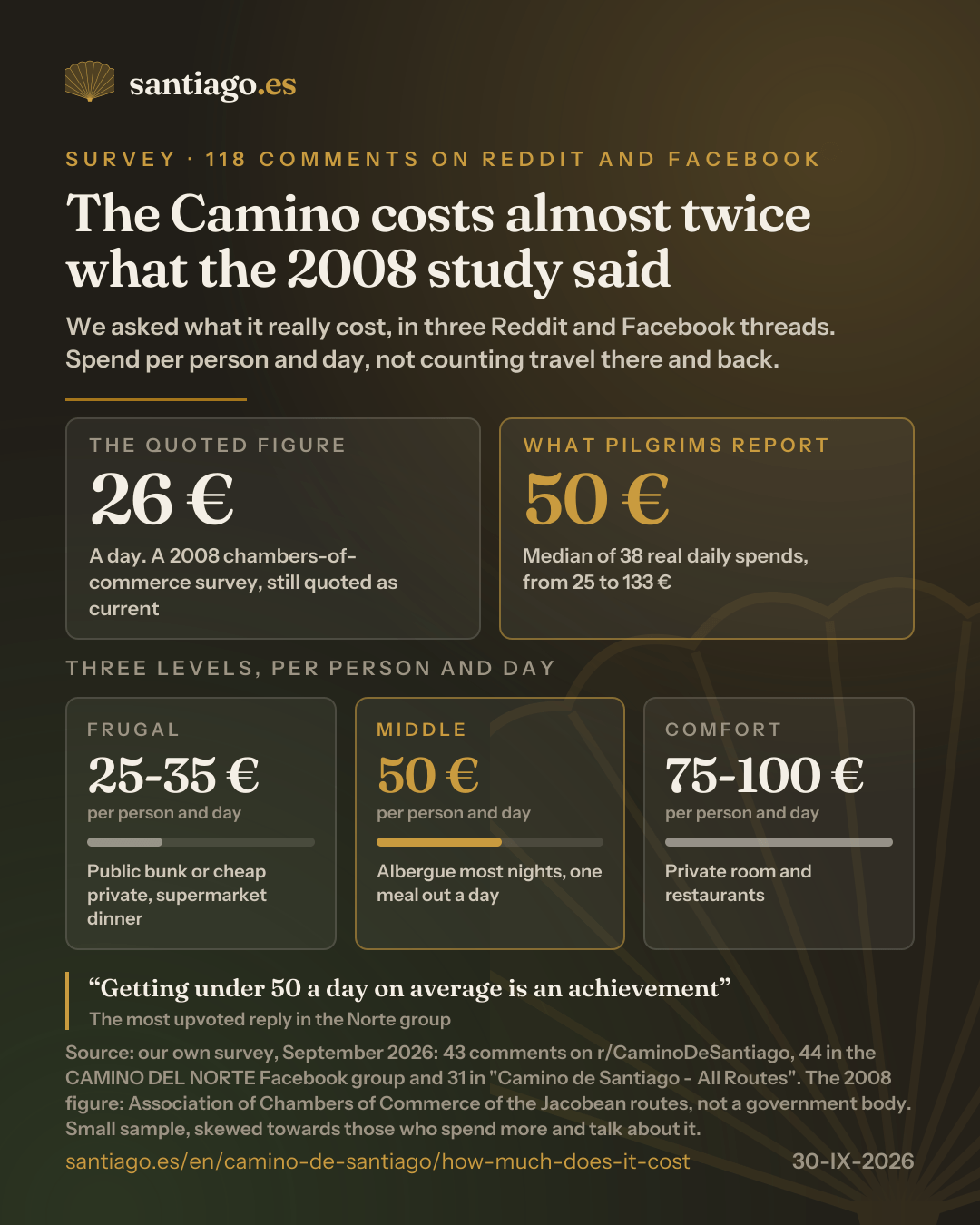
For a full 30-day Francés that's roughly €900 at the frugal level, €1,500 in the middle and €3,000 or more at the comfortable end, before getting to Saint-Jean and back. For the five or six days from Sarria, €150, €300 and €500. To pin it to your own days and sleeping habits, the budget calculator uses these same prices.
The cost nobody had planned for
That was the second half of the question, and the answers repeat more than we expected. None of them is big on its own. All of them add up.
- Santiago. «Super expensive, which I didn't count on», writes the person who spent the most. It's no accident: it's the only stop on the Camino without a public albergue in the old town, everyone who set off with you arrives the same afternoon, and the last night is paid at city prices. We have a guide on where you end up without a bed and a list of the albergues in Santiago.
- The mid-morning coffee. A café con leche and a slice of tortilla that cost €4 at the start of the Francés become €7 or €8 near Santiago, says someone who paid for it every day for 37 stages «because it was my sacred ritual». At an average of €5, that's €185 in a month.
- The village supermarket. «I often paid €8 for ingredients when I could've paid €10 for a meal with actual protein in a restaurant.» Shopping isn't always cheaper: it is in the cities, not in the only shop of a hamlet.
- Gear, before leaving. £550 on kit for fourteen days of the Portuguese, «some of it I could have done without». That's more than half of what the same person then spent on the ground. What you actually need is in the packing list.
- Rest days. Almost everyone above €50 a day explains it the same way: hotel nights in Burgos, León or Santiago. Three or four of those lift the average for the whole month.
- A private bed when the public one is full. The Xunta's €10 only counts if you arrive in time; the day you don't, it's €15-25. In high season that happens several times on any Camino.
- The evening round. Beers with the people from the albergue. Someone who walked in June and July puts it at «well over €50 a day» and blames that, not the food.
- The extras that never get counted. Luggage transfer at €7 a stage, washer and dryer, the credencial, the bus from the airport. And a tattoo in Santiago, which also came up.
How they did it on €30 a day
The most upvoted comment in the thread, by a wide margin, is the list from the person who walked the whole Francés on €30 in 2024. Condensed, no frills:
- Know where you're sleeping tomorrow. One village has expensive albergues and five kilometres on there's a public one. Check where the last supermarket before your stop is, too.
- Buy dinner and breakfast the night before. The bar breakfast is the most avoidable expense of the day.
- Fountains and the albergue tap. Bottled water adds up more than it seems.
- Don't stop at the famous stage ends: «the same meal costs €5 more than in the next little village». Five kilometres before or after.
- Restaurants only for the pilgrim menu, never à la carte. And a half menu where they offer one, because portions are big.
- Expensive gear doesn't walk for you: «I passed people with €500 shoes doing 15 km a day».
- Join the albergue crowd for the evening round, but with something from the supermarket or a single drink.
And the reply, which also collected votes and which we share: money spent on the Camino is money spent in villages that live off it. «The €5 breakfast in the most random café you stopped at might actually mean way more to that business» than the €10 shell made in China means to you. Stopping for the coffee and carrying your own food is the middle ground several people defend. One more warning, a single voice but a plausible one: albergue kitchens are getting rarer «because equipment kept getting stolen», so a plan built on cooking every night is worth checking albergue by albergue. And someone did go below €30: in the second wave, two people reported €25 a day, one sleeping only in public albergues, buying at the supermarket and camping some nights where it's allowed, the other cooking every other night and stretching cheese, chorizo and a baguette over two days. Which towns have a supermarket and a greengrocer, when the kitchen is actually open and how the menú del día differs from the pilgrim menu is in eating on the Camino. And since a good part of that spending — the Xunta bunk, the hamlet bar, the donativo — is paid in cash, which town to withdraw it in and which stretches have no ATM is in cash and ATMs on the last 100 km.
By route
Two answers agree: the Francés and the Primitivo are the cheapest, thanks to the density of public albergues and of competition; the Norte and the Portuguese from the border, the most expensive. That squares with what we've published: in the Basque Country the Norte's private albergues run €22-27, and on the Portuguese Coastal the pair in the table paid €25 on average for a bunk without setting foot in a municipal. In Galicia, by contrast, the Xunta's flat rate levels the floor across every route: a public bed costs €10 on the Francés, the Norte or the English Way. What rises on the last 100 km is everything else, because of the crowds.
The Norte, with its own numbers. On 6 September 2026 we asked the same question in a 96,000-member Facebook group devoted to the Camino del Norte, and within ten days it drew 44 comments, mostly from Spaniards with walks from 2023 to 2026. Eleven gave a daily figure, and they cluster tightly: €40-50 (the most upvoted answer, an Irún to Santiago in 31 days in July 2026), €45-50 "all public albergues, no luxuries" twice, €45 "albergues, pilgrim menu and supermarket dinner" on the Francés, €50 on average from Ribadeo to Santiago in August, €59 itemised (bed 25, breakfast 5, lunch menu 15, supermarket dinner 5), €60-70, €65 eating every meal in a bar, and €60-75 "without going short". The line that came up most was that averaging under €50 "counts as a win" once you include coffees, beers and the farewell dinner in Santiago; and the reason the Norte costs more is concrete: San Sebastián, Bilbao, Zarautz and Gernika have no public albergue. The €200 for a month in 2013 and the €450 from Logroño in 2010 that also came up are no use today, and they said so themselves: "prices have doubled since 2010".
The second wave, in English. On 21 September we posted this page's infographic in the "Camino de Santiago - All Routes" Facebook group and within a day it drew 40 comments; Facebook would only let us read 31, and fourteen of those gave a daily figure. They were added separately, without touching the earlier figures. They moved the floor: two people report €25, below the €30 nobody had gone under until then. The median didn't move: with 38 figures it's still €50, and three more people land right there, one of them on the Francés, having "lived like a king". At the top end they repeat what we'd already seen: €55 per person for a couple from Le Puy to Burgos, because in France the albergue includes dinner and costs more; about €60 on this year's Norte; €62 per person on a 50-day Francés with a private room every night; and €100 a day with private rooms and supermarket food. There were also two fair criticisms, with no figure attached: that €50 a day is a "relatively luxurious" Camino for anyone sleeping in municipals and donativos, and that the people who spend more are the ones who talk about it online. Both point at the same bias, and we cover it in the questions below.
What we don't know
We haven't found any figure per pilgrim and day newer than 2008, official or otherwise; if a regional government or chamber has published one, we'd like to read it. The sample is 38 people with a daily figure, mostly English speakers, who remember what they spent with the precision one remembers a trip: rounded. We didn't ask for receipts. And we didn't convert currencies: the $77 of a 2024 trip aren't today's euros. The second wave, from 21 September in the "Camino de Santiago - All Routes" group, was added separately to the first two: it lowered the floor from €30 to €25 and left the median where it was, at €50. What this page does stand on is what repeats across all three: only two people in 38 went below €30 a day, and whoever spends €100 does it on the bed, not on the food.
Frequently asked questions
How much does the Camino de Santiago cost per day?
Between €25 and €100 per person, depending on where you sleep. People who use public or cheap private albergues and supermarket food report €25 to €35 a day; the survey's median (38 daily spends), with an albergue almost every night and one meal out a day, is €50; with a private room and restaurants it reaches €100 or more. The €26 everyone quotes comes from a 2008 survey by the Camino chambers of commerce, not from a government.
Can you walk the Camino on €26 a day?
You can get close, with discipline: €10 for a Xunta bunk plus about €15 of supermarket food. Of 38 people, two report €25 a day, both sleeping only in public albergues and buying at the supermarket, one camping some nights and the other cooking every other night. They are the lowest spenders: the next five sit between €30 and €37. And on the day the public albergue is full a bed costs €15-25. Carry €40 a day as a cushion, even if you spend 30.
How much does the whole Camino Francés cost?
For the 30-33 days from Saint-Jean, reported budgets go from about €900 (albergues and supermarkets) to €1,500 (middle level) and €3,000-5,000 (hotels and restaurants), not counting the trip to Saint-Jean or the way home from Santiago. One person did it for £1,500 and, another time, for £4,000.
What costs more on the Camino, sleeping or eating?
It depends on the level. At the frugal end they weigh about the same: €10-15 for the bed and €8-15 for food. From the middle level up, the bed rules: the pair on the Portuguese Coastal spent €30 a day on accommodation and €20 on food per person, and everyone above €75 explains it with hotels and private rooms.
Which is the cost nobody plans for?
Santiago, the last night, is the one that repeats most: no public albergue in the old town and everyone arrives the same afternoon. After that, the small daily costs that pile up: the coffee with tortilla (€4 at the start of the Francés, €7-8 near Santiago), the evening beers and the hotel nights on rest days.
Which route is the cheapest?
According to the thread, the Francés and the Primitivo, for their density of public albergues and of competition. The most expensive, the Norte (private albergues at €22-27 in the Basque Country) and the Portuguese from the border. In Galicia the Xunta's flat rate puts the public bed at €10 on every route.
Isn't this a biased sample?
Yes, and upwards. People who answer a question about money on Reddit or in a Camino Facebook group tend to write in English, travel from far away and spend more than average; the pilgrim who sleeps in municipals, eats from the supermarket and isn't on those forums barely shows up. These are 38 daily spends from three threads, without receipts, rounded from memory and with currencies left unconverted; they don't represent the more than half a million pilgrims a year. That's why we give the whole range, €25 to €133, and not just the median. And the €26 quoted as a benchmark is not an official figure: it comes from a March 2008 survey by the Association of Chambers of Commerce of the Jacobean routes, of almost 2,000 pilgrims, with a different method and eighteen-year-old prices: the comparison shows the jump, it doesn't decide which of the two is right.
How this was done. The question was posted on 5 September 2026 on r/CaminoDeSantiago and harvested on the 11th, with the thread already quiet: 43 comments, 20 direct answers, 16 with a usable figure. Left out of the table: a €540 total with no day count and a two-person trip with flights inside. The same question went to the CAMINO DEL NORTE Facebook group on 6 September (44 comments, 11 daily figures, harvested on the 16th), and the second wave came from the comments on the infographic in "Camino de Santiago - All Routes" on the 21st (31 readable comments out of 40, 14 daily figures, harvested on the 22nd). When someone gave the spend of a couple or a family, we divided it by the number of people; budgets that were never spent and totals without a day count don't go into the median. The figure of €26 a day and €583 in total is from the Association of Chambers of Commerce of the Jacobean routes, published in March 2008 from a survey of almost 2,000 pilgrims. The reference prices (Xunta bunk, private albergues, pilgrim menu) are the ones we publish across this guide as of September 2026, and are indicative. If you walked this year and your figure matches none of these, the correction button at the foot of the page gets it to us.
Related guides
With your days and your way of sleeping
Budget calculator
The same prices as this page, multiplied by your stages. Plus the backpack scale.
The cost that sets the budget
Where you end up without a bed
Which network charges what, where the public ones fill up, and why the last night is always the dearest.
What people ask before setting off
Camino FAQ
Budget, insurance, credencial, albergue etiquette and bedbugs, answered with data.