The Camino routes
Vía de la Plata: 970 km from Seville, and why half of them start in Ourense
The longest route people actually walk end to end, and the emptiest of the eight. Here are the 37 days, the point where you choose between Ourense and Astorga, the heat that empties Extremadura five months a year, and one official figure that changes the conversation: one in two pilgrims on this route never sees Seville.
- Distance
- 970 km from Seville
- Stages
- 37 (38-45 days)
- Pilgrims in 2025
- 8,838 · 1.7%
- From Ourense
- 105 km · 5 stages
By Cesar Rodriguez · updated
On this page
Published on 24 September 2026.
The Vía de la Plata is nearly always told the same way: the Roman road, the solitude, Extremadura, a thousand kilometres. All of that is true. What that version leaves out is who actually walks it, and there the Pilgrim's Office dashboard says something we have not seen written in any guide: in 2025, of the 8,838 pilgrims who declared this route, 4,500 set off from Ourense and only 1,783 from Seville. One in two starts 105 km from Santiago. Fewer than five people a day start walking in Seville across the whole year.
That doesn't diminish the route. It makes it two different walks sharing a name: one of almost a thousand kilometres across dehesa and plain for anyone with six weeks, and one of five Galician days you reach by train from Santiago for less than the price of dinner. This page covers both, with the numbers alongside.
The short answer
It is 970 km from Seville in 37 stages, counting from Granja de Moreruela along the Camino Sanabrés, the branch that enters Galicia through Ourense. The alternative, carrying on to Astorga to join the Camino Francés, comes to 959 km in 38 stages: near enough the same. Our figure comes from adding up Gronze's stage table one by one; their own information page rounds it to "about 1,000 km", and the gap is only how each guide splits the days.
In 2025, 8,838 pilgrims walked it, 1.66% of the total, according to the official dashboard we track on our Camino statistics page. From January to August 2026 it stands at 7,000, or 1.77%. For a sense of the emptiness: the Francés carries about twenty-seven times as many people a year.
Who actually walks it: the figure nobody publishes
The Pilgrim's Office records the start point you declare when you collect your Compostela. Here is the split for this route, and it explains almost everything else on this page:
| Start | 2025 | % of 2025 | 2026 (Jan-Aug) |
|---|---|---|---|
| Ourense | 4,500 | 50.9% | 3,882 |
| Seville | 1,783 | 20.2% | 1,251 |
| Salamanca | 291 | 3.3% | 144 |
| Zamora | 237 | 2.7% | 176 |
| Chaves (Portugal) | 188 | 2.1% | 158 |
| Granja de Moreruela | 172 | 1.9% | 110 |
| Puebla de Sanabria | 141 | 1.6% | 142 |
| Mérida | 101 | 1.1% | 51 |
| Cáceres | 26 | 0.3% | 22 |
Chaves is on the list because the Camino Sanabrés has a Portuguese variant that comes in through Verín. And Granja de Moreruela, the village where everything is decided, shows only 172 starts: almost nobody begins there, you arrive on foot.
Summer doesn't empty the route: it empties Extremadura
Cross the start point with the month and the cliché falls apart on its own. These are the 2026 departures from the two ends of the route:
| Month | Starting in Seville | Starting in Ourense |
|---|---|---|
| March | 71 | 160 |
| April | 232 | 425 |
| May | 508 | 617 |
| June | 265 | 406 |
| July | 83 | 1,174 |
| August | 56 | 1,054 |
From 508 departures in May to 56 in August: down 89%. The July and August bump you see in the route's headline total is entirely Galician. And in 2025 more people set off from Seville in October (193) and November (103) than in July (84) and August (86). So "don't start it in summer" isn't a forum opinion: it is what the people who have walked it do.
The real window from Seville is April to June and September to November, peaking in May. One nuance almost nobody mentions: spring and autumn are not symmetrical. Leaving in spring you walk north with the heat rising behind you; leaving in September you reach Sanabria and Galicia in November, with rain, cold and little daylight. Both windows work, but they are not the same walk.
The heat, in numbers
These are AEMET's mean daily maximum temperatures, 1981-2010 series, at the stations closest to the route. Mérida has no station of its own: the sensible proxy is Badajoz, same Guadiana valley and similar altitude.
| Station | June | July | August | July rainfall |
|---|---|---|---|---|
| Seville Airport | 32.2 °C | 36.0 °C | 35.5 °C | 2 mm |
| Badajoz Airport | 31.4 °C | 34.8 °C | 34.5 °C | 4 mm |
| Cáceres | 29.9 °C | 33.7 °C | 33.2 °C | 6 mm |
| Salamanca Airport | 26.6 °C | 30.0 °C | 29.5 °C | 11 mm |
| Zamora | 27.0 °C | 30.4 °C | 29.8 °C | 12 mm |
| Ourense | 27.5 °C | 30.2 °C | 30.6 °C | 20 mm |
Averages flatten things, so here is an AEMET figure that is both scarier and more honest: the mean daily maximum of the hottest full month on record. In Seville, July 2022 averaged 39.4 °C as a daily high across the whole month; in Badajoz 39.0, in Cáceres 38.1. Not one afternoon, thirty-one days in a row. And nearly all those full-month records are from the last five years: June 2026 was the warmest June on record at five of the seven stations we checked.
Two useful oddities: in Ourense August (30.6) is hotter than July (30.2), the only case on the list; and Seville gets 2 mm of rain in July, so no cloud is going to provide the shade.
Granja de Moreruela: where the route splits
608.6 km from Seville, behind the village church, a signpost cuts the route in two. From there:
- Via the Sanabrés: 361.8 km in 14 days (nine to Ourense, five from Ourense to Santiago). It enters Galicia through A Gudiña and Laza.
- Towards Astorga: 94.3 km in four days (Benavente, Alija del Infantado, La Bañeza, Astorga), where you join the Francés, which still has 256 km to run.
"Sanabrés or Astorga?" usually gets answered with adjectives. With numbers it's easier: the Sanabrés keeps you on a route walked by 8,838 people a year; Astorga drops you onto one walked by 242,040. Someone who took the Astorga branch put it bluntly: four days without meeting a soul, and then more people in one afternoon than in the previous month. The case for the other side is fair too: if you are never going to walk the Francés, Astorga is how you see O Cebreiro and the Cruz de Ferro, and the Sanabrés is not.
The dashboard hints at what people choose: intermediate starts on the Sanabrés add up (Puebla de Sanabria 141, A Gudiña 132, Xunqueira de Ambía 130, Laza 98, Verín 82 in 2025) against Benavente 15 and La Bañeza 4. It is not a measure of the split at Granja de Moreruela, which nobody publishes, but it points one way.
Where everything is
| Town | Km from Seville | Km to Santiago |
|---|---|---|
| Monesterio | 102.0 | 868.4 |
| Mérida | 208.7 | 761.7 |
| Cáceres | 282.0 | 688.4 |
| Salamanca | 498.8 | 471.6 |
| Zamora | 566.8 | 403.6 |
| Granja de Moreruela | 608.6 | 361.8 |
| Puebla de Sanabria | 724.4 | 246.0 |
| A Gudiña | 776.2 | 194.2 |
| Ourense | 865.0 | 105.4 |
| Cea | 887.3 | 83.1 |
The long stages and the stretches with nothing
Twelve of the 37 days are over 30 km. It isn't the climbing that hurts, as it is on the Primitivo: it is distance and exposure.
| Stage | Km | Difficulty |
|---|---|---|
| Almadén de la Plata → Monesterio | 33.6 | 4 |
| Mérida → Alcuéscar | 35.9 | 4 |
| Alcuéscar → Cáceres | 37.4 | 4 |
| Cáceres → Embalse de Alcántara | 34.5 | 3 |
| Grimaldo → Carcaboso | 30.2 | 3 |
| Carcaboso → Aldeanueva del Camino | 38.3 | 4 |
| Salamanca → El Cubo del Vino | 36.4 | 4 |
| El Cubo del Vino → Zamora | 31.6 | 3 |
| Santa Marta de Tera → Mombuey | 36.1 | 4 |
| Mombuey → Puebla de Sanabria | 31.7 | 3 |
| A Gudiña → Laza | 34.0 | 4 |
| Laza → Xunqueira de Ambía | 33.0 | 4 |
The queen stage is Carcaboso → Aldeanueva del Camino, 38.3 km and about nine and a half hours, and it comes with a reward: it passes under the Roman arch of Cáparra, a four-sided arch the Camino literally goes through. You can split it by detouring to Valdeobispo, Plasencia or Oliva de Plasencia.
There are three stretches with genuinely nothing in between, and they are worth noting:
- Castilblanco de los Arroyos → Almadén de la Plata, 28.2 km with no services along the way, and nine of the first sixteen kilometres on tarmac. It is your second day out of Seville.
- Calzada de Valdunciel → El Cubo del Vino: over 20 km with nothing, hugging the N-630 and the motorway, and very exposed.
- A Gudiña → Laza, 34 km above 1,000 m, with Campobecerros as the only village with services.
Beds: the network is continuous, but thin
We are not giving a total number of albergues because the sources disagree (some count 80-90 places between Seville and Astorga, others pass 150 once you add hostales and church hospitality). What can be said with confidence is the shape of it:
- One or two albergues every twenty kilometres, not one every five. That governs how your stages break far more than your legs do.
- Public and municipal, €5-16; private, €12-20 for a bunk. In Extremadura and Castile there are stretches where the only option is a hostal or pensión at €30-40 for a single, and that is what lifts the budget.
- The Sanabrés has more services than the Extremaduran stretch, the opposite of what people assume: it is rare to go more than 10-15 km without a village with a fountain.
- There is no race for a bed here. Anyone arriving from the Francés is surprised to find that rolling in at seven in the evening is fine. What you should do is ring the day before wherever there is only one place to sleep, and check opening dates out of season, when the small ones close.
On money, there is a "€50 a day" myth that the people who have walked it flatly deny: the normal figure is €25-30. The counterpoint is true as well, and almost nobody says it: there are fewer municipal albergues and fewer pilgrim menus than on the Francés, so you eat more expensively. The full figures, from our own survey, are on how much the Camino costs.
The Compostela: Ourense clears it by five kilometres
The Pilgrim's Office asks for 100 continuous km towards Santiago on one and the same camino, a stamped credencial, and the last stage on foot. From Ourense there are 105.4 km left: it qualifies, by five kilometres and not one more. The next stop, Cea, is 83.1 km out and does not qualify. If you want a margin, start a stage earlier at Allariz, around 119 km.
And yes, the Sanabrés counts: it is not a separate camino but the Galician branch of the Vía de la Plata, and the Office files it under that name. The proof is in the table above: the 4,500 people who started in Ourense in 2025 collected their Compostela. If you go via Astorga you get one too, but your last 100 km are Francés, from Sarria or thereabouts; the solitary part ends for you in Astorga.
Getting to Seville, and starting in Ourense
From Madrid to Seville there is a Renfe AVE in 2 h 30, seven direct services a day, and enough competition to make it cheap: Avlo from €7 and Ouigo from €9, with three departures a day. Iryo covers it in about 2 h 52.
From Santiago to Seville there is no direct train, whatever the ticket search engines say: what they sell as direct are connections with a change. There are three real options:
- A direct flight, operated by Vueling according to Aena's destination list: around 1 h 25.
- Train with a change in Madrid, 6 h 30 to 7 h 30 in total. And here is the trap that makes people miss trains: the Galician Avril arrives at Chamartín and the AVE to Seville leaves from Atocha. They are two different stations, 12-15 minutes apart on Cercanías and included in your ticket through Combinado Cercanías, but leave an hour for it.
- A direct ALSA coach, overnight, more than two services a day all year: departures at 15:00 and 16:10, arriving at Plaza de Armas at 07:35 and 06:50 the next morning. Fifteen to sixteen and a half hours.
And to start in Ourense, which is what half the people on this route do: it is 83 km from Santiago, about 39 minutes on Renfe's Avant, with fourteen to seventeen services a day and fares from around €7. In other words, the five Galician days of the Vía de la Plata sit a long commuter ride from the Cathedral itself. That, and nothing else, is what explains the 50% in the table.
Fares and frequencies are indicative, as of September 2026, and move with how far ahead you book and the season. The ALSA timetable and Aena's direct-route listing are checked on their own sites; the specific fares are not.
Waymarking, dogs and water
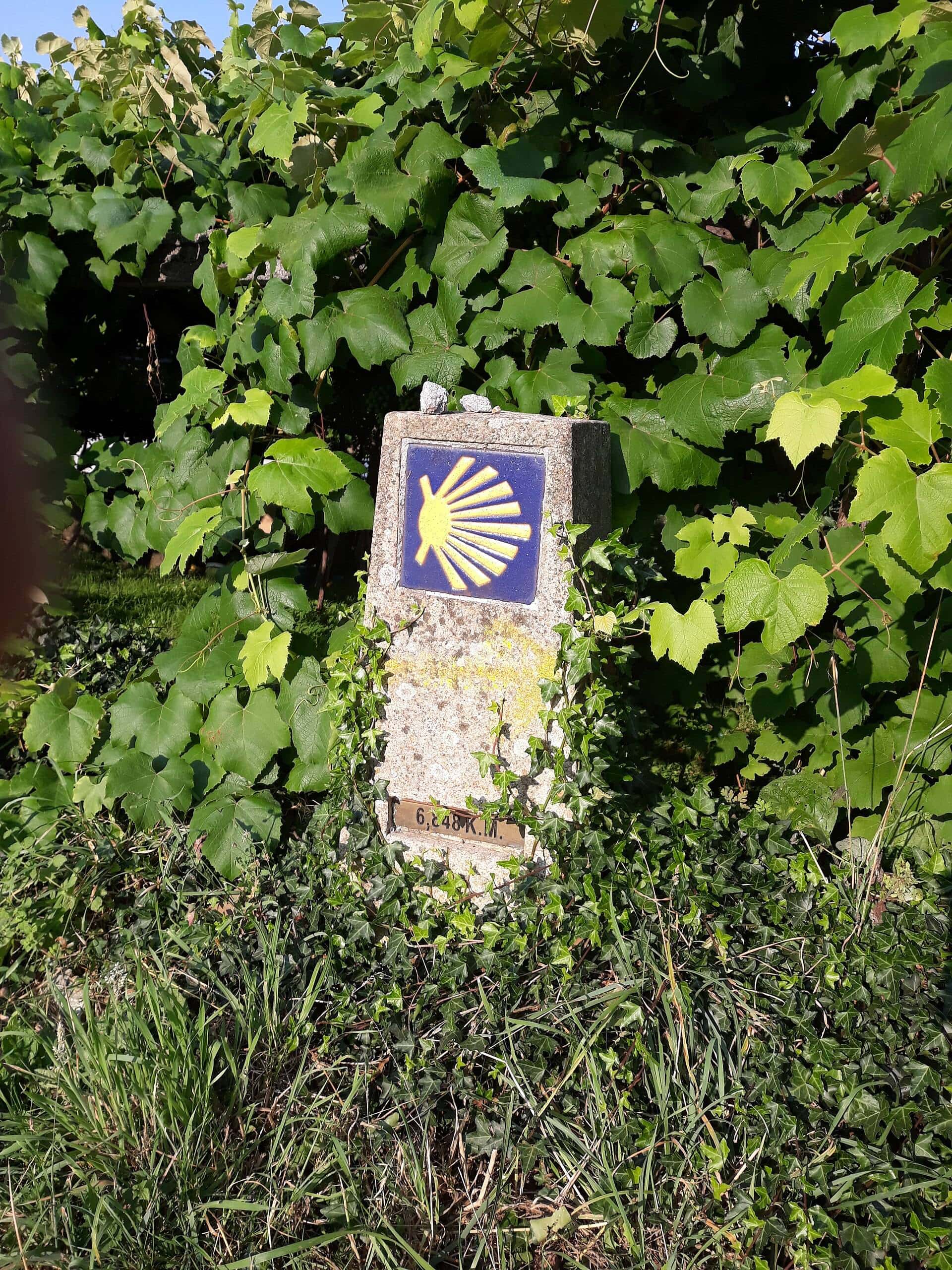
It is waymarked with yellow arrows the whole way, good quality if more austere than the Francés. If you find accounts saying otherwise, check the date: reports from a decade ago describe getting lost daily, while everything from 2022 onwards agrees the marking is good. It improved a great deal in the last ten years. Even so, plenty of people recommend carrying the map downloaded rather than relying on coverage.
On dogs, the usual worry is aimed at the wrong target: it isn't loose village dogs, it is the mastiffs guarding livestock in the dehesas, because the path crosses grazing land with cattle and sheep often enough. We found no documented attack; what does get repeated is the method, which is to walk around the perimeter of the flock rather than through it, and that trekking poles put dogs off.
And the water line is not generic advice here: unlike the Francés or the Norte, there are no taps everywhere, and village bars keep Spanish hours rather than pilgrim hours. Leaving with food on you is part of the plan.
Four things worth seeing, each with a figure
- Itálica, about 9 km out of Seville on day one: its amphitheatre seated 25,000 across more than 20,000 m², the largest in the Empire outside Italy by surface area. It sits slightly off the official route.
- Mérida, km 208.7: the Roman theatre was commissioned by Marcus Agrippa and opened in 16-15 BC, seating 6,000. The archaeological ensemble has been World Heritage since 1993.
- Cáceres, km 282: the old town has been World Heritage since November 1986. You walk into it, which is not the same as seeing it in passing.
- Ourense, km 865: As Burgas rise at around 67 °C in the middle of the old town, and since 2010 there has been a free open-air thermal pool. After eight hundred kilometres, that is an argument.
Frequently asked questions
How long is the Vía de la Plata really?
About 970 km from Seville to Santiago via the Camino Sanabrés, in 37 stages, adding up Gronze's stage table one by one. Via Astorga and the Camino Francés it is 959 km in 38 stages. Guides that say 'about 1,000 km' are rounding, and the difference is in how each one splits the days, not in the route itself.
Can you walk it in summer?
From Seville, almost nobody does: in July 2026, 83 people set off from Seville and 1,174 from Ourense. Seville's mean daily maximum in July is 36 °C in AEMET's 1981-2010 series, and July 2022 averaged 39.4 °C for the entire month. People who do walk it in August leave before dawn, carry two litres of water and finish the stage by mid-morning. From Ourense, by contrast, summer is the busiest time of the year.
Sanabrés or Astorga at Granja de Moreruela?
The Sanabrés leaves 361.8 km in 14 days and keeps you on a route walked by 8,838 people a year. Astorga leaves 94.3 km until you join the Camino Francés, which carries 242,040 a year: the change of company is abrupt, from one day to the next. Astorga's argument in favour is O Cebreiro and the Cruz de Ferro, which the Sanabrés does not pass.
Where do you have to start for the Compostela to count?
From Ourense, 105.4 km from Santiago: it clears the 100 km by five kilometres. The next stop, Cea, is 83.1 km out and does not qualify. If you want a margin, start a stage earlier at Allariz, around 119 km. The Sanabrés counts as Vía de la Plata for all purposes.
Do you need to book beds?
Generally no: this is the camino without a race for the albergue, and arriving at seven in the evening is not a problem. What is worth doing is ringing the day before in villages with a single place to sleep, and checking opening dates out of season. One specific warning: the albergue at Embalse de Alcántara is closed with no reopening in sight, so that stage has to be replanned before you leave Cáceres.
What does it cost a day?
People who have walked it report €25-30 a day, not the €50 that circulates. The nuance: there are fewer municipal albergues and fewer pilgrim menus than on the Francés, and in parts of Extremadura and Castile the only option is a pensión at €30-40, so the average is pushed up by food and by the nights without an albergue.
Sigue leyendo
Compare
All the Camino routes
The eight routes to Santiago with distances, stages, difficulty and what share of pilgrims walks each one.
Data
Camino statistics
Pilgrims by route, by month and by start point, from the Pilgrim's Office dashboard.
On arrival
The Compostela
The 100 continuous kilometres, the credencial, the stamps and what you actually get at the Office.
When to go
The best time to walk
Month by month, with the real arrival figures and what opens and closes along the way.