Xacobeo 2027 · The Holy Door
The Holy Door: history and the opening ceremony
A door that only opens in a Holy Year, a five-hundred-year-old ritual, and a silver hammer. Here's the story behind the gesture that starts Xacobeo 2027.
By Cesar Rodriguez · updated
On this page
Updated 13 August 2026.
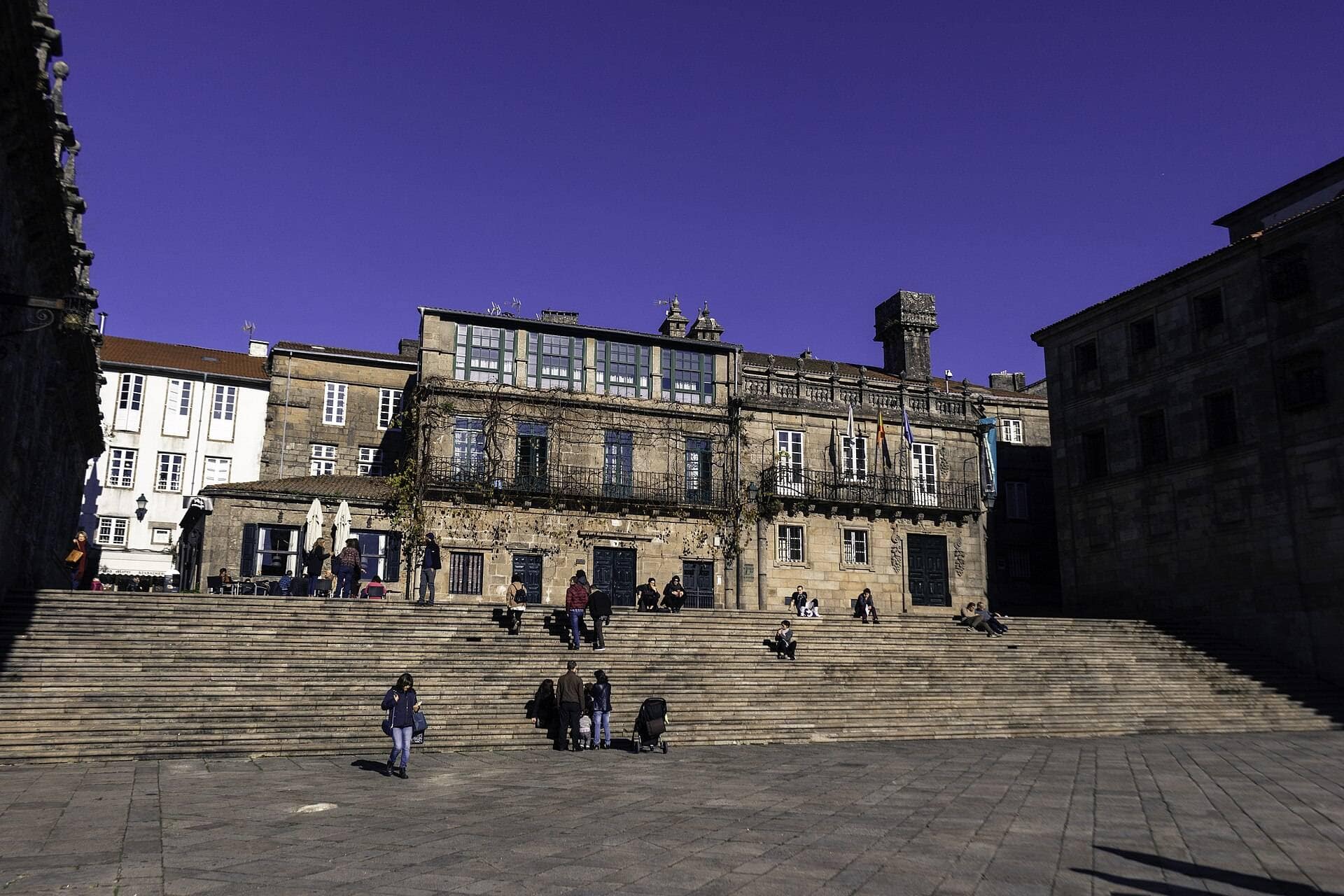
The Holy Door, also called the Door of Forgiveness, is the only door of the Cathedral that stays closed almost all the time: it only opens during Holy Years. It sits in the wall facing Praza da Quintana, on the Cathedral's rear façade, and crossing it during the Xacobeo is one of the most symbolically loaded gestures of the whole pilgrimage — though, as explained in the Holy Year guide, it isn't actually a requirement for the plenary indulgence.
Origins: an idea borrowed from Rome
The tradition of a holy door in Santiago dates back to the first half of the 16th century, under Archbishop Alonso III de Fonseca. The idea didn't originate in Galicia: it was directly inspired by the holy door Pope Alexander VI had instituted in Rome in 1500, within the tradition of Roman jubilees. Santiago adapted that same idea — a door that stays sealed and is only opened in designated years — to its own Jacobean calendar.
The 27 figures of the Holy Door
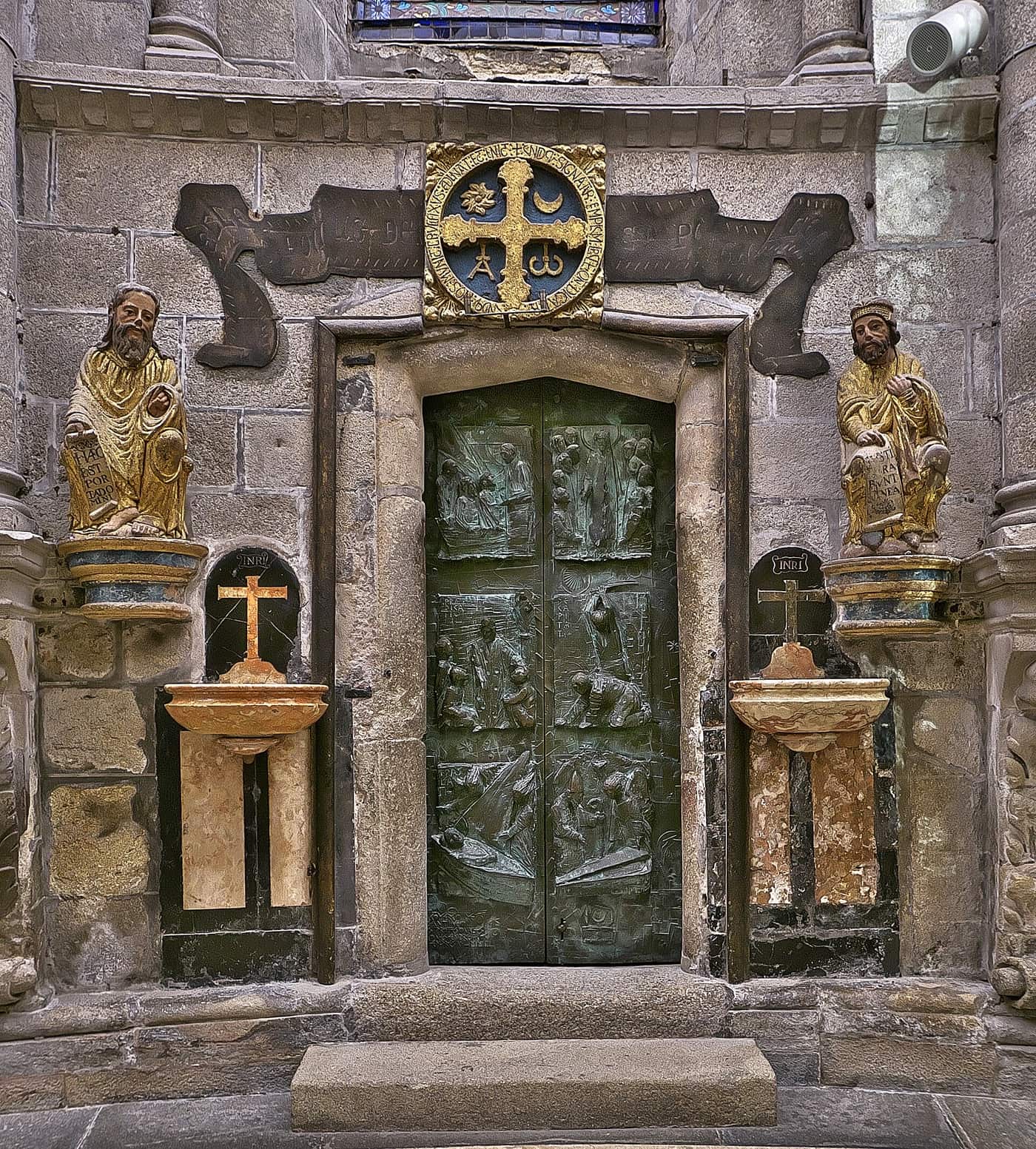
The exterior baroque portico, built in the 17th century, is the most recognisable part of the ensemble: twenty-four sculptures — twelve on each side — flank the door, several of them taken from the Cathedral's demolished 12th-century Romanesque stone choir. Around 1694, three more figures were added by sculptor Pedro del Campo: Santiago as a pilgrim in the centre, flanked by his disciples Teodoro and Atanasio. That total of twenty-four plus three gives the ensemble its popular name: "the 27 of the Holy Door."
The bronze leaves, by Suso León
The bronze-and-steel door leaves opened every Holy Year are relatively recent: they were installed in 2004, made by Compostela sculptor Suso León, and weigh around 300 kg each. They were funded with the support of some thirty local businesses. The outer face depicts Christ and Santiago in prayer; the inner face, seen when crossing into the Cathedral, shows six reliefs illustrating the Jacobean tradition.
The opening ceremony, step by step
The 31 December 2026 opening follows a ritual repeated, with minor variations, at every Holy Year. Roughly, here's what happens:
- The ceremony takes place in Praza da Quintana, in front of the sealed wall, starting around 4:30 pm (an approximate time reported by the press, unconfirmed officially as of July 2026).
- The Archbishop of Santiago, Francisco José Prieto Fernández — in office since June 2023 — strikes the wall three times with a silver hammer.
- Workers then remove the masonry sealing the doorway.
- A group of priests clean the threshold with olive branches and holy water.
- The Archbishop is the first to cross the threshold, followed by everyone else present.
From that moment, the door stays open for the following 365 days, until it's sealed again in an equivalent ceremony on 31 December 2027. Stepping through it puts you directly in the Cathedral's transept, the same spot the botafumeiro hangs from. It is not swinging right now, though: it has been grounded since 24 August 2026 by the cimborrio scaffolding, with no return date. See where that stands and when it normally flies.
The closing, a year later
On 31 December 2027, the reverse ceremony takes place: the door is closed and sealed again with masonry until the next Holy Year, which — barring an exceptional change like the one in 2021-22 — won't arrive until 2032. For everything else about visiting the Cathedral — hours, tickets and the ongoing restoration works — see the Cathedral guide.
Frequently asked questions
Where is the Holy Door of Santiago Cathedral?
In the wall facing Praza da Quintana, on the Cathedral's rear façade. It's also known as the Door of Forgiveness.
Who opens the Holy Door, and how?
The Archbishop of Santiago, currently Francisco José Prieto Fernández, strikes the sealed wall three times with a silver hammer; the masonry is then removed and the Archbishop is the first to cross the threshold.
Who are the '27 of the Holy Door'?
The 24 sculptures of the 17th-century baroque portico — some from the old Romanesque choir — plus the three figures added around 1694 by Pedro del Campo: Santiago as a pilgrim and his disciples Teodoro and Atanasio.
What are the door leaves made of?
Bronze and steel, made by sculptor Suso León and installed in 2004. Each leaf weighs around 300 kg and was funded with support from about thirty local Santiago businesses.
Keep reading
The Holy Year
What a Holy Year is, and the indulgence
The 6-5-6-11 cycle, the 2021-22 anomaly, and what the plenary indulgence requires.
Plan your trip
When to visit in 2027
Month by month: expected pressure and when to book before prices climb.
Back to the hub
Xacobeo 2027: the complete guide
Key dates, what to expect, and everything the city is preparing for the Holy Year.