Recipe
The authentic Tarta de Santiago recipe
The cake itself takes no flour and no raising agent: almonds, sugar and egg, with three minimums fixed by the PGI rulebook. This is the cake the Protected Geographical Indication defends, and how to make it at home.
By Cesar Rodriguez · updated
On this page
Almost everyone who tries Tarta de Santiago assumes it is a sponge cake like any other, only almond-flavoured. It isn't. In the version protected by the Protected Geographical Indication (PGI), the cake carries not a gram of flour or of raising agent: it is, by definition, a pure almond cake, and that absence is exactly what gives it the dense, moist texture that no sponge has. What is worth knowing, because hardly anyone says it, is that the rulebook covers two presentations: the plain one, with no base, and a lined cake whose base is indeed made with wheat flour. Both may carry the label.
A history that starts in 1577
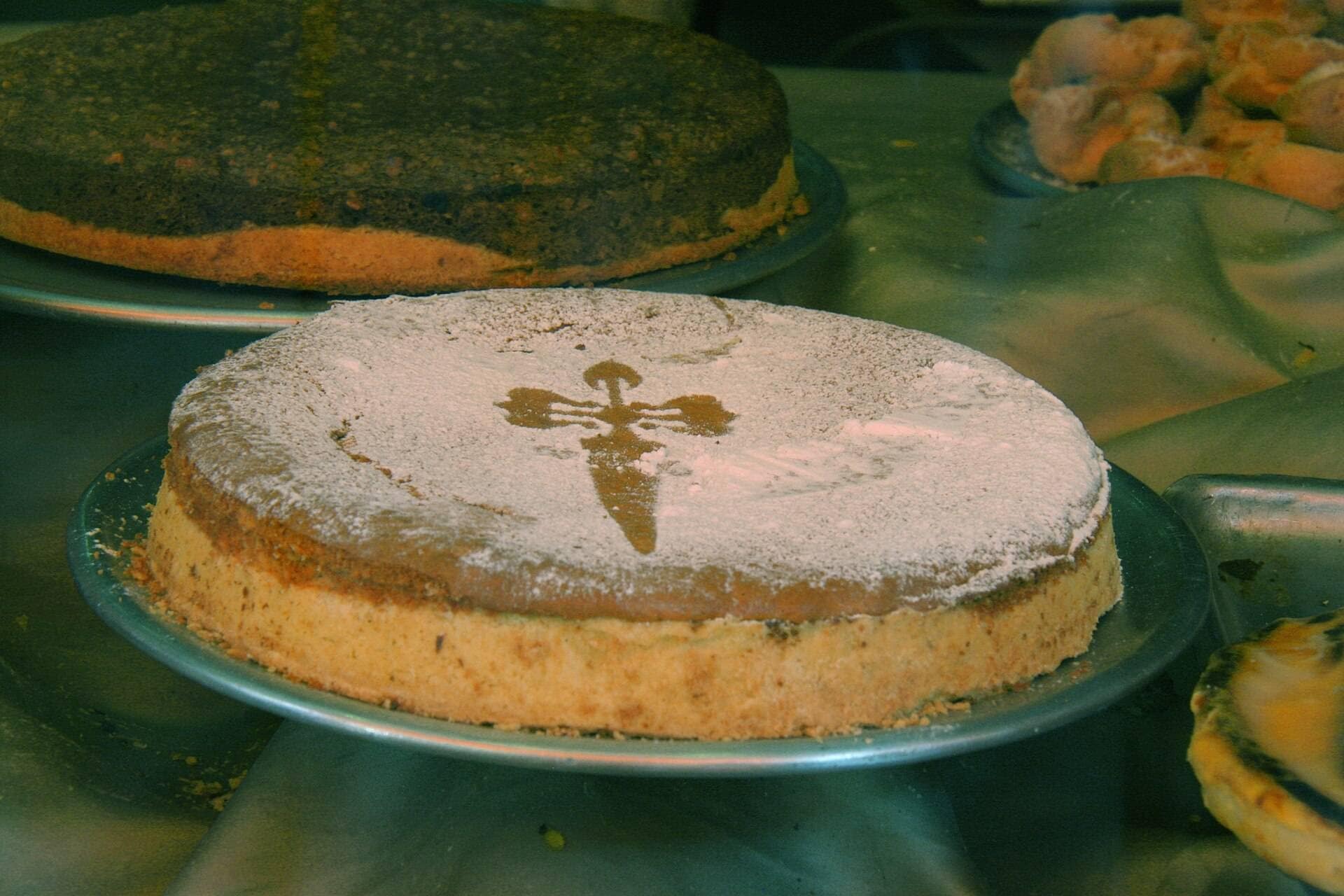
The first documented reference to a similar cake is from 1577, when a «torta real» of almonds — confectionery reserved at the time for the upper classes — was served during a visit to the University of Santiago. The first detailed, reliable recipes only arrive in 1838, written down by the soldier and confectioner Luis Bartolomé de Leybar, by then under the name «tarta de almendra». But the gesture everyone recognises today — the cross in icing sugar across the top — is far more recent: it is attributed to Casa Mora — the family business closed for good in 2025, though its mark stayed in every shop window in the city — the most important confectioner in the Santiago of 1924, founded by José Mora, who came up with the decoration as his workshop's signature. The other Compostelan bakeries took it up straight away, and it has been inseparable from the cake ever since; our guide to the best Tarta de Santiago goes through which of them still defend that craft best.
Legal protection came much later: the PGI application was published in the BOE, the Spanish state gazette, in 2006, and the definitive regulation, with its Regulatory Council, was approved by an Order of 10 February 2010 published in the Official Gazette of Galicia. Since then, only a cake that meets a very specific set of conditions can be sold as «Tarta de Santiago» under the PGI.
The ratios the rulebook sets
The PGI regulation sets three minimums on the total weight of the cake mixture, not counting the icing sugar on top: at least 33% almond, at least 33% sugar and at least 25% egg. The authorised flavourings make up the rest. And the part that surprises people who don't know it: the list of ingredients for the cake mixture is closed, and it does not include flour, raising agents or starches. What holds the cake together is egg beaten with sugar, not a leavening agent.
That list applies to the body of the cake. The lined presentation, which the rulebook covers just as it covers the plain one, adds a base that may weigh up to 25% of the total and that allows only two compositions, both of them with wheat flour: puff pastry (wheat flour, butter, water and salt) or pasta brisa, plain shortcrust (wheat flour, butter, refined sugar, whole egg, milk and salt). So «it has the PGI» does not mean «it has no flour»: it means the almond body meets the three minimums. The recipe below is the unlined cake, which is the one with no flour anywhere in it and the one you can eat gluten-free. All of this comes from the PGI summary sheet published in the BOE of 22 March 2006, sections 4.2 and 4.5.
As for the almonds, the rulebook requires quality Mediterranean varieties with a fat content above 50%: comuna, marcona, mollar, largueta or planeta. The authorised flavourings are lemon zest, sweet wine, brandy, coffee liqueur and orujo spirit. Cinnamon, so common in home recipes, does not appear as a required ingredient in the rulebook — it is a popular variation, not a requirement — so you can leave it out without betraying the original.
The recipe, for a 22-24 cm tin
These quantities respect the 33/33/25 ratio the PGI demands, and make a cake of about 8 to 10 servings:
- 250 g raw ground almonds
- 250 g sugar
- 5 medium-to-large eggs
- Grated zest of one lemon
- 1 teaspoon ground cinnamon (optional)
- A splash of orujo liqueur, brandy or sweet wine (optional)
- Icing sugar, to decorate
- Butter and a little flour to grease and dust the tin — it does not go into the batter
Method
- Heat the oven to 180 °C, top and bottom heat.
- Beat the eggs with the sugar until pale and doubled in volume.
- Add the lemon zest, the cinnamon and the liqueur if you are using them, and mix well.
- Fold in the ground almonds, without overworking the mixture, until the batter comes together.
- Pour into the tin, greased and dusted with flour beforehand.
- Bake for 30 to 45 minutes depending on how deep the tin is, until a skewer comes out of the centre clean.
- Let it cool completely before turning it out: warm, it breaks easily.
- Lay the Santiago cross stencil on the cold cake — you can print it or cut it out of card — dust icing sugar over it through a sieve and lift the stencil off carefully to reveal the shape.
Frequently asked questions
Does authentic Tarta de Santiago contain flour?
Not in the cake mixture: the rulebook's list of ingredients is closed and does not include flour, raising agents or starches. The body is pure almond held together by egg beaten with sugar. But the PGI covers two presentations, and the lined one has a base of puff pastry or shortcrust, both with wheat flour, which can be up to 25% of the weight of the cake. The one with no flour anywhere is the unlined cake.
What kind of almonds should I use?
The regulation allows quality Mediterranean varieties with more than 50% fat: comuna, marcona, mollar, largueta or planeta. Any good raw ground almond works well at home.
Where can I buy one ready-made in Santiago?
In any bakery in the old town, though quality varies a good deal from one to the next. We compare some of the references in our guide to where to eat in Santiago.
Why does it have the cross of Santiago on top?
The decoration is attributed to Casa Mora, the most important confectioner in the Santiago of 1924, which used it as its workshop's signature. The other bakeries took it up afterwards and today it is inseparable from the cake.
Keep reading
Buy it instead
Where to buy the best Tarta de Santiago
Six bakeries near the Cathedral, with prices and what the PGI label guarantees.
Eating
Where to eat in Santiago
Octopus á feira, the Mercado de Abastos and the Michelin-starred tables.
Pilgrims
Arriving in Santiago
The tradition of marking the end of the Camino with octopus and tarta de Santiago.