Self-guided walk
The squares walk
The four squares around the Cathedral, in the order that tells the city's story best. Flat, short and with no surprise climbs.
- Time
- ~1 hour
- Distance
- ~1.2 km
- Difficulty
- Very low
- Pram / wheelchair
- Fine, but cobbled
This is the shortest walk in the guide and the densest in history: a little over a kilometre crosses seven centuries of religious, civil and university power. You do not have to follow the order to the letter, but this one chains the squares so that each makes more sense for what you have just seen in the one before.
- Praza do Obradoiro. The starting point and, in truth, the end of every Camino route. Look at the four buildings that close the square: the baroque facade of the Cathedral to the east, the Pazo de Raxoi (the city hall) to the west, the Hostal dos Reis Católicos to the north — the old Royal Hospital of 1499, today a Parador and a contender for the oldest hotel still working in the world — and the Colexio de San Xerome, the university rectorate, to the south. It is the only one of the four with nothing to interrupt it: no terraces, no traffic, just stone and people sitting on the ground.
- Rúa de Fonseca. Leave the Obradoiro by its southern side and turn into this short, narrow street, barely a couple of minutes long, where the Colexio de Fonseca stands: the first building of the University of Santiago, put up in the first half of the 16th century. It marks the change of scale in the walk, from monumental square to university street.
- Praza das Praterías.The oldest square in the street plan of Santiago, laid out in the 11th century by archbishop Diego Gelmírez. It takes its name from the silversmiths’ workshops that filled it for centuries. In the middle stands the Fonte dos Cabalos, a bronze fountain of 1825 with four sea horses holding up a figure bearing the star of Compostela — it used to be known as the Fountain of the Star — and put into a poem, Danza da lúa en Santiago, by Federico García Lorca. It is also the best angle for a close look at the Cathedral’s south facade, the least photographed of the four.
- Praza da Quintana. Round the Cathedral to the east and you reach the most photographed square in the city and, for centuries, the least welcoming: it splits into two levels joined by a flight of steps from the early 17th century. The Quintana de Mortos, the lower part, was the main cemetery of Santiago from 1075 to 1833. The Quintana de Vivos, the upper part, is where concerts and the Feito a Man festival happen in August. Set in the Cathedral wall on this square is the Holy Door, which opens only in a Holy Year. The next time is 31 December 2026.
- Praza da Inmaculada. One step further, with the monastery of San Martiño Pinario taking up a whole side: one of the largest monastic complexes in Spain after El Escorial. Its baroque facade, from the early 18th century, sits against the plainness of the Cathedral opposite.
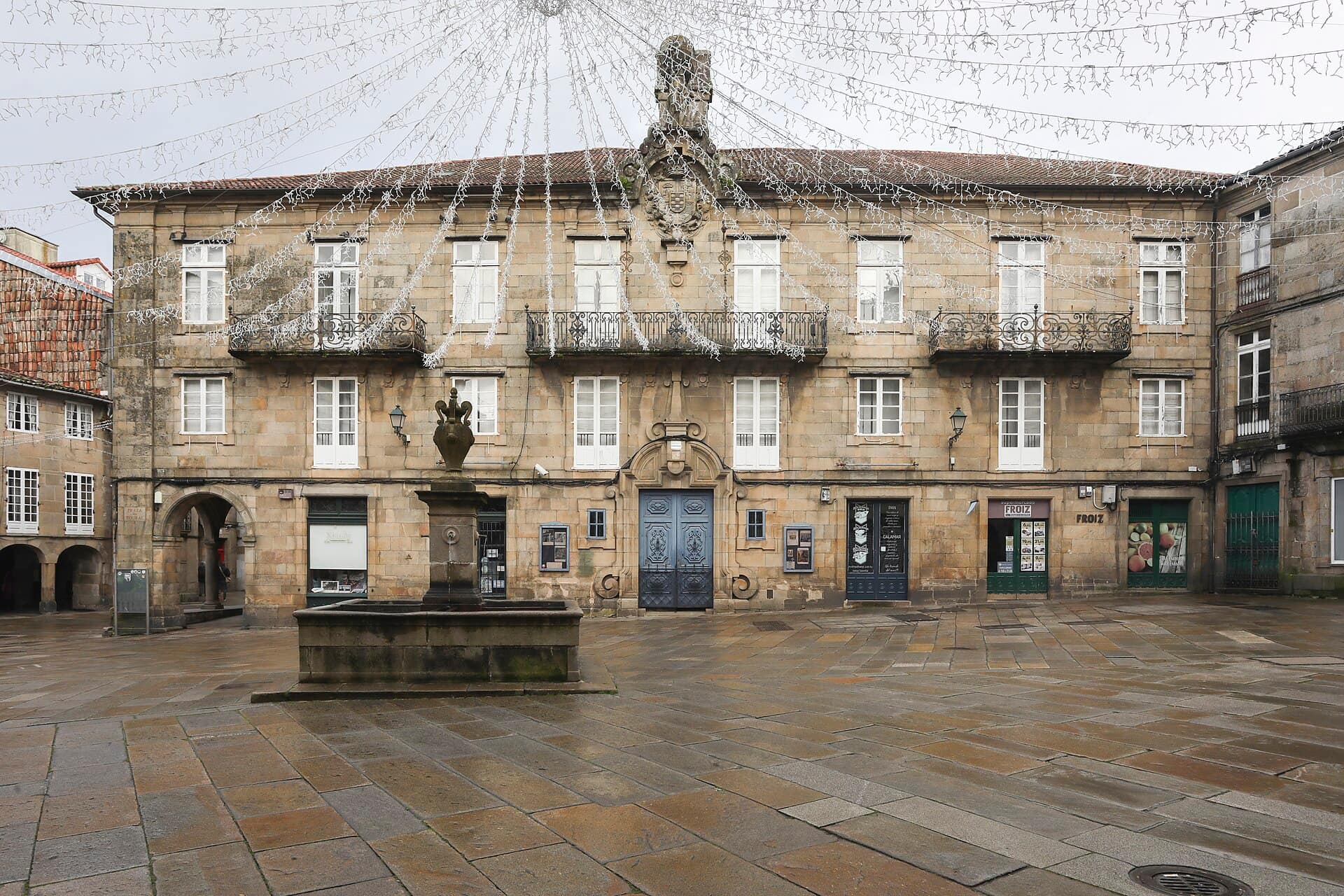
- Rúa do Vilar. Walk down this arcaded street, with Renaissance and neoclassical fronts, as far as O Toural. The arcades have been there for centuries for exactly one reason, which is walking out of the rain: use them to look in the shop windows without ever stepping out from under cover.
- O Toural. The end of the walk: a square more commercial and less monumental than the others, standing where a gate in the medieval city wall used to be. A good place to sit down with a drink and call the walk finished.
Take it on paper
Print this page or save it as a PDF: you get the route on its own, with no menu and no photos.
Next
Before you set off
What to see in Santiago
The full guide to the old town, with opening hours and prices for every monument.
More walking
Itineraries: 1, 2 and 3 days
How to fit the city into the time you actually have, day by day.
If it rains
Santiago in the rain
It rains here almost half the year. Plans that do not depend on the sky.