Our own survey · August 2026
How many nights should you stay in Santiago after the Camino?
You decide this weeks in advance, when you book the flight, and no official statistic answers it. So we asked 51 pilgrims who had already arrived.
By Cesar Rodriguez · updated
On this page
The Pilgrim's Reception Office publishes how many people arrive, where they come from and which route they walked. It does not publish — and has no reason to — how many nights each of them stays, which is precisely the number you need in order to book. Since it doesn't exist anywhere, in August 2026 we asked directly, in four languages: 51 people told us how many nights they stayed, what they did with the extra day, and whether it felt too long or too short. It isn't a representative sample, and further down we spell out exactly what it is and what it isn't. But it's first-hand data, and as far as we know there is no other.
And that is no longer just our impression: we put the question to Ad Limina, the journal of the Xunta de Galicia, which passed it on to the Instituto de Estudios Turísticos. Their answer, on 27 August 2026, is that they do not currently keep that statistic, and that they have asked the Faculty of Geography and History whether any research group is working on it. If an official series appears, it goes here and this survey goes back to being what it was: a stopgap while there was nothing better.
These nights are counted separately from the stages you walk to get here. If you haven't decided yet how many days to give the final stretch, the calculated five-stage split from Sarria spreads the stretch so no single day balloons past the rest.
The short answer
Two nights. It's the most common answer by a clear margin, and almost everyone describes the same split: the first day goes on the Compostela, the mass and celebrating, and the second is the one where you actually see the city. That said, "most common" is not "what you should do": one night works better than it's usually given credit for, and three nights — contrary to what we ourselves assumed — are hardly ever considered too many.
| Stay | People | Note |
|---|---|---|
| None (leaving the same day) | 2 | Flight or train that afternoon |
| 1 night | 9 | Seven of the nine say it was enough |
| 2 nights | 21 | The most common answer |
| 3 nights | 10 | Nine of the ten defend it |
| 4 or more | 2 | This is where boredom shows up |
| Several stays, no single figure | 7 | Repeat pilgrims comparing |
One night: less regret than you'd expect
Of the nine who stayed a single night, seven say it was the right call. And the reason they give usually isn't logistics but saturation: you arrive after weeks of quiet and open country, and a city full of people is hard going. "One night and I was outta there. Couldn't stand the tourists after solitude," as one of them put it.
There's also an accounting detail worth getting straight: "one night" almost never means one day. If your flight or train leaves late the following day, you effectively get a full day in Santiago without paying for a second night, and several people who did it that way describe it as the ideal plan. If you're flying out in the evening, check whether you really need that second night or just somewhere to leave your pack.
Two nights: the pattern that repeats
This is the modal stay, and the description matches so closely between people who have never met that it reads like a template. Day one: arrival, the queue at the Reception Office, Compostela, mass and a long lunch to celebrate. Day two: sleep, laundry, errands, a museum, a walk without the backpack, and standing in the Obradoiro watching the people who were a day behind you come in. That second day is the one nearly everyone singles out as the good one — and also the one that gets wasted if you arrive without knowing what's there. "Two nights was more than enough," sums up one pilgrim who spent the first day on the mass — Botafumeiro included — and the second eating, shopping and waiting in the square for the friends still walking in.
Three nights: we were wrong
We were going to write that three nights are usually one too many. The data says otherwise: of the ten people who stayed three nights, nine defend it — "the perfect amount of time", "no problem filling the time" — and only one says a night was surplus. Boredom shows up later: from the fourth night on, and above all among people who have already been many times. A veteran of some fifteen visits put it well: if it's your first time, no more than three.
What to do with the extra day
Ordered by how many people mentioned it, not by what we'd like to recommend. The first thing on the list isn't a museum:
- Fisterra and Muxía, the number one mention. Note that these are two different plans: half do it as a day trip by bus — €7.35 to Fisterra and €6.85 to Muxía, Monbus fares checked this month — and half keep walking for three or four days. Someone who ruled it out explained it better than anyone: they didn't want to spend their last time in Spain on a bus. A third option came up only among the Italian pilgrims: the organised Costa da Morte tour, which solves the timetable problem and adds stops — Ézaro, Muxía, Fisterra — for about €52 per person. That is exactly the range we quote in the day-trips guide(€41-55), and the person who took it says it was worth it.
- The pilgrim's mass, with honest caveats. Some call it the highlight of their stay; one described it as a waste of time. One thing that came up repeatedly and isn't in the guidebooks: the smaller masses, away from the main nave, were more warmly remembered, because it's easier to connect with the other pilgrims. The easiest to find is the 10:30 mass in English, in the chapel of the Pilgrim's Reception Office, held every day except Wednesdays, but only from mid-April to October. And a warning that came straight out of the replies: the Botafumeiro does not only fly at the noon mass, yet plenty of people build their whole day around that slot. One pilgrim explained where the idea came from: "it was what I also heard from my hotel, so I planned everything around the 12pm slot". If reception tells you the same thing, check it: outside the fixed feast days it depends on which group has paid for it, and it often falls at the 7:30 pm mass. And since 24 August 2026 there is one more thing to check: the botafumeiro is temporarily out of action, because the scaffolding from the dome restoration covers its mechanism, with no return date. If your second night rested on seeing it, that sum does not add up right now.
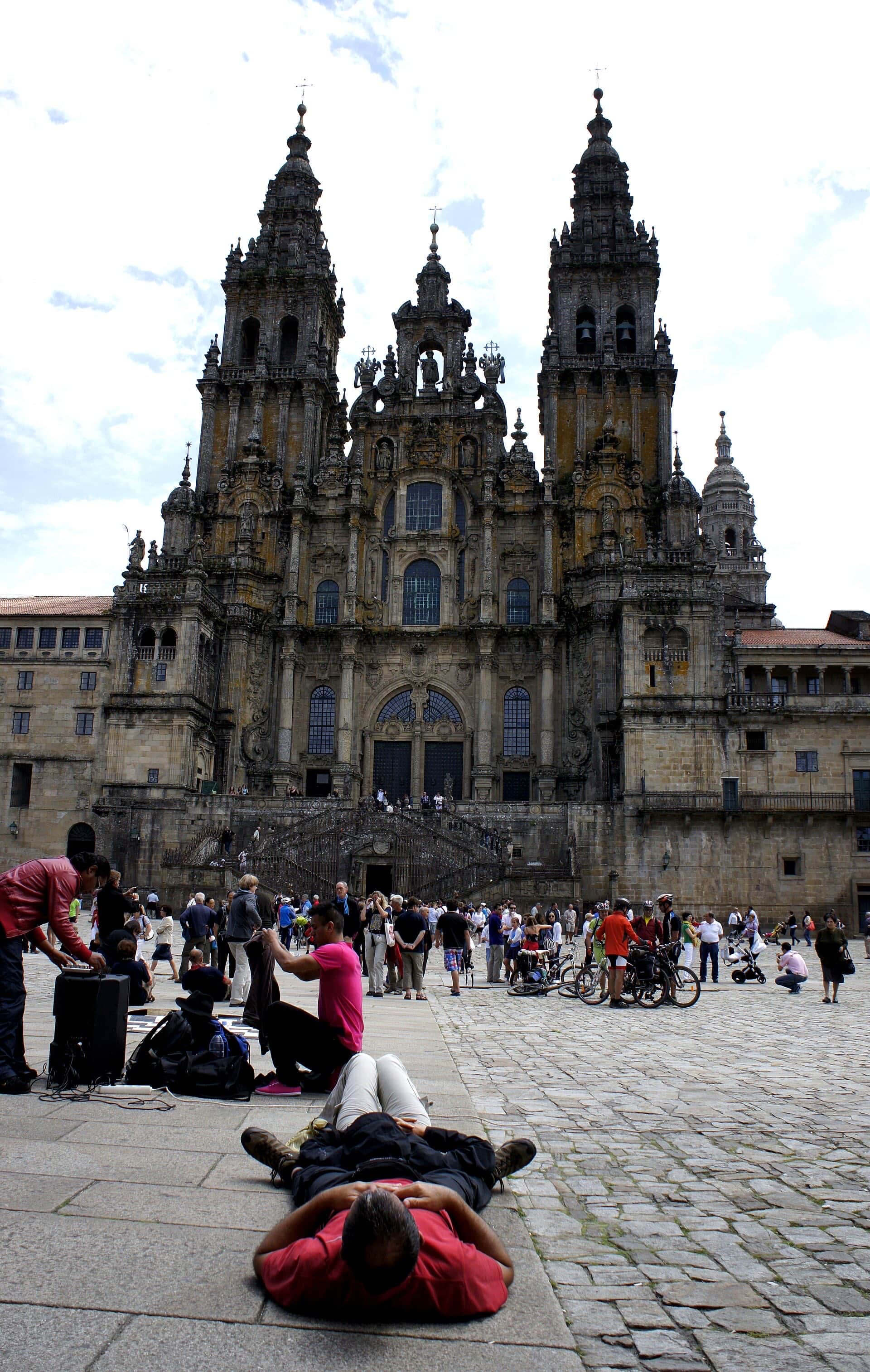
- Watching other people arrive. Sitting in the Obradoiro applauding the ones walking in is, literally, the plan most people mention with affection.
- Eating slowly and Parque da Alameda, which comes up more often than any museum. One reader recommends finding the whispering bench.
- The Cathedral rooftops, five mentions, and several people insist on booking online in advance. €15 general, €12 with a pilgrim's credential.
- The Cathedral Museum, with a useful warning: the person who rushed it regretted it. It asks for considerably more time than people set aside.
- Laundry and errands. Unromantic and widely cited: washing clothes, replacing kit and, more than once, buying a suitcase for the trip home.
- A tattoo. Five people. It's a Camino classic.
- The free-museum afternoon. An Italian pilgrim described the plan the English-language forums barely mention: the Museo do Pobo Galego — a former convent, with its triple-helix staircase — and, directly opposite, the CGAC, free to enter; the Mercado de Abastos, where you can also eat; and the cloister of the Pazo de Fonseca, a university building with no admission charge. A whole day for the price of lunch.
- The Colexiata de Santa María de Sar. This one came not from a pilgrim but from a local, answering exactly the question of what to do with a spare day. It's a fifteen-minute walk from the centre, costs €2 and is free if you already hold any Cathedral Museum ticket: a 13th-century cloister and a set of leaning columns that have held that way for centuries. It's the visit anyone in a hurry skips, which is precisely what you are not with a day to spare.
- The evenings, in the squares. Nobody asked about nights and it still came up twice: in summer there are open-air concerts around the Cathedral, and several people describe that festive atmosphere as the best part of the second day. Whatever is on this week is in the events listing.
Five practical warnings that came out of the replies
None of them were in our guides before we asked, and all of them change how you plan the day.
- The quiet hour is between 8:15 and 9:00. Two people independently described finding the Cathedral practically empty first thing. The window is a narrow one: the Cathedral opens at 7:00, the 7:30 mass ends around 8:10, and people start filing back in for the 9:30. In those forty-five minutes you can hug the Apostle and go down to the crypt almost alone. That holds until 15 October 2026: from the 16th the 9:30 mass is held in the church of San Agustín and the 7:30 moves to the Communion chapel, so the gap after the first mass should be longer; we don't yet have accounts from those weeks.
- You can't enter the Cathedral with a backpack or poles. It isn't etiquette: it's banned on security grounds, and the Museum adds bags and umbrellas. You can't take them up to the rooftops either. It's the day-one surprise for anyone arriving with everything on their back, which makes left luggage a requirement rather than a convenience. Easiest is to leave it at your accommodation, which will almost always hold it even if you arrive early. Otherwise the option with a published price, 150 m from the Obradoiro, is the Correos post office at Rúa do Franco 4: €4 a day for a backpack or small suitcase, €6 for a large one, €7 for a bicycle and €1 for a walking pole, open daily 8:30–20:30 in season. The Intermodal bus station has lockers on the main floor, with no published rate. And there are three shop-based left-luggage networks — online booking, no cash — at €2 to €5 per item per day. The Pilgrim's Reception Office can now be pinned down, which on 28 August we still couldn't do: its own website advertises no left-luggage service, but the Turismo de Santiago FAQ lists where to leave luggage in the city and files the Pilgrim's Office under one telling word, «puntualmente», occasionally. So it isn't absent and it isn't a service: it happens sometimes and not others, which means you should not plan around it. It also explains why regulars in Camino groups swear they left a pack there. And an unverified tip, closer to the door than any of those: one pilgrim says there is a jeweller's that minds backpacks just to the left of where you queue to go in to the Cathedral. We don't know the name, the hours or the price; neither does she, and she has offered to ask the people she walked with. We have not been able to check it, so treat it as a lead rather than a fact. The same person has heard that Pilgrim House has lockers, also unconfirmed — read the next warning before counting on it.
- Pilgrim House isn't always there. It's recommended in a lot of places — ours included — as where to find other pilgrims, but of the four people who tried, not one found it running: two found it closed and two had the evening gathering cancelled for lack of people. Treat it as a possibility, not a plan.
- Museo do Pobo Galego and the CGAC close on Mondays. If your extra day falls on a Monday, that's the day for the rooftops, the Cathedral Museum or a walk, not for museums. Full detail in the opening hours and closing days table.
- Some dates fill the city without being a holiday. This one came not from the survey but from a later warning: from 7 to 10 October 2026 Santiago hosts the national congress of SEMERGEN, more than 4,500 family doctors at the Palacio de Congresos, and the hoteliers have already said there are not enough rooms for everyone. If your extra night falls on a congress like that, book it before any other night of the Camino, and check the dates when Santiago fills up when you fix your arrival date: there are twelve up to the close of the Holy Year, and not all of them are festivals.
How we ran this survey
For transparency, and so anyone can judge how much weight to give it. Between 16 and 17 August 2026 we asked openly, identifying ourselves as the editors of this guide, in four places: two pilgrim forums — one in English, one in Spanish — and two Camino groups, one Italian and one Czech. The question was the same in all four: how many nights did you stay at the end, what did you do with the extra day, and was it too long or too short. The threads kept receiving replies after we published, so the count was updated on 19 August 2026 with three further stays. In all we collected 53 replies, of which 51 describe a stay of their own — 46 in the forums and 5 in the groups — and those are the ones we counted. Several people describe more than one Camino; in those cases we took the stay they themselves flag as typical, and where they repeat the same figure across trips we count that figure rather than the exception: someone who stayed two nights on two Caminos and around four on a third, because an injury turned it into a holiday, counts as two.
What this is not: a representative sample. People who answer in an English-language forum are mostly international pilgrims with time and an interest in the subject, which skews both available days and enthusiasm upwards. It doesn't separate seasons either: replies from February and August sit side by side. And 51 people are too few for percentages with decimal points, which is why we give absolute numbers and don't convert them into rates. We publish it because the alternative figure is none at all.
Frequently asked questions
How many nights do people stay in Santiago after finishing the Camino?
Two is the most common: of 51 pilgrims we asked in August 2026, 21 stayed two nights, 9 stayed one and 10 stayed three. The typical two-night split is a first day for the Compostela, the mass and celebrating, and a second for resting and seeing the city without a backpack.
Is one night in Santiago enough?
For many people, yes: of the nine who stayed a single night, seven say it was enough. It works especially well if your flight or train leaves late the next day, because you effectively gain a full day without paying for a second night. It's also the choice of those walking on to Fisterra the following morning.
Are three nights in Santiago too many?
Not according to the people who did it: of ten who stayed three nights, nine defend the decision and only one says a night was surplus. Boredom appears from the fourth night onwards and, above all, among people who have already visited the city many times.
What is there to do in Santiago the day after finishing the Camino?
The most mentioned are the bus trip to Fisterra and Muxía (€7.35 and €6.85 with Monbus), the pilgrim's mass, sitting in the Obradoiro watching other pilgrims arrive, Parque da Alameda, the Cathedral rooftops (€15, €12 with a credential) and the Cathedral Museum. Laundry and errands come up a lot too.
Where can I leave my backpack if I arrive before check-in?
Easiest is your accommodation, which will almost always hold it even before check-in. The option with a published price, 150 m from the Obradoiro, is the Correos post office at Rúa do Franco 4: €4 a day for a backpack or small suitcase, €6 for a large suitcase, €7 for a bicycle and €1 for a walking pole. The Intermodal bus station has lockers with no published rate, and shop-based networks charge €2 to €5 per item per day with online booking. The Pilgrim's Reception Office only minds luggage occasionally, so do not plan around it. It matters because backpacks and poles are banned inside the Cathedral.
What's the best time to visit the Cathedral without crowds?
Between 8:15 and 9:00, at least until 15 October 2026. The Cathedral opens at 7:00, the 7:30 mass ends around 8:10 and people start coming back in for the 9:30 one: in that window several pilgrims agree you can hug the Apostle and visit the crypt almost alone. From 16 October the 9:30 moves to the church of San Agustín and the 7:30 to the Communion chapel, so that morning gap should get longer.
Keep reading
Day one
Arriving in Santiago: what to do in the first hours
Compostela, pilgrim's mass, Botafumeiro and the embrace of the Apostle, in order.
The extra day
What to see in one, two or three days
Ready-made itineraries for the city without a backpack and without rushing.
Moving on
Leaving Santiago
Fisterra, Muxía, Porto and Madrid: buses, trains and checked prices.